
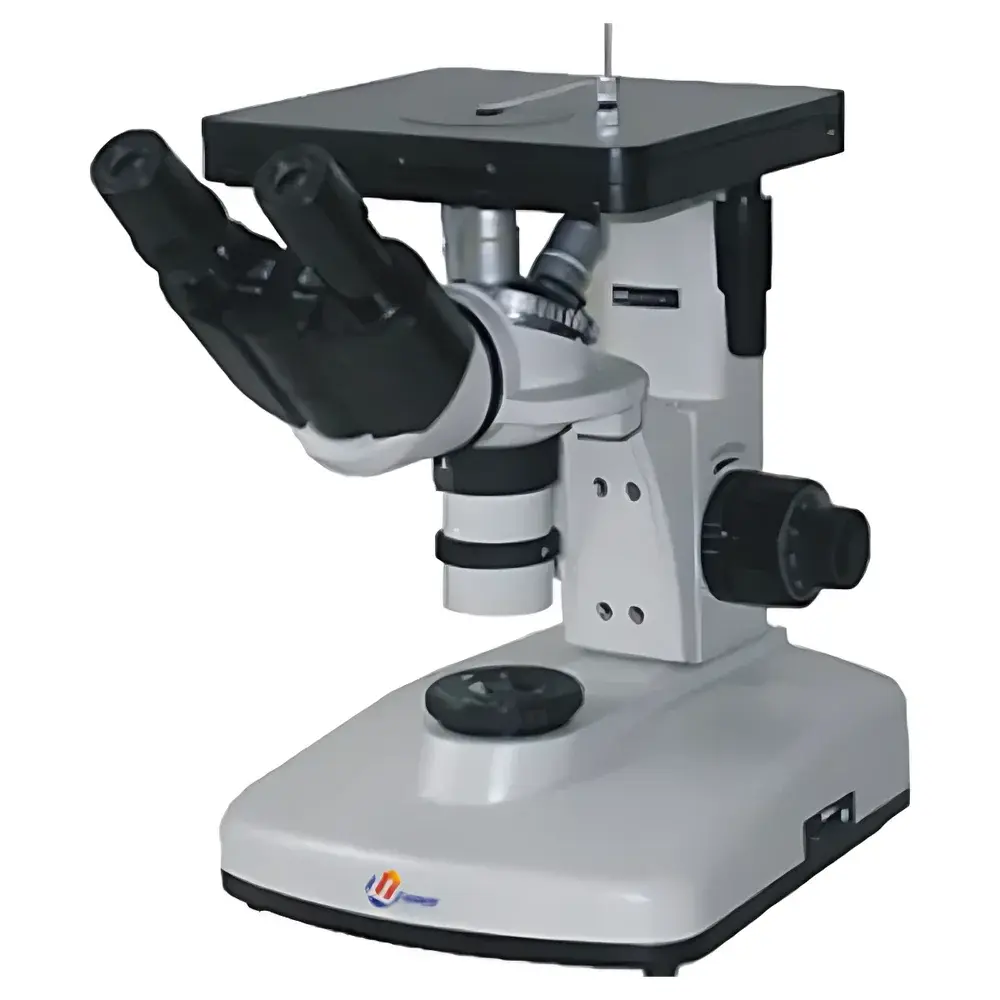
YANRUN 4XB Dual-Eyepiece Inverted Metallurgical Microscope
| Brand | YANRUN |
|---|---|
| Origin | Shanghai, China |
| Manufacturer Type | Direct Manufacturer |
| Product Origin | Domestic (China) |
| Model | 4XB Dual-Eyepiece Inverted Metallurgical Microscope |
| Configuration | Inverted |
| Image Analysis System | Not Integrated |
| Total Magnification Range | 100×–1000× |
| Eyepieces | Wide-Field 10× |
| Objectives | Achromatic 10×, 40× (Plan), 100× Oil Immersion |
| Objective Working Distances (mm) | 7.31, 0.65, 0.37 |
| Numerical Apertures | 0.25, 0.65, 1.25 |
| Mechanical Tube Length | 160 mm |
| Coarse/Fine Focus Travel | 7 mm total (graduated at 0.002 mm per division) |
| coarse focus range | 7 mm |
| Mechanical Stage Dimensions | 75 × 50 mm |
| Base Platform Size | 150 × 150 mm |
| X–Y travel range | 30 × 30 mm |
| Illumination | 6 V / 12 W halogen lamp with adjustable brightness, AC 220 V (50 Hz) |
| Filter Set | Yellow, Green, Blue, Ground Glass |
| Net Weight | 5 kg |
| Packing Dimensions | 360 × 246 × 350 mm |
Overview
The YANRUN 4XB Dual-Eyepiece Inverted Metallurgical Microscope is a precision optical instrument engineered for high-fidelity reflected-light observation of opaque metallurgical specimens. Designed according to classical finite-conjugate optical principles with a standardized 160 mm mechanical tube length, it employs Köhler illumination geometry to deliver uniform, glare-free contrast across the entire field of view. Unlike upright microscopes, its inverted configuration positions the objectives beneath the specimen stage—enabling stable, vibration-resistant imaging of large, heavy, or irregularly shaped metallographic samples (e.g., castings, welds, or heat-treated billets) without requiring top-side mounting constraints. The system operates exclusively in brightfield reflected-light mode, optimized for polished and etched metallic surfaces where phase boundaries, grain morphology, inclusion distribution, and precipitate networks must be resolved at magnifications from 100× to 1000×.
Key Features
- Inverted optical layout with fixed-stage design—ideal for observing bulk specimens up to 20 mm in thickness using standard 10 mm and 20 mm specimen holders
- Three achromatic objectives: 10× (NA 0.25, WD 7.31 mm), 40× plan-corrected (NA 0.65, WD 0.65 mm), and 100× oil immersion (NA 1.25, WD 0.37 mm), all calibrated to 160 mm tube length
- Dual wide-field 10× eyepieces providing comfortable binocular viewing with ergonomic interpupillary adjustment
- Precision coaxial coarse/fine focusing mechanism with 7 mm total travel, graduated micrometer scale (0.002 mm/division), and built-in tension control and upper limit stop
- Stable 150 × 150 mm base platform with 30 × 30 mm mechanical X–Y translation stage and spring-loaded specimen clamp
- Adjustable 6 V / 12 W halogen illumination system with continuous brightness control and interchangeable color filters (yellow, green, blue) plus ground-glass diffuser for optimal contrast enhancement
- Robust all-metal construction with compact footprint (360 × 246 × 350 mm shipping dimensions) and 5 kg operational weight for lab bench integration
Sample Compatibility & Compliance
The 4XB supports standard metallographic sample preparation protocols compliant with ASTM E3, ISO 643, and GB/T 6394. Its inverted architecture accommodates specimens prepared on standard 25 mm or 30 mm diameter mounts, as well as larger rectangular blocks secured via the dual-spring stage clamp. The 100× oil-immersion objective enables resolution of sub-micron features—including carbide dispersion, intermetallic phases, and fine martensitic laths—when used with immersion oil (n = 1.515). All optical components meet ISO 10110 surface quality standards for transmitted and reflected light microscopy. While the instrument itself does not include digital imaging hardware, its trinocular port (optional upgrade path) allows integration with third-party CCD/CMOS cameras meeting EN 13857 safety clearance requirements.
Software & Data Management
The YANRUN 4XB is supplied as a standalone optical platform without embedded image acquisition or analysis firmware. It is fully compatible with industry-standard third-party metrology software packages—including NIS-Elements (Nikon), ZEN (Zeiss), and Olympus cellSens—via C-mount adapter (C-mount thread: 1″–32 UN, flange distance: 17.526 mm). When paired with a compliant USB 3.0 or GigE camera, the system supports audit-trail-capable image capture, measurement annotation (line, area, particle count), and export to TIFF, BMP, or JPEG2000 formats. For regulated environments, users may configure external acquisition systems to comply with FDA 21 CFR Part 11 requirements—including electronic signatures, secure user authentication, and immutable metadata logging—provided the host PC and software are validated per GxP guidelines.
Applications
- Microstructural evaluation of ferrous and non-ferrous alloys per ASTM E112 (grain size), ASTM E45 (inclusion rating), and ASTM E1245 (automated inclusion analysis)
- Failure analysis of fracture surfaces, fatigue cracks, and stress-corrosion cracking in aerospace and power-generation components
- Quality assurance of heat-treated parts including case depth verification (carburized, nitrided), decarburization assessment, and tempering response validation
- Weld metal characterization—dendrite arm spacing, fusion zone boundary delineation, and HAZ microstructure mapping
- Research-grade metallography in academic and industrial R&D labs where cost-effective, mechanically stable, and optically reliable inverted observation is required
FAQ
What is the maximum specimen height accommodated by the 4XB inverted stage?
The inverted configuration permits specimens up to 20 mm in vertical height when placed directly on the stage, with full objective clearance maintained across all magnifications.
Is the 100× objective designed for oil immersion only?
Yes—the 100× objective has a numerical aperture of 1.25 and requires immersion oil (refractive index ~1.515) for optimal resolution and depth of field; dry use will result in severe spherical aberration and loss of contrast.
Can this microscope be upgraded with motorized focus or digital imaging?
The mechanical design includes a standardized trinocular port and focus drive interface; retrofits for motorized Z-axis control and C-mount camera integration are supported through qualified third-party vendors.
Does the halogen illumination meet photometric stability requirements for quantitative reflectance analysis?
While suitable for qualitative and semi-quantitative metallography, the analog brightness control lacks closed-loop intensity regulation; for calibrated reflectance measurements, users should integrate an external photometer or stabilized LED illuminator.
What maintenance procedures are recommended for long-term optical performance?
Annual cleaning of objective front lenses with lens-grade solvent (e.g., xylene followed by ethanol) and inspection of focus gear backlash are advised; halogen bulbs should be replaced in pairs to maintain consistent color temperature and illumination uniformity.




