
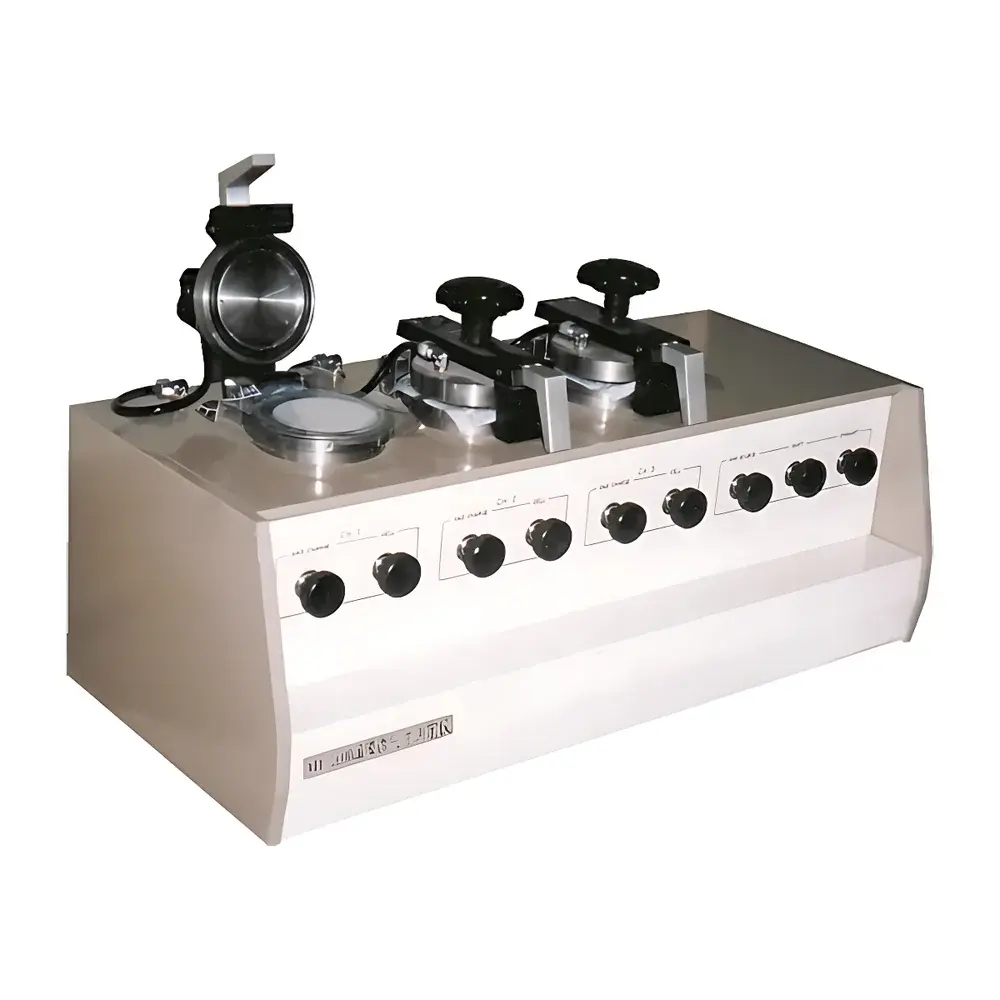
HARKE HK-C2 Oxygen Transmission Rate (OTR) Testing System
| Brand | HARKE |
|---|---|
| Model | HK-C2 |
| Application | Vacuum-Method Gas Permeability Tester for Films and Flexible Packaging Materials |
| Origin | Beijing, China |
| Manufacturer | HARKE (Domestic Producer) |
| Compliance | GB/T 1038, ISO 15105-1, ISO 2556, ASTM D1434, JIS K7126-1, YBB00082003 |
| Test Gases | O₂, N₂, CO₂, Air, He, H₂, CH₄, NH₃, C₃H₈, C₄H₁₀ (hazardous gases require pre-order specification) |
| Measurement Range | 0.05–160,000 cm³/m²·24h·0.1MPa |
| Resolution | 0.001 cm³/m²·24h·0.1MPa |
| Vacuum Resolution | 0.1 Pa |
| Temperature Control Range | 5–95 °C (external chiller/heater required) |
| Temp. Stability | ±0.1 °C |
| Specimen Thickness | ≤5 mm (customizable) |
| Specimen Size | ≥150 mm × 94 mm or circular |
| Effective Test Area | 48 cm² |
| Test Pressure Range | −0.1 to +0.1 MPa |
| Supply Gas Pressure | 0.3–1.0 MPa |
| Gas Inlet Port | Ø8 mm |
| Dimensions | 330 mm (L) × 600 mm (D) × 330 mm (H) |
| Power | AC 220 V, 50 Hz |
| Weight | 28 kg |
| Sample Capacity | 1 specimen per test chamber |
| Multi-chamber Option | Up to 3 independent test chambers (configurable) |
| Clamping Method | Pneumatic |
| Test Modes | Proportional, Fuzzy Logic, and Time-Based Endpoint Detection |
| Expandable Range | Optional high-permeability modules available |
| Hazardous Gas Compatibility | Available with custom safety interlocks and gas-handling modules (subject to engineering review) |
Overview
The HARKE HK-C2 Oxygen Transmission Rate (OTR) Testing System is an engineered vacuum-manometric instrument designed for precise determination of gas permeation parameters—including oxygen transmission rate (OTR), diffusion coefficient (D), solubility coefficient (S), and permeability coefficient (P)—in flexible packaging materials and functional barrier films. It operates on the principle of coulometric detection combined with high-vacuum differential pressure measurement, in strict accordance with gravimetric and manometric methodologies defined in ISO 15105-1 and ASTM D1434. The system employs a dual-chamber configuration: a high-vacuum test chamber evacuated to ≤0.1 Pa and a controlled-gas supply side maintained at regulated pressure (±0.001 MPa). Gas molecules permeating through the specimen generate a measurable pressure rise in the evacuated chamber, which is converted into volumetric transmission data normalized to standard conditions (cm³/m²·24h·0.1MPa). This methodology ensures traceable, reproducible results across diverse material classes—from ultra-high-barrier metallized PET to porous biodegradable films—under rigorously stabilized thermal environments (5–95 °C).
Key Features
- Vacuum-based manometric measurement architecture compliant with ISO 2556 and GB/T 1038 for OTR quantification
- Triple-mode endpoint logic: proportional response, fuzzy-logic thresholding, and fixed-duration testing for adaptive protocol execution
- Pneumatically actuated clamping system ensuring uniform sealing pressure and repeatable specimen loading (no manual torque dependency)
- Modular multi-chamber design supporting up to three independent test stations for parallel sample evaluation and statistical validation
- Expandable measurement range via optional high-flow sensor modules, enabling accurate assessment of low-barrier materials (e.g., LDPE, rubber elastomers) without signal saturation
- Integrated vacuum integrity diagnostics and real-time leak-rate monitoring to validate chamber seal performance prior to each test cycle
- Configurable hazardous gas handling package—including explosion-proof solenoid valves, gas-tight exhaust routing, and fail-safe purge protocols—for safe operation with H₂, CH₄, NH₃, or other flammable/toxic gases (requires pre-delivery hazard review)
Sample Compatibility & Compliance
The HK-C2 accommodates flat, non-porous, and semi-crystalline specimens up to 5 mm thick and 48 cm² effective area, including aluminum foil composites, PVDC-coated films, SiOₓ/PET laminates, pharmaceutical blister foils (e.g., PVC hard sheets), battery separators, medical barrier membranes, and aerospace-grade polyimide films. Its mechanical design conforms to YBB00082003 (Chinese pharmaceutical packaging standard) and supports GLP-aligned audit trails when paired with HARKE’s validated software suite. All hardware components contacting test gases meet USP Class VI biocompatibility requirements where applicable. Calibration traceability is maintained to NIST-traceable pressure and temperature standards, and system verification follows ISO/IEC 17025-compliant procedures.
Software & Data Management
HARKE PermeaSoft™ v4.2 (included) provides full instrument control, real-time permeation curve visualization, automated parameter derivation (D, S, P), and batch report generation compliant with FDA 21 CFR Part 11 requirements—including electronic signatures, audit logging, and role-based access control. Raw data files are stored in vendor-neutral CSV and XML formats, supporting third-party statistical analysis (e.g., JMP, Minitab). The software includes built-in uncertainty propagation models aligned with GUM (Guide to the Expression of Uncertainty in Measurement) and enables direct export to LIMS environments via HL7 or ASTM E1461 interfaces. Firmware updates are delivered via secure HTTPS channel with cryptographic signature verification.
Applications
- Quality assurance of food packaging films for shelf-life prediction under modified atmosphere conditions
- Development and validation of high-barrier coatings for flexible electronics encapsulation
- Regulatory submission support for pharmaceutical primary packaging per ICH Q5C and USP
- Accelerated aging studies correlating OTR drift with thermal/UV exposure history
- Comparative permeability screening of bio-based polymers (PLA, PHA) versus conventional PET
- Permeation resistance characterization of fuel tank liners, tire innerliners, and inflatable medical devices
- Research on ion-selective membranes for energy storage applications (e.g., lithium-ion battery separators)
FAQ
Does the HK-C2 comply with ASTM D3985 for oxygen permeability testing?
Yes—the instrument implements the same vacuum-manometric principle as ASTM D3985 and is configured to meet all procedural requirements, including specimen conditioning, vacuum stabilization time, and pressure-rise linearity validation.
Can the system be used for water vapor transmission rate (WVTR) testing?
No—WVTR requires distinct sensor technology (e.g., modulated IR or coulometric electrolytic detection) and is outside the scope of this OTR-dedicated platform. HARKE offers separate WVTR systems (e.g., HK-W3 series) compliant with ASTM F1249 and ISO 15106.
Is external temperature control equipment mandatory?
Yes—precise thermal regulation (±0.1 °C) requires integration with an external recirculating chiller/heater unit (e.g., Julabo F25 or similar), as the HK-C2 does not include an integrated thermoregulation module.
What documentation is provided for regulatory submissions?
Each unit ships with a Factory Acceptance Test (FAT) report, IQ/OQ protocol templates, calibration certificates traceable to national standards, and a complete Design Qualification (DQ) dossier upon request.
How is system performance verified after installation?
HARKE provides on-site Installation Qualification (IQ) and Operational Qualification (OQ) services, including challenge tests using certified reference films (e.g., NIST SRM 1477) and full uncertainty budget analysis per ISO/IEC 17025 Annex A.3.
Related Products






