
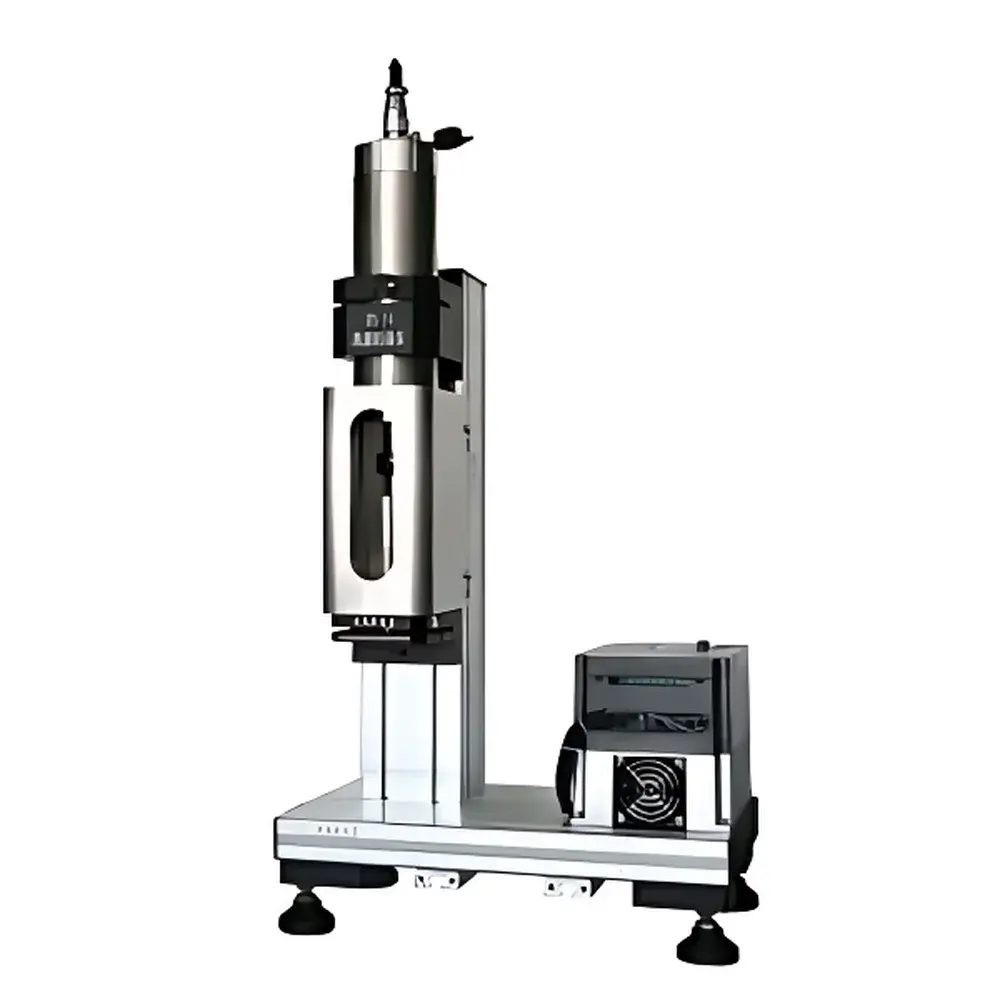
HARKE XR-14 Latex Mechanical Stability Tester
| Brand | HARKE |
|---|---|
| Origin | Beijing, China |
| Manufacturer Type | Direct Manufacturer |
| Country of Origin | China |
| Model | HARKE-XR-14 |
| Price | Upon Request |
| Operating Temperature Range | 10–40 °C |
| Relative Humidity Limit | <85% RH |
| Stirring Speed | 14,000 rpm ±200 rpm |
| Speed Resolution | 1 rpm |
| Speed Accuracy | ≤0.1% FS |
| Max Speed | 20,000 rpm |
| Min Speed | 2,000 rpm |
| Power Supply | 220 V ±10%, 50 Hz, 1500 W |
| Dimensions (W×D×H) | 400 mm × 350 mm × 720 mm |
| Sample Container | Cylindrical borosilicate glass vessel (ID 58 mm, OD 63 mm, height >100 mm) |
| Stirrer Tip Diameter | 6.3 mm |
| Stirring Discs | Two interchangeable discs — Type A (Ø20.83 mm ±0.03 mm, thickness 1.57 mm ±0.05 mm) for natural rubber latex |
| Integrated Cooling Pump | Yes |
| Display | LED via frequency converter interface |
| Compliance Standards | GB/T 8301–2008, SH/T 1151–1998 |
Overview
The HARKE XR-14 Latex Mechanical Stability Tester is an engineered precision instrument designed specifically for quantitative assessment of mechanical stability in both natural and synthetic rubber lattices. It operates on the principle of controlled high-shear agitation under standardized thermal conditions, simulating industrial processing stresses that induce coagulation or destabilization. The instrument implements a defined rotational shear protocol—maintaining a constant speed of 14,000 rpm ±200 rpm at 35 °C ±1 °C—to accelerate destabilization kinetics while ensuring repeatability across laboratories. Its core function is to determine the time-to-onset of visible coagulum formation (the “endpoint”) during continuous high-speed stirring, providing a critical quality control parameter for latex producers, polymer chemists, and R&D laboratories engaged in elastomer formulation and process optimization.
Key Features
- Dual-disc configuration with traceable dimensional tolerances (±0.03 mm diameter, ±0.05 mm thickness) optimized separately for natural (Ø20.83 mm) and synthetic (Ø36.12 mm) latex systems per SH/T 1151–1998 and GB/T 8301–2008 requirements
- High-fidelity speed control system with ±200 rpm tolerance at 14,000 rpm, supported by real-time LED display via integrated frequency converter and independent digital tachometer
- Dedicated closed-loop cooling pump system to maintain motor thermal stability during extended operation—extending service life and minimizing drift in rotational performance
- Borosilicate glass sample container (ID 58 mm, height >100 mm) compliant with standard specimen geometry for consistent shear field development and minimal wall effects
- Stirrer shaft with 6.3 mm tip diameter engineered for rigidity and minimal harmonic vibration at 14,000 rpm, reducing mechanical noise and enhancing measurement reproducibility
- Wide operational speed range (2,000–20,000 rpm) enabling method development beyond standard protocols, including comparative shear sensitivity studies
Sample Compatibility & Compliance
The XR-14 supports both ammonia-stabilized natural rubber latex (NRL) and carboxylated or styrene-butadiene synthetic lattices (SBR, NBR), provided samples are pre-conditioned to 55 wt% total solids and thermally equilibrated to 35 °C ±1 °C prior to testing. The instrument’s mechanical design and procedural workflow align strictly with two internationally referenced standards: GB/T 8301–2008 (“Determination of Mechanical Stability of Concentrated Natural Rubber Latex”) and SH/T 1151–1998 (“Test Method for High-Speed Mechanical Stability of Synthetic Rubber Latex”). These standards define endpoint detection criteria—including the palm test (coagulum appearance on skin surface) and water dispersion test (coagulum visibility upon surface deposition)—which remain operator-executed per regulatory guidance. While the XR-14 does not automate endpoint recognition, its precise speed and temperature control ensures compliance with the physical test conditions mandated by both standards.
Software & Data Management
The XR-14 operates as a stand-alone electromechanical platform without embedded software or network connectivity. All operational parameters—including elapsed time, target speed, and real-time RPM—are displayed locally via LED interface driven by the industrial-grade frequency converter. Timing is initiated manually at the moment of sample placement, and endpoint determination remains a human-verified visual assessment per standard methodology. For laboratories operating under GLP or GMP frameworks, users may integrate external digital timers with audit-trail functionality and log results manually into LIMS or electronic lab notebooks. The absence of proprietary firmware simplifies validation, reduces cybersecurity exposure, and facilitates 21 CFR Part 11 compliance when paired with documented SOPs and signed paper/electronic records.
Applications
- Quality assurance of incoming natural rubber latex feedstock in glove, condom, and medical device manufacturing facilities
- Formulation screening of stabilizer packages (e.g., fatty acid soaps, surfactants, pH buffers) in synthetic latex development
- Batch-to-batch consistency verification for commercial latex products supplied to foam, dipped goods, or adhesive industries
- Accelerated aging studies correlating mechanical stability loss with storage time or thermal history
- Research into colloidal stability mechanisms under high-shear hydrodynamic stress, supporting rheological modeling of dispersed polymer systems
FAQ
What standards does the XR-14 comply with?
The instrument is configured and validated for full conformance with GB/T 8301–2008 and SH/T 1151–1998, covering mechanical stability testing of natural and synthetic rubber lattices respectively.
Can the XR-14 be used for non-rubber colloidal systems?
While not validated for non-standard materials, the instrument’s adjustable speed range and geometrically defined shear field may support exploratory testing of other high-solids aqueous dispersions—subject to user-developed protocols and internal validation.
Is automatic endpoint detection available?
No. Endpoint identification follows the visual methods specified in the cited standards (palm test or water dispersion test) and requires trained operator judgment.
Does the unit include temperature control?
The XR-14 provides a fixed-position sample holder but does not incorporate active heating or temperature regulation. Users must pre-equilibrate samples to 35 °C ±1 °C using external thermostatic baths prior to loading.
What maintenance is required for long-term reliability?
Routine inspection of stirrer disc geometry, cleaning of glass vessel and shaft, periodic verification of tachometer accuracy, and scheduled coolant reservoir checks are recommended per the manufacturer’s maintenance schedule.





