
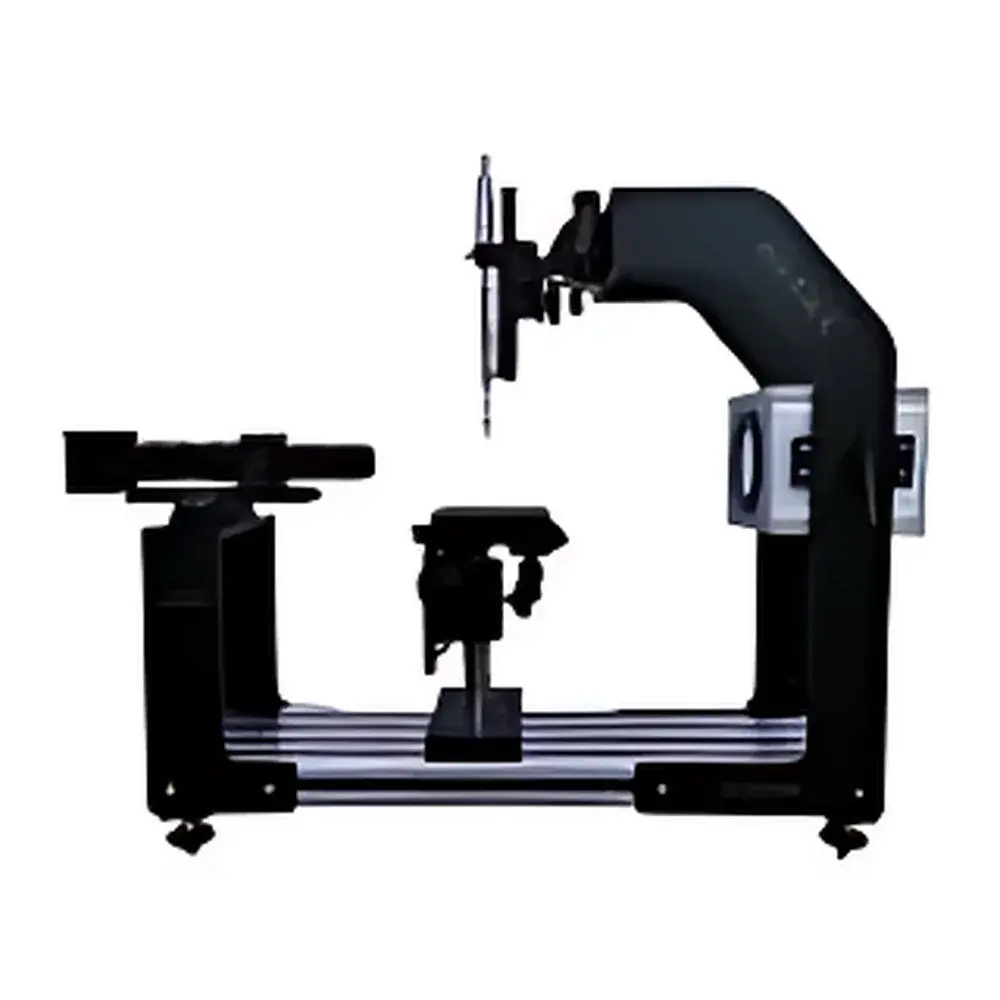
HARKE HK-SPCA Advanced Contact Angle Goniometer
| Brand | HARKE |
|---|---|
| Origin | Beijing, China |
| Manufacturer Type | Direct Manufacturer |
| Instrument Category | Domestic |
| Model | HK-SPCA |
| Instrument Class | Benchtop Laboratory Contact Angle Analyzer |
| Contact Angle Measurement Range | 0–180° |
| Contact Angle Measurement Accuracy | ±0.1° |
| Contact Angle Display Resolution | 0.01° |
| Sample Stage Dimensions | 400 mm × 400 mm (standard) |
| Optical Zoom Ratio | 0.7×–4.5× |
| Surface/Interfacial Tension Measurement Method | Pendant Drop |
| Surface/Interfacial Tension Range | 0–1000 mN/m |
| Surface/Interfacial Tension Accuracy | ±0.01 mN/m |
| Imaging System | ZF-180 High-Resolution Stepping Zoom Lens + USB 2.0 Camera (30 fps standard |
| optional | 100/300/1000+ fps) |
| Software | HARKE-SPCA v1.0 |
| Surface Energy Calculation Methods | Equation of State (EOS), Circle Fit, Ellipse Fit, Small-Drop Method |
| Environmental Operation | Ambient Temperature |
| Power Supply | 220 V AC / 3 A / 50 Hz |
| Instrument Dimensions | 260 mm × 700 mm × (height not specified) |
| Lens Vertical Travel | 120 mm |
| Net Weight | ~30 kg |
| Compliance | Designed for GLP-aligned workflows |
Overview
The HARKE HK-SPCA Advanced Contact Angle Goniometer is a precision-engineered benchtop instrument designed for quantitative characterization of solid surface wettability and liquid interfacial behavior using optical sessile drop and pendant drop methodologies. Based on high-resolution silhouette image acquisition and advanced edge-detection algorithms, the system determines contact angle (θ) at the three-phase boundary—gas, liquid, and solid—by fitting geometric models (circle, ellipse, or Young–Laplace-based contour) to the liquid droplet profile. This principle enables rigorous assessment of surface heterogeneity, anisotropy, and dynamic wetting phenomena including advancing/receding angles and contact angle hysteresis. The instrument operates under ambient laboratory conditions and is calibrated traceably to NIST-traceable reference standards for angular and force measurements. Its architecture integrates mechanical stability, thermal drift mitigation, and vibration-isolated stage design to ensure measurement reproducibility across repeated trials.
Key Features
- Benchtop modular platform with motorized Z-axis lens translation (120 mm travel) and precision XYZ sample positioning
- High-fidelity optical train featuring ZF-180 stepping zoom lens (0.7×–4.5× magnification) and adjustable LED coaxial illumination for optimal contrast in low-reflectivity or transparent substrates
- Multi-frame-rate imaging capability: standard 30 fps USB 2.0 camera; upgradeable to 100/300/1000+ fps for dynamic contact angle kinetics, droplet impact analysis, or rapid surface energy mapping
- HARKE-SPCA v1.0 software suite supporting automated multi-point contact angle acquisition, time-resolved θ(t) profiling, and batch processing of up to 99 sample positions per run
- Comprehensive surface energy evaluation via EOS (Equation of State), Wu harmonic mean, Owens–Wendt–Rabel–Kaelble (OWRK), and van Oss–Chaudhury–Good (vOCG) models using user-defined or built-in probe liquid databases
- Integrated pendant drop module for interfacial tension quantification (0–1000 mN/m) with automatic contour fitting and density-corrected Laplace equation solving
Sample Compatibility & Compliance
The HK-SPCA accommodates rigid and flexible substrates up to 400 mm × 400 mm in footprint, with a defined active measurement zone of 100 mm × 120 mm. Samples include polymers, metals, ceramics, textiles, coatings, thin films, and biomedical membranes. The system supports static, quasi-static, and dynamic measurement protocols aligned with ASTM D7334 (Standard Practice for Surface Wettability of Coatings), ISO 19403-2 (Contact angle measurement — Part 2: Static contact angle), and ISO 19403-4 (Dynamic contact angle). While not pre-certified for FDA 21 CFR Part 11, the software architecture permits configuration of electronic signatures, user access levels, and audit trail logs—enabling compliance with GLP and internal GMP documentation requirements when deployed in regulated QC environments.
Software & Data Management
HARKE-SPCA v1.0 provides native Windows-based control with real-time video overlay, live contact angle calculation, and synchronized metadata tagging (operator ID, timestamp, environmental notes). All raw images, fitted contours, and numerical outputs are stored in structured HDF5 format with embedded calibration parameters. Export options include CSV (for statistical analysis in JMP or Minitab), PDF reports with embedded graphs and annotated images, and XML for LIMS integration. Version-controlled software updates are distributed via secure manufacturer portal; no cloud dependency or telemetry is enabled by default.
Applications
- Quality control of hydrophobic/hydrophilic coatings in automotive, aerospace, and medical device manufacturing
- Development and validation of anti-fouling, self-cleaning, or oleophobic surfaces
- Characterization of plasma-treated, corona-treated, or UV-ozone-cleaned substrates
- Formulation screening of surfactants, emulsifiers, and dispersants via interfacial tension kinetics
- Surface energy mapping of printed electronics substrates and flexible OLED layers
- Academic research in colloid science, biomaterials, and microfluidics interface engineering
FAQ
What contact angle methods does the HK-SPCA support?
Sessile drop (static, advancing/receding, rolling angle), pendant drop (interfacial tension), and tilting plate (dynamic hysteresis).
Is the software compliant with 21 CFR Part 11?
It supports configurable audit trails, electronic signatures, and role-based access—allowing implementation of Part 11 controls within validated lab environments.
Can the system measure contact angles on curved or rough surfaces?
Yes, through localized focus adjustment, high-magnification imaging, and robust ellipse/Young–Laplace fitting routines optimized for non-planar topographies.
What is the minimum droplet volume resolvable for surface energy analysis?
Down to 0.1 µL using calibrated syringe pumps; accuracy maintained via pixel-scale calibration and sub-pixel edge detection.
Does the instrument require external vibration isolation?
No—its rigid aluminum frame and passive damping base provide sufficient stability for standard lab floors; active isolation is recommended only for ultra-high-speed (>1000 fps) or nanoliter-scale measurements.



