
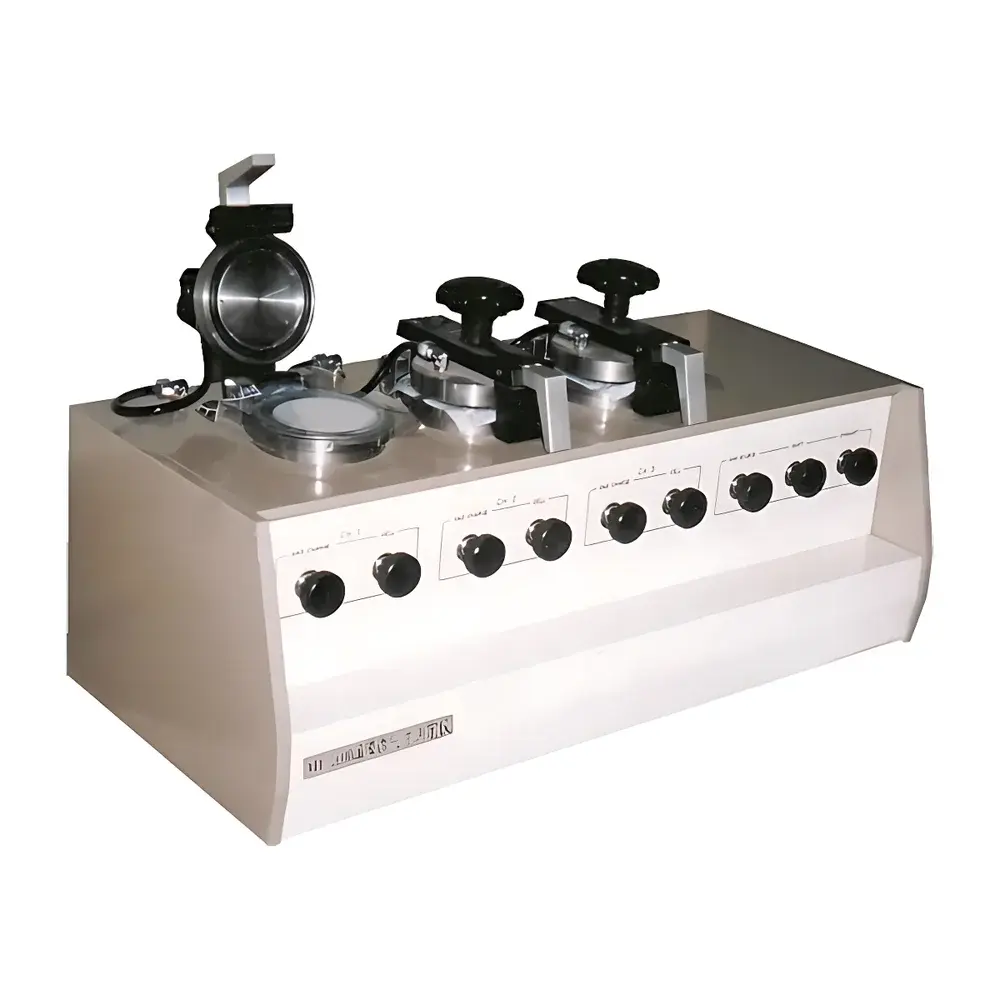
HARKE HK-398A Water Vapor Transmission Rate (WVTR) Tester
| Brand | HARKE |
|---|---|
| Model | HK-398A |
| Measurement Range | 0.01–1200 g/m²·24h (standard), up to 7500 g/m²·24h (optional) |
| Resolution | 0.001 g/m²·24h |
| Temperature Control Range | 5–95°C |
| Temperature Accuracy | ±0.1°C |
| Humidity Control | 0%RH, 35–90%RH, 100%RH |
| Humidity Accuracy | <±1%RH |
| Sample Quantity | 1–6 independent stations |
| Test Area | 38 cm² (standard) |
| Sample Dimensions | 150 mm × 94 mm or circular |
| Max Sample Thickness | ≤5 mm |
| Carrier Gas | 99.999% high-purity N₂ (user-supplied) |
| Gas Pressure | ≥0.16 MPa |
| Gas Flow Rate | 0–200 mL/min |
| Gas Inlet | 1/8″ metal tubing |
| Power Supply | AC 220 V, 50 Hz |
| Dimensions (L×W×H) | 650 × 690 × 415 mm |
| Net Weight | 80 kg |
Overview
The HARKE HK-398A Water Vapor Transmission Rate (WVTR) Tester is a gravimetric-based permeation measurement system engineered for precise, reproducible quantification of water vapor transmission through flexible barrier materials. It operates on the principle of dynamic desiccant-assisted gravimetric analysis: test specimens are sealed between conditioned dry and humid chambers, establishing a controlled vapor pressure gradient across the sample. Water vapor diffusing through the material is carried by a purified nitrogen carrier gas stream into a precision moisture analyzer—typically a high-stability infrared or coulometric sensor—where mass flux is continuously measured over time. This method complies with core international standards including ASTM E96/E96M (desiccant and water methods), ISO 15106-1 (infrared detection), and ISO 2528 (gravimetric cup method), enabling traceable, laboratory-grade WVTR data essential for packaging integrity validation, shelf-life modeling, and regulatory documentation.
Key Features
- Multi-station architecture supporting simultaneous testing of 1–6 samples under identical environmental conditions—enhancing throughput without compromising inter-test consistency.
- High-resolution gravimetric detection with 0.001 g/m²·24h resolution and full-scale range extension to 7500 g/m²·24h for highly permeable substrates such as nonwovens or foams.
- Independent dual-climate control: temperature regulated from 5°C to 95°C (±0.1°C stability) and humidity precisely maintained at 0%, 35–90%, or 100% RH (<±1%RH accuracy) in the wet-side chamber.
- Standardized 38 cm² test area with interchangeable fixtures accommodating rectangular (150 mm × 94 mm) or circular specimens; compatible with materials up to 5 mm thickness.
- Integrated carrier gas management system with adjustable flow (0–200 mL/min), pressure monitoring (≥0.16 MPa minimum inlet), and standardized 1/8″ stainless steel gas inlet for 99.999% N₂ supply.
- Rugged industrial enclosure (650 × 690 × 415 mm, 80 kg net weight) designed for long-term stability in QC laboratories and production environments subject to ambient thermal drift.
Sample Compatibility & Compliance
The HK-398A accommodates a broad spectrum of polymeric and porous materials critical to functional packaging and technical textiles. Validated applications include multilayer plastic films (e.g., PET/AL/PE, BOPP/CPP), metallized coatings, ethylene-vinyl alcohol (EVOH) barrier laminates, polyurethane foams, hydrophobic nonwovens, coated leather, and woven/nonwoven fabrics used in medical drapes or protective apparel. All test configurations adhere to Good Laboratory Practice (GLP) requirements, with audit-ready calibration logs, environmental parameter timestamps, and user-accessible uncertainty budgets. The system supports IQ/OQ documentation packages aligned with ISO/IEC 17025 and FDA 21 CFR Part 11 compliance when paired with HARKE’s optional secure software module featuring electronic signatures and change-controlled data archiving.
Software & Data Management
HARKE’s proprietary WinWVTR software provides real-time graphical visualization of cumulative transmission curves, automatic slope-based WVTR calculation per ASTM E96 Annex A5, and statistical reporting (mean, SD, CV%) across replicate samples. Raw sensor output, temperature/humidity setpoints, gas flow profiles, and operator annotations are stored in encrypted binary format with SHA-256 checksum verification. Export options include CSV, PDF test reports with embedded metadata (ISO 17025-compliant headers), and XML files compatible with LIMS integration. Audit trail functionality records all user actions—including method edits, result overrides, and calibration events—with immutable timestamps and operator ID linkage.
Applications
This instrument serves as a primary metrology tool in R&D labs developing moisture-sensitive pharmaceutical blister packs, food packaging with extended ambient shelf life, and sterile barrier systems for Class II/III medical devices. It is routinely deployed in quality assurance workflows for incoming raw material qualification (e.g., film lot release against specification limits), process validation of coating or lamination lines, and accelerated aging studies correlating WVTR shifts with thermal-humidity stress exposure. End-use sectors include contract packaging organizations (CPOs), biopharmaceutical manufacturers maintaining ICH Q5C stability protocols, and textile innovators engineering breathable yet waterproof membranes for sportswear and PPE.
FAQ
What carrier gas is required, and why must it be 99.999% pure nitrogen?
Ultra-high-purity nitrogen eliminates interference from ambient moisture, oxygen, or hydrocarbons that could saturate the detector or catalyze oxidative degradation of sensitive samples during prolonged tests.
Can the HK-398A measure WVTR at sub-zero temperatures?
No—the system’s operational temperature range is strictly 5°C to 95°C due to limitations in condensation control and sensor thermal stability below 5°C.
Is calibration traceable to NIST or other national standards?
Yes—HARKE provides factory calibration certificates traceable to NIST SRM 1921b (water vapor permeation standard) and includes certified reference membranes with assigned WVTR values for user-performed interval verification.
How does the system handle edge effects for non-standard sample geometries?
The sealed test cell design with gasketed clamping ensures defined diffusion area; users must ensure specimen coverage fully exceeds the 38 cm² aperture to prevent lateral vapor bypass—no correction algorithms are applied.
Does the instrument support automated humidity ramping or cyclic RH profiling?
No—humidity is held constant per test cycle; dynamic RH profiles require external environmental chamber integration and manual protocol sequencing.





