
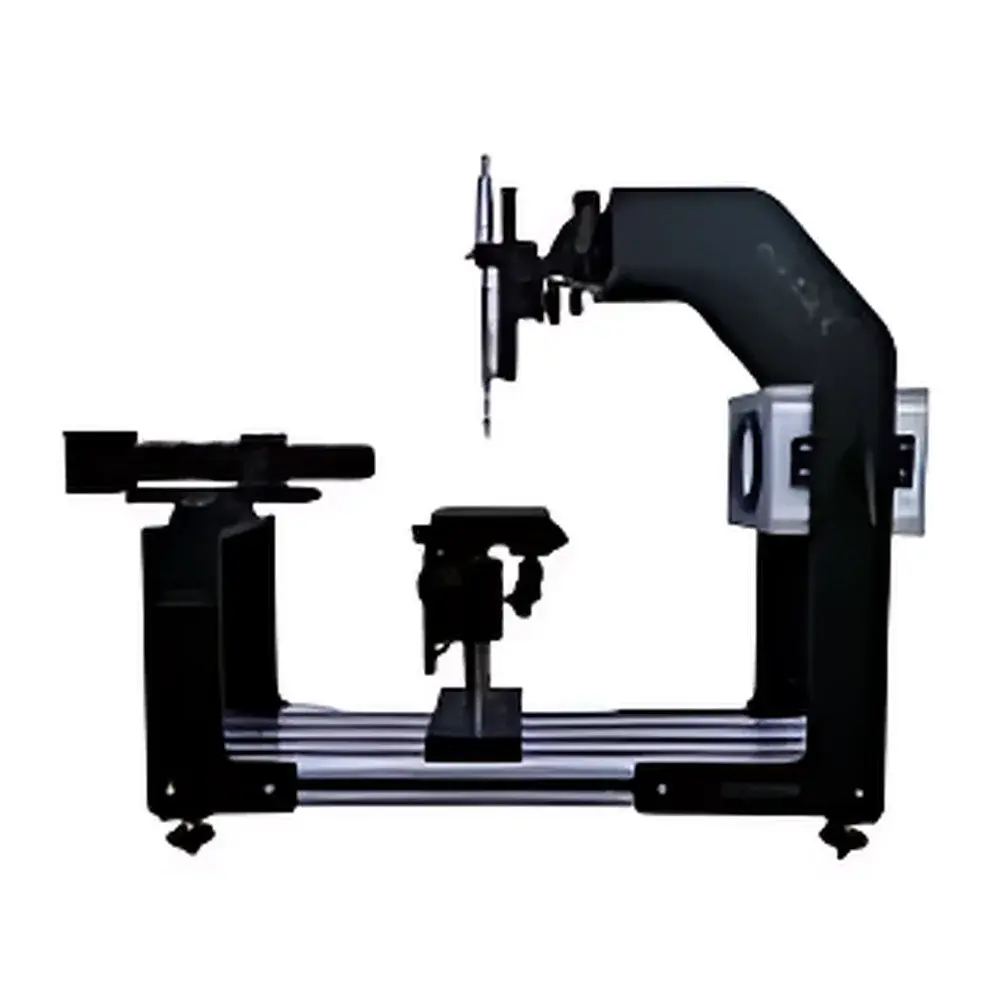
HARKE SPCA-C Single-Fiber Contact Angle Analyzer
| Brand | HARKE |
|---|---|
| Model | SPCA-C |
| Origin | Beijing, China |
| Manufacturer | HARKE Instrument Co., Ltd. |
| Instrument Type | Benchtop Laboratory System |
| Contact Angle Measurement Range | 0–180° |
| Contact Angle Accuracy | ±0.1° (display), ±0.5° (measurement) |
| Surface/Interfacial Tension Range | 0–1000 mN/m |
| Surface/Interfacial Tension Accuracy | ±0.1 mN/m |
| Sample Stage Dimensions | 400 mm × 400 mm |
| Optical Zoom Ratio | 0.7×–5× (stepped zoom lens) |
| Video Capture | USB 3.0 camera, software-controlled frame rates up to 1000 fps (standard: 30 fps) |
| Injection System Travel | 30 mm |
| Lens Vertical Travel | 30 mm |
| Positioning Resolution (motorized stage) | ±0.1 mm |
| Dimensions (W×D×H) | 300 mm × 760 mm × — mm (height not specified) |
| Weight | 30 kg |
| Power Supply | 220 V, 3 A, 50 Hz |
| Operating Temperature | Ambient |
| Measurement Methods | Circle fitting, ellipse fitting, height-width method, Young-Laplace curve fitting, and five additional algorithmic approaches (total of eight) |
| Software | SPCA 1.0 (Windows-based, real-time image acquisition & analysis) |
Overview
The HARKE SPCA-C Single-Fiber Contact Angle Analyzer is a precision-engineered benchtop instrument designed for quantitative characterization of wettability and interfacial energetics at the microscale—specifically tailored for individual fibers, filaments, micro-wires, and other quasi-one-dimensional substrates. Unlike conventional sessile-drop contact angle systems optimized for flat, rigid surfaces, the SPCA-C integrates motorized high-precision positioning, variable-magnification optics, and multi-algorithm image analysis to resolve dynamic wetting behavior on cylindrical or irregular geometries with sub-degree angular resolution. Its operational principle relies on high-contrast side-view imaging of liquid menisci formed around suspended or vertically mounted fibers, followed by pixel-level edge detection and geometric modeling based on Young–Laplace theory and axisymmetric drop shape analysis (ADSA). This enables robust derivation of contact angle, surface free energy components (via Owens–Wendt or Wu methods), and interfacial tension—critical parameters in fiber functionalization, composite reinforcement, textile finishing, and biomedical filament coating development.
Key Features
- Motorized XYZ sample stage with ±0.1 mm repeatability and programmable trajectory control for precise fiber alignment and multi-point measurement
- Stepped optical zoom system (0.7×–5×) with fixed magnification positions ensures consistent pixel-to-length calibration across magnifications—eliminating interpolation drift in contact angle quantification
- Dual-mode dispensing: syringe pump with 30 mm vertical travel supports both static sessile drop and dynamic advancing/receding angle protocols on single fibers
- Real-time video capture at up to 1000 fps (optional high-speed module) enables kinetic analysis of droplet spreading, absorption, and capillary rise on fibrous substrates
- SPCA 1.0 software suite provides eight validated fitting algorithms—including circle, ellipse, height-width, and full Young–Laplace numerical solution—to accommodate asymmetric menisci, partial wetting, and low-contrast interfaces
- Benchtop footprint (300 mm × 760 mm) and modular design allow integration into ISO Class 5–7 cleanrooms or QC laboratories without dedicated vibration isolation
Sample Compatibility & Compliance
The SPCA-C accommodates fibers ranging from 5 µm to 500 µm in diameter—including natural (cotton, wool, silk), synthetic (polyester, nylon, aramid), metallic (stainless steel, copper), carbon-based (PAN-derived, graphite), and bioresorbable (PLA, PCL) filaments. Samples are mounted using custom clamping fixtures compatible with tensile testing jigs or suspended via micro-hooks to minimize substrate interference. The system complies with ASTM D7334–22 (Standard Practice for Surface Wettability Assessment of Polymer Surfaces by Contact Angle Measurement), ISO 19403-2:2017 (Contact angle measurement – Part 2: Static contact angle), and supports GLP-compliant audit trails when paired with optional electronic signature modules. All measurement data—including raw images, timestamped metadata, operator ID, and environmental logs—are stored in vendor-neutral TIFF and CSV formats for regulatory submission.
Software & Data Management
SPCA 1.0 is a Windows-based application developed under IEC 62304 Class B software lifecycle requirements. It features real-time image preprocessing (background subtraction, contrast enhancement, noise filtering), batch processing for multi-sample datasets, and automated report generation in PDF/HTML with embedded traceable calibration records. The software supports FDA 21 CFR Part 11 compliance through configurable user roles, electronic signatures, and immutable audit logs recording every parameter change, image acquisition event, and result export. Export options include ASTM E1447-compliant data packages and direct integration with LIMS platforms via OPC UA or RESTful API (available as licensed add-on).
Applications
- Quantifying hydrophobicity/hydrophilicity of textile fibers pre- and post-plasma treatment or silicone finishing
- Evaluating adhesion promotion on carbon fiber surfaces prior to epoxy matrix impregnation in aerospace composites
- Characterizing surface energy heterogeneity along electrospun nanofiber mats for controlled drug release scaffolds
- Assessing surfactant adsorption kinetics on monofilament fishing lines and medical sutures
- Validating cleaning efficacy on stainless-steel wire meshes used in pharmaceutical filtration systems
- Supporting R&D of flame-retardant coatings on aramid fibers via contact angle hysteresis analysis
FAQ
Can the SPCA-C measure contact angles on non-vertical fiber orientations?
Yes—the motorized stage allows rotation and tilt adjustment within ±15°, enabling measurements on angled or bent fibers while maintaining optical axis alignment.
Is calibration traceable to NIST standards?
Certified reference goniometers (10°, 45°, 90°, 135°) and certified surface tension standards (e.g., 2-ethylhexanol, diiodomethane) are supplied with NIST-traceable certificates; in-house calibration procedures follow ISO/IEC 17025 guidelines.
Does the system support dynamic contact angle measurement (advancing/receding)?
Yes—via programmable syringe pump volume ramping combined with continuous high-speed imaging and frame-by-frame meniscus tracking.
What file formats are supported for raw image and analysis export?
TIFF (lossless, 12-bit), AVI (uncompressed), CSV (angle/time/tension), and XML (metadata-rich structured export compatible with MATLAB and Python pandas).
Is remote operation possible for lab automation integration?
Yes—SPCA 1.0 includes TCP/IP command interface and DLL libraries for custom scripting in LabVIEW, Python, or C#, enabling integration into automated test sequences and MES environments.



