
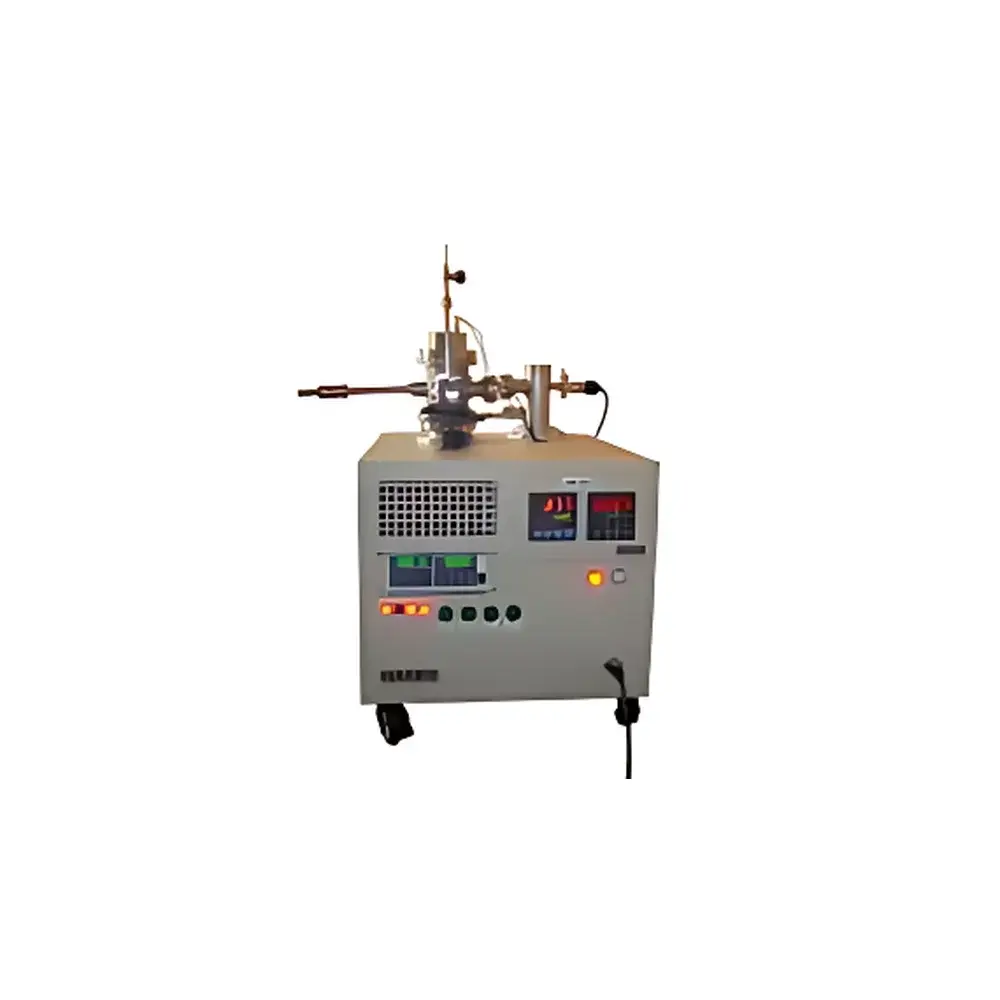
HARKE HTV1 High-Temperature & High-Vacuum Contact Angle Analyzer
| Brand | HARKE |
|---|---|
| Model | HTV1 |
| Type | Benchtop High-Temperature Vacuum Contact Angle Analyzer |
| Contact Angle Range | 0–180° |
| Contact Angle Accuracy | ±0.1° |
| Sample Stage Dimensions | 40 × 40 mm |
| Optical Magnification | 0.7×–5× (stepped zoom) |
| Surface/Interfacial Tension Range | 0–5000 mN/m |
| Surface/Interfacial Tension Resolution | 0.01 mN/m |
| Max Operating Temperature | 1500 °C |
| Ultimate Vacuum | 1 × 10⁻⁵ Pa |
| Heating System | Low-voltage, high-power controllable heating |
| Temperature Control | Imported multi-zone precision temperature controller |
| Vacuum System | Oil-free molecular pump + branded rotary vane pump |
| Imaging | USB 3.0 digital camera with laser-illuminated backlighting |
| Software | HARKE-HTV1.0 (compliant with GLP audit trail and data integrity requirements) |
| Power Supply | 220 V / 30 A / 50 Hz |
| Instrument Dimensions (W × D × H) | 600 × 800 × 1200 mm |
| Net Weight | 100 kg |
| Measurement Method | Sessile Drop |
| Optional Accessories | Sample pre-positioning stage, interfacial tension module |
Overview
The HARKE HTV1 High-Temperature & High-Vacuum Contact Angle Analyzer is an engineered benchtop instrument designed for quantitative characterization of solid–liquid and solid–vapor interfacial behavior under extreme thermal and vacuum conditions. Utilizing the sessile drop method combined with high-resolution optical imaging and advanced contour analysis algorithms, the system measures contact angle, surface energy, interfacial tension, and dynamic wetting kinetics across temperatures from ambient to 1500 °C and pressures down to 1 × 10⁻⁵ Pa. Its core architecture integrates a precisely regulated low-voltage resistive heating system, multi-zone PID temperature control, and a dual-stage vacuum train comprising an oil-free molecular pump and a high-performance rotary vane pump—ensuring thermal stability ±1 °C and pressure repeatability within ±5% over extended dwell periods. The instrument is purpose-built for metallurgical research, high-temperature ceramics development, molten metal–ceramic interface studies, and reactive alloy processing where oxide formation, interfacial segregation, or vapor-phase reactions must be isolated and quantified.
Key Features
- High-fidelity optical path: Stepped 0.7×–5× zoom lens with fixed magnification positions ensures pixel-level reproducibility across measurement series; calibrated using NIST-traceable stage micrometers.
- Thermal–vacuum co-control: Independent real-time monitoring of chamber pressure, sample surface temperature (via dual-wavelength pyrometer), and heater zone profiles enables synchronized parameter logging with timestamped metadata.
- Laser-assisted illumination: Collimated 635 nm diode laser backlight eliminates ambient light interference and enhances droplet edge contrast—even at elevated temperatures where thermal glow may obscure boundaries.
- Rigid mechanical platform: Cast aluminum frame with vibration-damped optical baseplate minimizes drift during long-duration measurements (>2 h) at >1200 °C.
- Compliance-ready software: HARKE-HTV1.0 implements 21 CFR Part 11–aligned user authentication, electronic signatures, and immutable audit trails for raw image archives, processed data, and calibration logs.
Sample Compatibility & Compliance
The HTV1 accommodates flat, polished, or as-sintered samples up to 40 × 40 mm in planar dimension and ≤25 mm in thickness. Compatible substrates include refractory metals (Mo, W, Nb), transition metal carbides (TiC, WC), oxide ceramics (Al₂O₃, ZrO₂), and graphite-based composites. All vacuum-wetted components are constructed from ultra-high-purity stainless steel (AISI 316L) and ceramic insulators rated for continuous operation at 1500 °C. The system meets ISO 19403-2 (contact angle measurement—part 2: static methods) and ASTM D7490 (standard test method for measuring contact angles of solid surfaces) under controlled thermal–vacuum conditions. Full traceability documentation—including temperature sensor calibration certificates (per ISO/IEC 17025), vacuum gauge verification reports, and optical resolution validation—is provided with each unit.
Software & Data Management
HARKE-HTV1.0 software provides automated droplet detection using adaptive Canny edge filtering and ellipse-fitting algorithms optimized for high-temperature image noise. It supports batch processing of time-lapse sequences, dynamic contact angle hysteresis analysis (advancing/receding), Owens–Wendt surface energy decomposition, and Young–Dupré work-of-adhesion calculations. All datasets export to CSV, HDF5, or vendor-neutral .tif stacks with embedded EXIF metadata (temperature, pressure, timestamp, lens magnification). Data storage follows ALCOA+ principles: Attributable, Legible, Contemporaneous, Original, Accurate, Complete, Consistent, Enduring, and Available. Audit logs record every user action—including image deletion, parameter override, or calibration modification—with IP address and session ID.
Applications
- Metallurgical interface engineering: Quantifying wettability of molten Al, Cu, or Ni alloys on ceramic substrates under inert or reducing atmospheres to optimize brazing and infiltration processes.
- Refractory material development: Assessing surface energy evolution of SiC or BN composites during thermal cycling, correlating with microstructural changes observed via in situ XRD.
- Nuclear fuel cladding research: Measuring UO₂–Zr alloy interfacial tension under simulated LOCA conditions (1200 °C, 10⁻⁴ Pa).
- Space materials science: Evaluating capillary-driven fluid transport in porous tungsten heat pipes operating at >1000 °C in vacuum environments.
- High-temperature sensor packaging: Validating adhesion stability of die-attach materials (e.g., Ag sinter pastes) on SiC power modules subjected to thermal shock between 25 °C and 600 °C.
FAQ
What vacuum level is required to suppress oxidation during high-temperature contact angle measurements?
For most transition metals and refractory carbides, a base pressure ≤5 × 10⁻⁵ Pa is recommended to limit partial pressure of residual O₂ to <10⁻⁸ atm—sufficient to inhibit measurable oxide nucleation over typical measurement durations (10–60 min).
Can the HTV1 perform captive bubble measurements at elevated temperature?
No—the current configuration supports only sessile drop and tilting plate modes. Captive bubble capability requires submerged chamber redesign and is not available in the HTV1 platform.
Is third-party software integration supported (e.g., MATLAB or Python)?
Yes—HARKE-HTV1.0 exposes a documented COM interface and provides ASCII-based data streaming via TCP/IP socket, enabling direct acquisition into custom analysis pipelines.
How is temperature uniformity across the sample surface verified?
Each unit undergoes thermal mapping using a 16-point thermocouple array mounted on a reference alumina wafer; uniformity is certified to ±3 °C over the central 30 × 30 mm region at 1400 °C.
Does the system comply with FDA or EU GMP requirements for regulated laboratories?
Yes—the software architecture, electronic record retention policy, and hardware calibration traceability meet Annex 11 (EU GMP) and 21 CFR Part 11 (FDA) requirements for analytical instrumentation used in quality-critical applications.



