
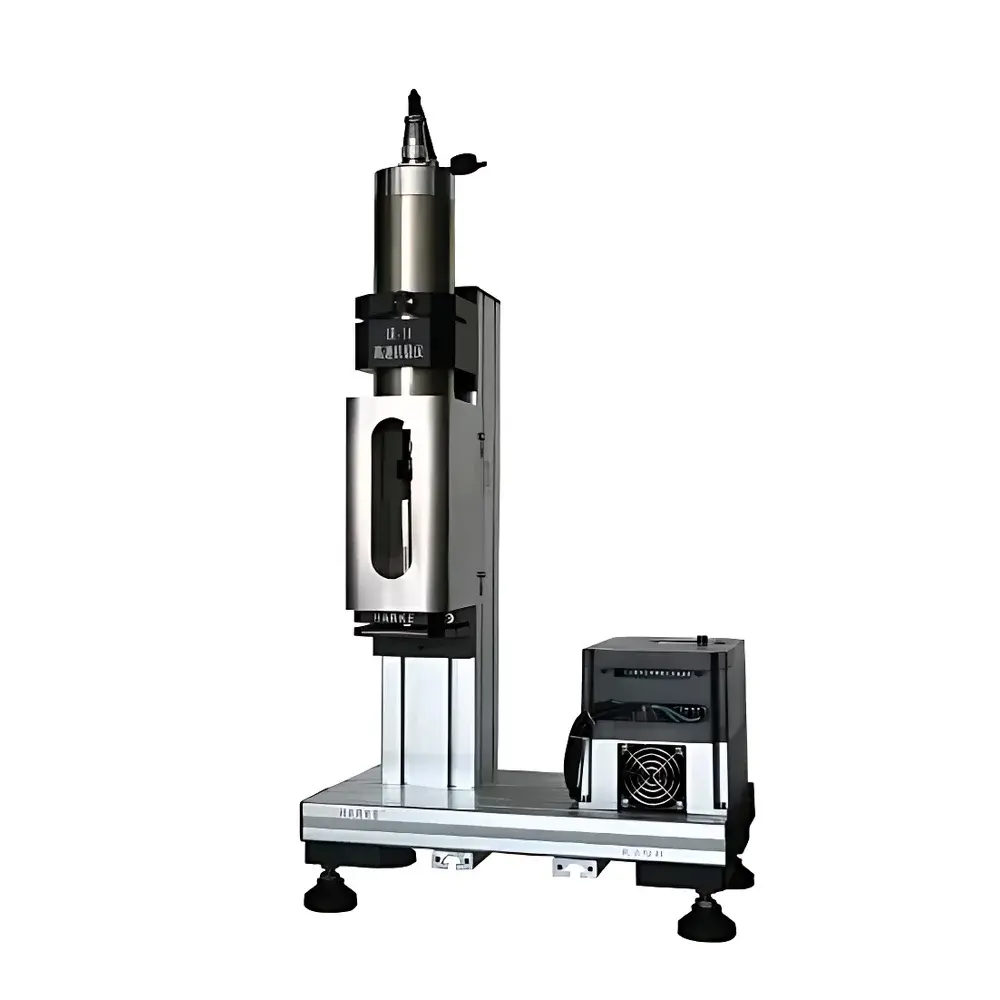
HARKE HK-XR-14W High-Speed Mechanical Stability Tester for Latex
| Brand | HARKE |
|---|---|
| Model | HK-XR-14W |
| Standard Compliance | GB/T 8301–2008, SH/T 1151–1998 |
| Rotational Speed | 14,000 ± 200 rpm |
| Temperature Control Range | 35–37 °C |
| Sample Mass | 80 g (pre-conditioned at 55% total solids) |
| Test Endpoint Detection | Visual coagulum onset via palm test or water dispersion test |
| Power Supply | 220 V AC, 50 Hz |
Overview
The HARKE HK-XR-14W High-Speed Mechanical Stability Tester is a precision-engineered instrument designed specifically for quantifying the mechanical stability of natural and synthetic latex dispersions under standardized high-shear conditions. It operates on the principle of controlled high-speed agitation to induce destabilization—mimicking industrial processing stresses such as pumping, homogenization, and high-velocity transfer—thereby enabling reproducible assessment of colloidal integrity. Mechanical stability, defined as the time elapsed from initiation of high-speed stirring until the first observable coagulum formation, serves as a critical quality indicator for latex producers, compounders, and R&D laboratories. The HK-XR-14W implements a rigorously defined test protocol aligned with GB/T 8301–2008 (for concentrated natural rubber latex) and SH/T 1151–1998 (for synthetic latex), ensuring metrological traceability and inter-laboratory comparability in rubber & plastic formulation development and QC workflows.
Key Features
- Stable, brushless DC motor drive delivering precise rotational speed control at 14,000 ± 200 rpm—maintained continuously throughout the test duration without drift.
- Integrated Peltier-assisted heating module with digital PID feedback, enabling rapid and uniform sample temperature stabilization within 35–37 °C (±0.5 °C accuracy).
- Dedicated stainless-steel stirring assembly comprising a conical rotor and fixed stator geometry optimized for laminar-to-turbulent transition in low-viscosity latex systems.
- Ergonomic sample cup holder with thermal insulation and quick-lock positioning to minimize thermal loss and ensure repeatable placement relative to the impeller axis.
- Real-time stopwatch interface with audible alert and manual endpoint confirmation button—designed to synchronize operator observation with timing precision.
- Robust aluminum alloy chassis with vibration-dampening feet and IP20-rated enclosure for long-term reliability in shared laboratory environments.
Sample Compatibility & Compliance
The HK-XR-14W is validated for use with ammonia-stabilized natural rubber latex (NRL), styrene-butadiene rubber (SBR) latex, nitrile rubber (NBR) latex, and acrylic emulsions meeting the 55% total solids specification after dilution. Sample preparation strictly follows ISO/IEC 17025-aligned procedures: pre-filtration through 100-mesh stainless steel mesh, gravimetric weighing (±0.01 g), and temperature verification using calibrated digital thermometers traceable to NIM (National Institute of Metrology, China). The instrument satisfies essential requirements for GLP-compliant testing environments; its operational parameters and endpoint determination methods are fully documented in test reports supporting internal audits and regulatory submissions under GMP frameworks for elastomer-based medical device raw materials.
Software & Data Management
While the HK-XR-14W operates as a dedicated hardware platform without embedded firmware or cloud connectivity, it supports full documentation integrity per FDA 21 CFR Part 11 principles when integrated into laboratory information management systems (LIMS). All test records—including start time, ambient temperature, operator ID, sample ID, observed endpoint time, and method of endpoint detection (palm test or water dispersion)—are manually entered into standardized paper or electronic worksheets compliant with Annex 11 guidance. Optional HARKE LabLog companion templates (available upon request) provide structured fields for audit trail generation, deviation logging, and trend analysis across batches. Instrument calibration certificates (torque, speed, temperature) are issued annually by accredited third-party metrology labs and archived alongside test data.
Applications
- Quality assurance of incoming latex feedstock in tire cord dipping, glove manufacturing, and foam production facilities.
- Formulation optimization of stabilizer systems (e.g., fatty acid soaps, surfactants, pH buffers) during polymer synthesis and post-polymerization treatment.
- Accelerated aging studies correlating mechanical stability loss with storage time, temperature exposure, or freeze-thaw cycles.
- Comparative evaluation of latex blends (e.g., NRL/SBR hybrids) for improved process robustness in extrusion and calendering operations.
- Supporting technical documentation for ISO 9001:2015 Clause 8.5.1 (Control of production and service provision) and ISO 14001:2015 environmental compliance reporting.
FAQ
What standards does the HK-XR-14W comply with?
It is engineered to meet the procedural and performance requirements of GB/T 8301–2008 and SH/T 1151–1998, including specified rotational speed tolerance, temperature control range, sample mass, and endpoint detection criteria.
Can the instrument be used for non-ammonia-stabilized latex systems?
Yes—provided the sample meets the 55% total solids requirement and exhibits measurable coagulum onset under 14,000 rpm shear; however, method validation per ASTM D1644 must be performed prior to routine use.
Is temperature calibration traceable to national standards?
Yes—each unit ships with a NIM-traceable temperature verification report covering the 35–37 °C operating band, and annual recalibration is recommended using a certified dry-block calibrator.
How is operator variability minimized during endpoint detection?
The palm test and water dispersion test protocols include explicit pass/fail criteria, training checklists, and dual-confirmation steps (e.g., +15 s verification stir) to reduce subjective interpretation and support inter-operator reproducibility studies.
Does HARKE provide installation qualification (IQ) or operational qualification (OQ) documentation?
Yes—custom IQ/OQ protocols aligned with ISO/IEC 17025 and GAMP5 guidelines are available upon request for regulated pharmaceutical or medical device manufacturing clients.





