
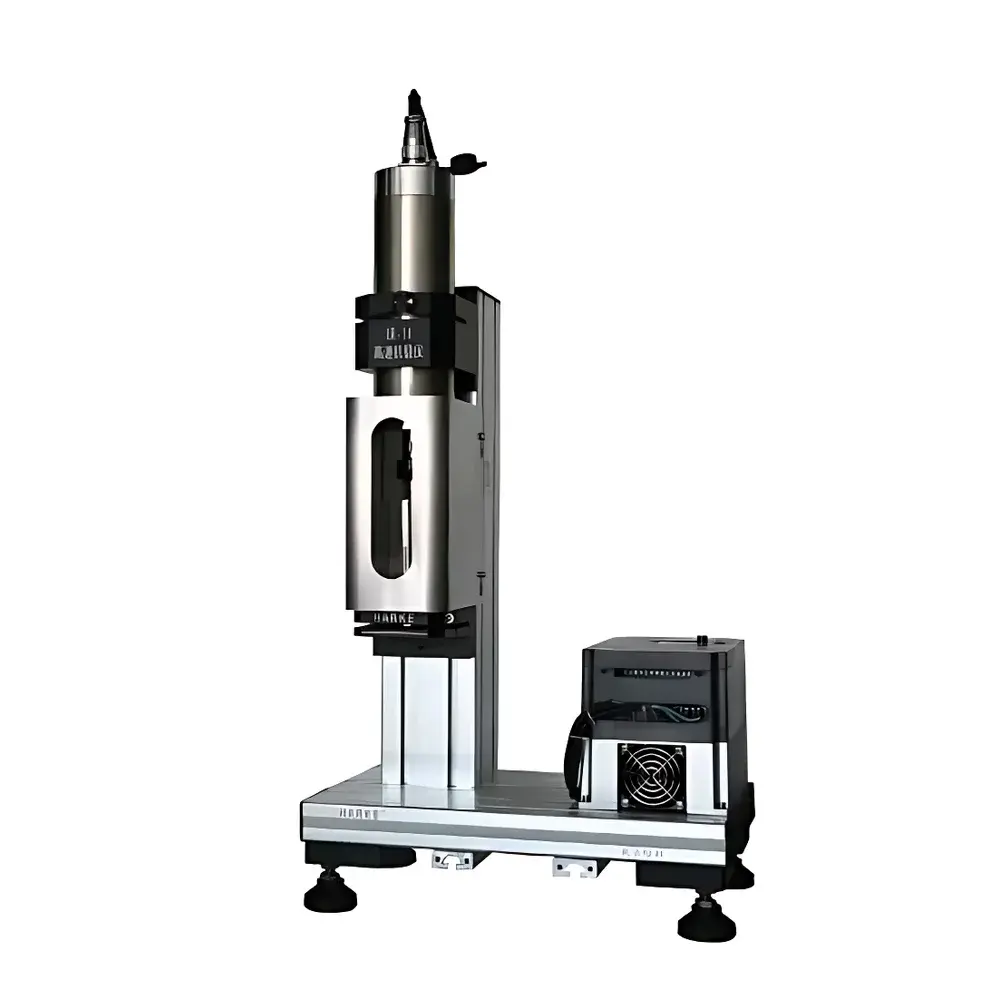
HARKE HK-XR-14 High-Speed Mechanical Stability Tester for Latex
| Brand | HARKE |
|---|---|
| Model | HK-XR-14 |
| Standard Compliance | GB/T 8301–2008, SH/T 1151–1998 |
| Stirring Speed | 14,000 ± 200 rpm |
| Temperature Control Range | 35 ± 1 °C (during test) |
| Stirrer Disc Diameter Options | 36.12 ± 0.03 mm (synthetic latex), 20.83 ± 0.03 mm (natural latex) |
| Resolution | 1 rpm |
| Display | LED via frequency converter |
| Power Supply | 220 V ± 10 %, 50 Hz, 1500 W |
| Dimensions | 400 × 350 × 720 mm |
| Operating Environment | 10–40 °C, <85 % RH |
Overview
The HARKE HK-XR-14 High-Speed Mechanical Stability Tester for Latex is an engineered precision instrument designed to quantify the resistance of natural and synthetic latex dispersions to mechanical shear-induced coagulation under standardized, reproducible conditions. It operates on the principle of controlled high-shear agitation—applying a defined rotational stress at 14,000 ± 200 rpm using a calibrated stainless-steel stirrer disc—to accelerate destabilization kinetics analogous to industrial processing steps such as pumping, homogenization, and pipeline transport. The endpoint—defined as the onset of visible coagulum formation—is determined objectively through either the palm test or water dispersion test, both specified in GB/T 8301–2008 (for concentrated natural rubber latex) and SH/T 1151–1998 (for synthetic latex). This test directly correlates with colloidal stability, surfactant efficacy, and formulation robustness, making it indispensable for quality control laboratories in rubber compound development, latex concentrate production, and R&D centers evaluating stabilizer performance.
Key Features
- Compliance-ready design aligned with two national standards: GB/T 8301–2008 and SH/T 1151–1998—ensuring traceable, auditable test execution for internal QC and third-party certification.
- Dual-diameter stirrer discs (20.83 ± 0.03 mm for natural latex; 36.12 ± 0.03 mm for synthetic latex), each manufactured to strict dimensional tolerances (±0.03 mm diameter, ±0.05 mm thickness) to maintain consistent shear geometry and energy input across sample types.
- Precision temperature-controlled pre-conditioning stage: integrated heating unit maintains sample at 35 ± 1 °C prior to and during testing—critical for eliminating thermal variability that affects colloidal stability kinetics.
- High-fidelity speed regulation: brushless motor driven by industrial-grade frequency converter delivers stable 14,000 rpm operation with ≤0.1% indication error and 1 rpm resolution—enabling accurate repeatability across batches and operators.
- Rugged mechanical architecture: stainless-steel stirring assembly, borosilicate glass sample vessel (ID 58 mm, height >100 mm), and vibration-damped base ensure long-term dimensional stability and minimal drift during high-speed operation.
- Intuitive LED interface displays real-time rpm and elapsed time—no software dependency required for basic operation, supporting GLP-compliant manual data recording.
Sample Compatibility & Compliance
The HK-XR-14 is validated for use with aqueous colloidal dispersions of natural rubber latex (e.g., ammonia-stabilized field latex, centrifuged concentrates) and synthetic elastomer lattices including styrene-butadiene rubber (SBR), nitrile rubber (NBR), and acrylic lattices. Sample preparation follows strict procedural controls: dilution to 55 wt% total solids with ammoniacal solution, filtration through stainless-steel mesh, and precise mass measurement (80 g ± 0.1 g). All operational parameters—including ambient temperature (10–40 °C), relative humidity (<85 % RH), and electrical supply (220 V ± 10 %, 50 Hz)—are documented per ISO/IEC 17025 requirements for method validation. While not inherently 21 CFR Part 11 compliant, the instrument supports audit-trail-ready documentation when paired with laboratory notebooks or LIMS-integrated timing logs.
Software & Data Management
The HK-XR-14 operates in standalone mode without proprietary software. Timing and speed are monitored via front-panel LED display; users record start/stop times manually alongside endpoint identification method (palm test or water dispersion test). For laboratories requiring digital traceability, external USB timers or GLP-compliant electronic lab notebooks (ELNs) may be synchronized with test initiation. No firmware updates, cloud connectivity, or automated reporting are included—intentionally minimizing validation burden for regulated environments where deterministic, low-complexity instrumentation is preferred. Calibration certificates for speed and temperature modules can be issued per ISO 17025-accredited providers upon request.
Applications
- Quality assurance of incoming natural rubber latex concentrates at tire and glove manufacturing facilities.
- Formulation screening of emulsifiers, dispersants, and pH modifiers in synthetic latex development.
- Batch-to-batch consistency verification in commercial latex production lines.
- Accelerated stability assessment during shelf-life studies of stabilized latex products.
- Research into coagulation mechanisms under shear, including interfacial rheology–stability correlations.
- Training platform for polymer science curricula focusing on colloidal stability theory and ASTM/ISO-standardized testing protocols.
FAQ
What standards does the HK-XR-14 comply with?
It is explicitly designed to meet the procedural and equipment specifications of GB/T 8301–2008 (Natural Rubber Latex) and SH/T 1151–1998 (Synthetic Rubber Latex).
Can the instrument test non-rubber latex systems, such as PVA or casein dispersions?
While not validated for non-elastomeric colloids, the mechanical shear protocol may be adapted for research use—however, endpoint interpretation and correlation to functional stability require independent method validation.
Is temperature control active during the entire test cycle?
The heater preconditioning step ensures the sample reaches 35 ± 1 °C before insertion; no active temperature maintenance occurs during agitation—consistent with standard methodology in both referenced specifications.
How is speed calibration verified?
Speed accuracy is confirmed using a traceable optical tachometer against the LED display output; annual recalibration of the frequency converter is recommended per ISO/IEC 17025 guidelines.
Does the instrument include safety interlocks or emergency stop functionality?
Yes—a hardware-based emergency stop button immediately cuts power to the motor and halts rotation, complying with IEC 61000-6-2 electromagnetic compatibility and basic machinery safety expectations for Class I laboratory equipment.





