
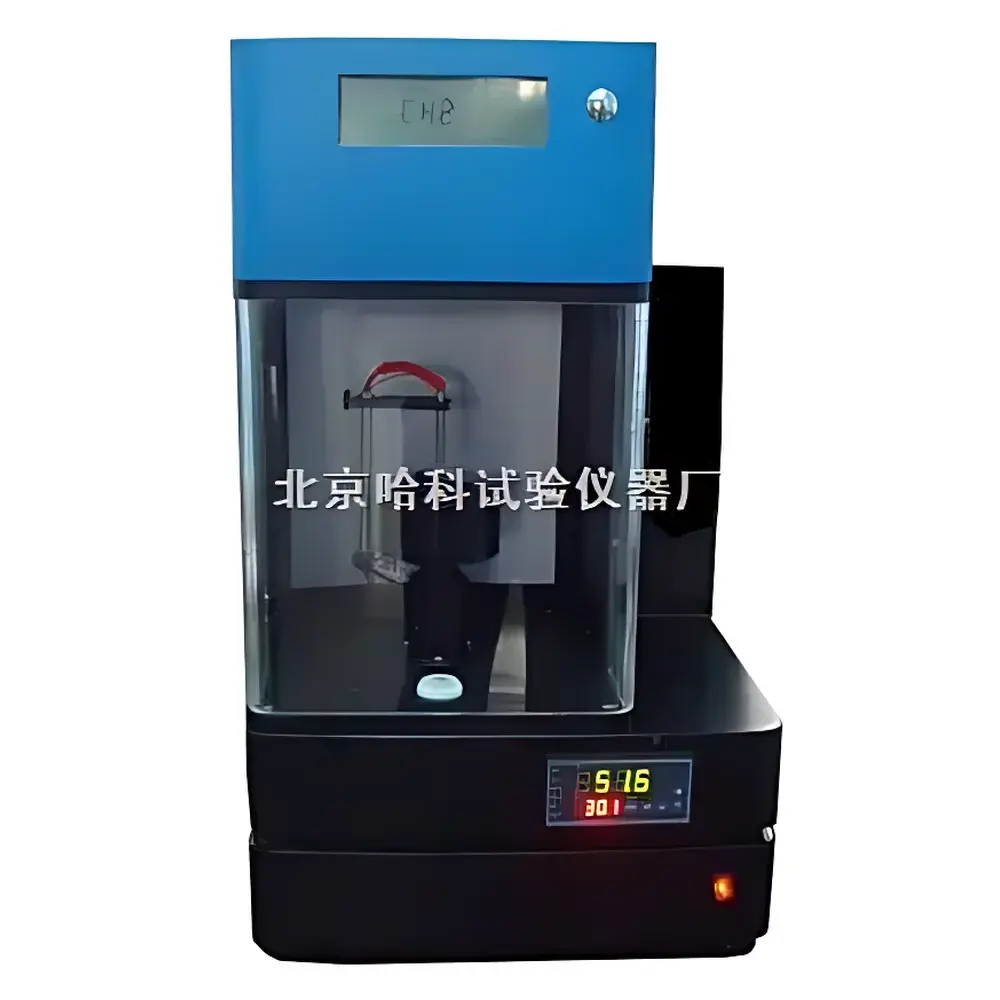
SFT-D1 Microcomputer-Controlled Surface Tensiometer (Formerly DW Series)
| Origin | Beijing, China |
|---|---|
| Manufacturer Type | Authorized Distributor |
| Origin Category | Domestic (PRC) |
| Model | SFT-D1 |
| Pricing | Upon Request |
| Measurement Range | 0–1000 mN/m |
| Resolution | 0.01 mN/m |
| Accuracy | ±0.01 mN/m |
| Data Acquisition Rate | Up to 23 readings/sec |
| Zeroing Method | One-Touch Auto-Zero |
| Stage Vertical Travel | 0–50 mm |
| Stage Repeatability | ±0.5 µm |
| Stage Speed Control | Programmable, Variable-Speed During Measurement |
| Interface | USB (for stage & software control), RS-232 (for legacy instrument communication) |
| Temperature Sensing Accuracy | ±0.01 °C |
| Temperature Readout | Software-Integrated, Independent Display |
| Dimensions (L×W×H) | 330 × 350 × 580 mm |
| Weight | 20 kg |
| Power Supply | 220 V AC, 3 A |
Overview
The SFT-D1 Microcomputer-Controlled Surface Tensiometer is an engineered solution for precise, reproducible quantification of surface and interfacial tension in laboratory and quality control environments. Based on classical force-balance principles—specifically the Wilhelmy plate and du Nouy ring methods—the instrument measures the force exerted on a calibrated platinum probe as it interacts with the liquid–air or liquid–liquid interface. These methods comply with internationally recognized standards including ISO 1409, ASTM D971, and DIN 53914, ensuring data integrity across regulatory and research contexts. The SFT-D1 integrates high-resolution electromechanical actuation, real-time force transduction, and temperature-stabilized environmental monitoring to support thermodynamically rigorous measurements. Its architecture is optimized for stability under ambient lab conditions, with minimal drift over extended acquisition windows and robust immunity to mechanical vibration.
Key Features
- High-precision force measurement system with 0.01 mN/m resolution and certified accuracy of ±0.01 mN/m across the full 0–1000 mN/m range
- Motorized vertical sample stage with 50 mm travel, sub-micron repeatability (±0.5 µm), and programmable velocity profiles—including dynamic speed adjustment during immersion and withdrawal phases
- Dual standardized measurement modes: Wilhelmy plate method (ideal for low-to-medium surface tension liquids and surfactant solutions) and du Nouy ring method (suited for higher-viscosity or volatile systems)
- Integrated Pt-100 temperature sensor with ±0.01 °C accuracy; temperature data acquired synchronously with force signals and displayed independently in the software interface
- Real-time data acquisition at up to 23 Hz, enabling capture of transient interfacial relaxation phenomena such as adsorption kinetics or Marangoni effects
- One-touch auto-zero function with thermal and mechanical drift compensation, eliminating manual baseline correction prior to each test cycle
- USB-native control architecture for seamless integration with Windows-based host systems; optional RS-232 port supports legacy automation protocols
Sample Compatibility & Compliance
The SFT-D1 accommodates standard cylindrical glass or quartz sample vessels (diameter ≥35 mm, height ≥40 mm) and accepts both aqueous and organic solvent systems—including ethanol, hexane, chloroform, and surfactant micellar solutions. Platinum probes are supplied pre-calibrated and certified per ISO 17025-accredited procedures. The instrument supports GLP-compliant workflows through audit-trail-enabled software logging, user-access controls, and timestamped metadata embedding (operator ID, calibration status, environmental parameters). All measurement routines align with ASTM D1331 (ring method), ASTM D1417 (plate method), and USP guidance for analytical instrument qualification. Optional IQ/OQ documentation packages are available for GMP-regulated facilities.
Software & Data Management
The native SFT-D1 Control Suite provides intuitive, menu-driven operation with dual-language UI (English/Chinese). It implements automatic meniscus detection using edge-gradient algorithms, eliminating subjective manual leveling. Test sequences are configurable via protocol templates—supporting multi-point surface tension vs. concentration (γ–c) curves, temperature ramps (γ–T), and time-resolved interfacial aging studies. All raw and processed data are stored in a relational SQLite database with field-level encryption. Export formats include CSV (for Excel or MATLAB), ORIGIN-compatible OPJ files, and PDF reports with embedded metadata (calibration certificate ID, probe serial number, ambient humidity/temperature logs). Software versioning follows ICH M5 requirements, and electronic records comply with FDA 21 CFR Part 11 when deployed with validated user authentication and digital signature modules.
Applications
- Surfactant formulation development and critical micelle concentration (CMC) determination
- Quality assurance of industrial coatings, inks, and agrochemical emulsions
- Interfacial rheology screening for enhanced oil recovery (EOR) formulations
- Biopharmaceutical characterization—e.g., protein-surfactant interactions in monoclonal antibody formulations
- Colloid and nanoparticle dispersion stability assessment via interfacial energy mapping
- Educational laboratories requiring traceable, standards-aligned tensiometry instruction
FAQ
Does the SFT-D1 support interfacial tension measurement between two immiscible liquids?
Yes—when equipped with appropriate density-matched subphase and probe immersion protocols, the instrument measures liquid–liquid interfacial tension using either the Wilhelmy plate or du Nouy ring method, in accordance with ISO 6883.
Is third-party calibration certification included with delivery?
Each unit ships with a factory-issued calibration report referencing NIST-traceable force and temperature standards; ISO/IEC 17025-certified calibration services are available upon request.
Can the software run on Windows 11 and 64-bit systems?
Yes—the SFT-D1 Control Suite is compatible with Windows 10 and Windows 11 (64-bit), requiring .NET Framework 4.8 and minimum 4 GB RAM.
What maintenance is required for long-term accuracy?
Annual verification of probe geometry and zero-force offset is recommended; platinum plates and rings are cleanable with ethanol and low-heat drying—no consumables or proprietary reagents are needed.
Is remote operation or network integration possible?
While the base configuration uses direct USB connection, optional Ethernet-to-USB converters enable networked deployment; API access for LabVIEW and Python is supported via documented DLL interfaces.



