
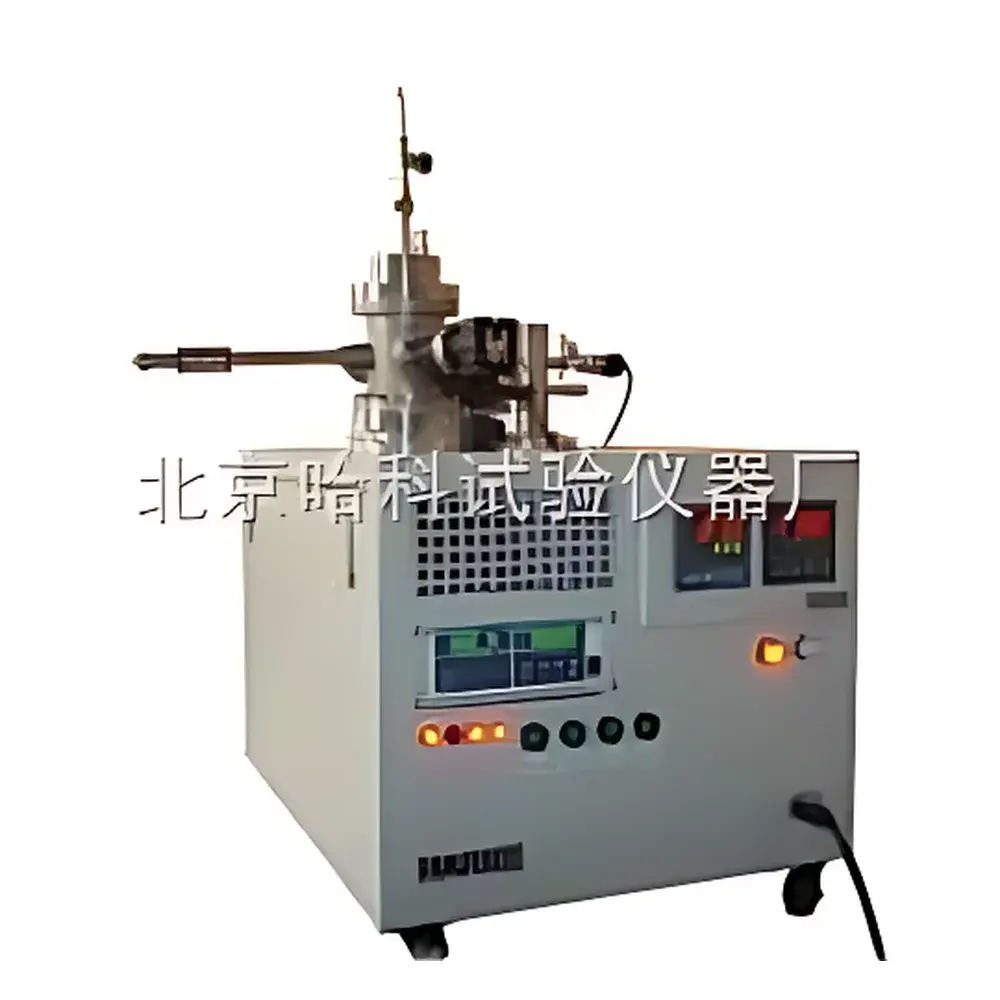
HARKE SPCA-GZ High-Temperature & High-Vacuum Contact Angle Goniometer
| Brand | HARKE |
|---|---|
| Origin | Beijing, China |
| Manufacturer Type | Direct Manufacturer |
| Instrument Category | Domestic |
| Model | SPCA-GZ |
| Instrument Class | High-Temperature Vacuum Contact Angle Goniometer |
| Instrument Form Factor | Benchtop Laboratory System |
| Contact Angle Measurement Range | 0–180° |
| Contact Angle Measurement Accuracy | ±0.1° |
| Sample Stage Dimensions | 1200 × 250 × 300 mm |
| Optical Magnification | 0.7×–4.7× |
| Surface/Interfacial Tension Range | 0–1000 mN/m |
| Surface/Interfacial Tension Accuracy | ±0.01 mN/m |
| Operating Temperature Range | Ambient to 1700 °C |
| Temperature Control Accuracy | ±2 °C |
| Base Vacuum Level (Room Temp) | 6×10⁻⁵ Pa |
| High-Temp Vacuum Level (≤1700 °C) | 6×10⁻³ Pa |
| Heating Zone Length | 100 mm |
| Uniform Temperature Zone Length | >100 mm |
| Maximum Heating Power | >5 kW |
| Furnace Tube Inner Diameter | Ø80 mm |
| Viewing Windows | Dual quartz observation ports (front/rear) |
| Gas Compatibility | Inert atmosphere (Ar, N₂, He) |
| Cooling Method | Axial-flow forced air (no water cooling required) |
| Vacuum Pumping System | Imported Japanese direct-drive rotary vane pump + proprietary aerospace-grade stainless-steel diffusion pump (CAS patented) |
| Vacuum Gauge | Programmable high-precision vacuum meter (Peking University developed) |
| Structural Integration | Monolithic benchtop architecture with castor-mounted base and locking mechanism |
| Imaging System | Digital camera + continuously variable zoom microscope |
| Software | Proprietary contact angle analysis suite with tangent, circle-fit, and θ/2 methods |
Overview
The HARKE SPCA-GZ is a fully integrated benchtop goniometer engineered for quantitative contact angle and surface/interfacial tension characterization under extreme thermal and vacuum conditions. It operates on the optical sessile drop method, utilizing high-resolution digital imaging and rigorous geometric algorithms—including tangent, circle-fitting, and θ/2 approaches—to extract thermodynamically consistent wetting parameters from liquid–solid–vapor interfaces. Unlike ambient-only systems, the SPCA-GZ incorporates a high-temperature furnace capable of sustained operation up to 1700 °C inside an ultra-high-vacuum chamber (6×10⁻⁵ Pa at room temperature; 6×10⁻³ Pa at elevated temperatures), enabling in situ studies of molten metals, ceramic precursors, refractory oxides, and reactive alloys where ambient oxidation or vapor-phase interference would otherwise compromise measurement integrity. Its dual quartz observation windows permit real-time optical monitoring without vacuum interruption, while the monolithic mechanical design—featuring aerospace-grade stainless-steel diffusion pumping components, ISO-standard vacuum fittings, and a compact forced-air cooling system—ensures long-term thermal stability and operational reproducibility across extended experimental cycles.
Key Features
- High-temperature vacuum chamber with continuous operation capability from ambient to 1700 °C and base pressure down to 6×10⁻⁵ Pa
- Aerospace-derived vacuum train: CAS-patented all-stainless-steel diffusion pump coupled with imported Japanese direct-drive rotary vane pump
- Programmable vacuum metrology using Peking University–developed digital vacuum controller with real-time logging and alarm thresholds
- Optical subsystem comprising continuously variable zoom microscope (0.7×–4.7×) and high-frame-rate CMOS camera for dynamic droplet evolution capture
- Integrated inert gas manifold supporting controlled Ar/N₂/He purging and partial-pressure regulation during heating
- Robust furnace assembly featuring Ø80 mm alumina tube, 100 mm active heating zone, >100 mm uniform temperature region, and >5 kW power delivery
- Benchtop monocoque chassis with industrial castors and mechanical locking for lab mobility and positional repeatability
- Proprietary software platform compliant with GLP data handling standards: full audit trail, timestamped image metadata, and export-ready CSV/PDF reporting
Sample Compatibility & Compliance
The SPCA-GZ accommodates solid substrates up to 120 mm in length and 25 mm in thickness within its precisely centered furnace zone. Compatible sample materials include sintered ceramics (Al₂O₃, ZrO₂), refractory metals (Mo, W, Ta), graphite, silicon carbide, and oxide-based composites—provided they maintain structural integrity and surface stability under combined thermal–vacuum stress. The system meets mechanical and electrical safety requirements per IEC 61010-1 and conforms to vacuum component standards specified in ISO 2861 and ASTM E1779 (Standard Guide for Vacuum Systems Used in Materials Testing). While not FDA-certified as a medical device, its software architecture supports 21 CFR Part 11–compliant user authentication, electronic signatures, and immutable data archiving when deployed in regulated QC/QA environments.
Software & Data Management
The embedded HARKE Contact Angle Analysis Suite provides deterministic image processing pipelines calibrated against NIST-traceable reference standards. It implements three independent contact angle calculation models—tangent, circle-fit, and θ/2—with automatic baseline detection, edge smoothing filters, and pixel-scale uncertainty quantification. All measurements are time-stamped and linked to corresponding vacuum pressure, furnace temperature, and gas flow logs. Raw images and processed data are stored in hierarchical folders with SHA-256 checksums; export formats include ASCII tab-delimited files for statistical analysis in MATLAB or Python, as well as annotated PDF reports suitable for internal documentation or regulatory submission. Audit trails record operator ID, session start/end times, parameter modifications, and manual corrections—fully traceable for ISO/IEC 17025 laboratory accreditation.
Applications
- In situ wettability analysis of molten aluminum or titanium alloys on ceramic substrates under controlled vacuum or argon atmosphere
- Thermal evolution studies of contact angle hysteresis in high-entropy oxide coatings during rapid heating/cooling cycles
- Interfacial tension determination of slag–metal systems relevant to metallurgical process optimization
- Surface energy mapping of functionalized carbon nanotube films across temperature-dependent dewetting transitions
- Validation of theoretical Young–Dupré and Cassie–Baxter models under non-ambient thermodynamic conditions
- Quality assurance of high-purity sintered targets used in thin-film deposition processes
FAQ
What vacuum level can the SPCA-GZ achieve at 1700 °C?
At operating temperatures ≤1700 °C, the system maintains a stable base pressure of 6×10⁻³ Pa, verified via continuous monitoring with the programmable high-precision vacuum gauge.
Is the furnace tube replaceable, and what is its typical service life?
Yes—the Ø80 mm high-purity alumina tube is field-replaceable and rated for ≥200 thermal cycles between ambient and 1700 °C under vacuum or inert gas.
Does the system support automated temperature ramping with dwell steps?
Yes—its intelligent PID controller accepts multi-segment ramp/dwell profiles with programmable heating/cooling rates up to 50 °C/min.
Can third-party software interface with the imaging or vacuum subsystems?
The system exposes hardware-level COM port and TCP/IP APIs for custom integration; however, contact angle computation remains exclusive to the validated HARKE software to ensure metrological consistency.
What maintenance intervals are recommended for the diffusion pump and vacuum gauges?
Diffusion pump oil replacement is advised every 12 months or after 2000 hours of cumulative operation; vacuum gauge calibration is recommended annually using certified reference cells.



