
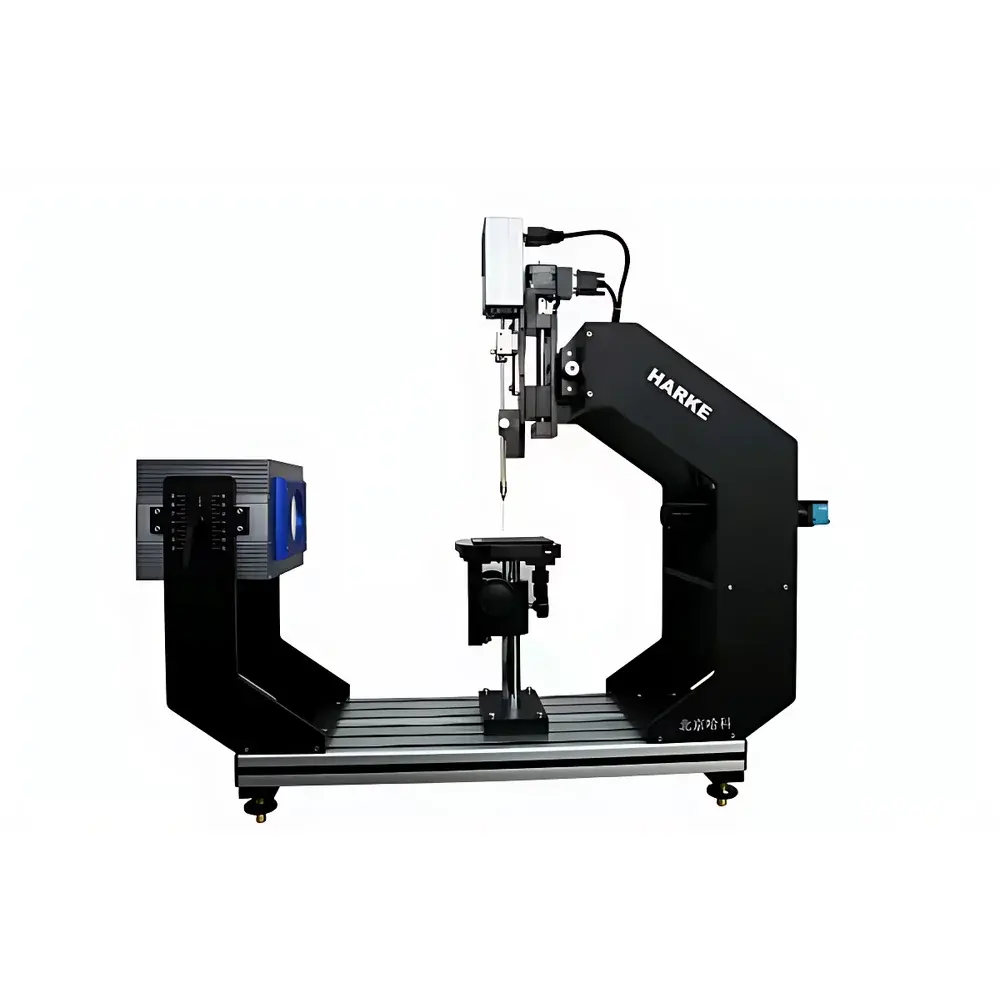
HARKE SPCA-X2 Video-Based Optical Contact Angle Analyzer
| Brand | HARKE |
|---|---|
| Model | SPCA-X2 |
| Type | Benchtop Video Optical Contact Angle Analyzer |
| Contact Angle Range | 0–180° |
| Contact Angle Measurement Accuracy | ±0.1° |
| Contact Angle Display Resolution | ±0.01° |
| Sample Stage Dimensions | 100 mm × 120 mm |
| Optical Magnification | 0.7×–5× (stepped zoom lens) |
| Surface/Interfacial Tension Range | 0–1000 mN/m |
| Surface/Interfacial Tension Resolution | 0.01 mN/m |
| Imaging Speed | Up to 1000 fps (optional) |
| Software | SPCA 1.0 |
| Power Supply | 220 V, 3 A, 50 Hz |
| Weight | 30 kg |
| Footprint | 300 mm × 760 mm |
| Vertical Lens Travel | 30 mm |
| Syringe Translation Stroke | 30 mm |
| XY Stage Positioning Accuracy | ±0.1 mm |
| Measurement Methods | Circle Fitting, Ellipse Fitting, Height-Width Method, and six additional algorithmic models (total of eight) |
Overview
The HARKE SPCA-X2 is a benchtop video-based optical contact angle analyzer engineered for high-precision quantification of solid–liquid interfacial interactions. It operates on the principle of sessile drop analysis using real-time high-resolution imaging and advanced edge-detection algorithms to determine contact angles from digitized drop profiles. The system supports both static and dynamic contact angle measurements—including advancing, receding, rolling, and sliding angles—enabling comprehensive wettability characterization across heterogeneous, anisotropic, or time-dependent surfaces. Designed for rigorous laboratory environments, the SPCA-X2 integrates a calibrated optical train with USB3.0 high-speed imaging (standard 40 fps; optional up to 1000 fps), motorized XYZ positioning, and thermally stable mechanical architecture to ensure measurement repeatability and long-term baseline integrity. Its modular design accommodates diverse sample geometries—from rigid substrates and flexible films to porous media and single fibers—while maintaining compliance with core metrological requirements for surface science instrumentation.
Key Features
- Benchtop form factor with compact footprint (300 mm × 760 mm) and robust aluminum alloy frame for vibration-damped operation
- Stepped magnification optical system (0.7×–5×) featuring fixed-focus telecentric lens assembly for distortion-free imaging across full field-of-view
- Motorized XYZ stage with ±0.1 mm positional accuracy and programmable sample translation for multi-point spatial mapping
- Automated syringe dispensing module with 30 mm vertical stroke and micro-step actuation for precise droplet volume control (0.1–10 µL typical range)
- SPCA 1.0 software platform supporting eight independent contact angle calculation algorithms—including circle, ellipse, height-width, Young–Laplace fitting, and tangent-based methods—to accommodate irregular droplets and non-ideal surface conditions
- Integrated surface/interfacial tension analysis via pendant drop method (0–1000 mN/m range, 0.01 mN/m resolution) compliant with ISO 1409 and ASTM D971 standards
- Real-time video capture at up to 1000 fps (optional upgrade) for kinetic analysis of wetting dynamics, absorption, and spreading behavior
Sample Compatibility & Compliance
The SPCA-X2 accommodates samples up to 120 mm wide × 100 mm deep × 50 mm tall, including rigid plates, polymer films, paperboard, wood veneers, textiles, carbon composites, and powdered compacts (via compressed pellet mounting). Its open-stage architecture permits in situ environmental control integration (e.g., humidity chambers, temperature stages, or gas purging manifolds) for conditional wettability studies. All measurement protocols align with internationally recognized standards: GB/T 24368–2009 (glass surface hydrophobicity assessment), ISO 27448 (photocatalytic surface characterization), and ASTM D7334 (surface energy determination by contact angle). Data acquisition and reporting support audit-ready traceability under GLP and GMP frameworks, with timestamped metadata, user authentication logs, and exportable CSV/PDF reports.
Software & Data Management
SPCA 1.0 is a Windows-native application developed for scientific reproducibility and regulatory readiness. It provides synchronized hardware control, real-time droplet contour detection, and batch processing for time-series contact angle evolution (e.g., CA vs. time curves). The software implements FDA 21 CFR Part 11–compatible electronic signatures, role-based access control, and immutable audit trails for all measurement parameters, image annotations, and calibration events. Export formats include TIFF (raw images), PNG (annotated frames), CSV (numerical datasets), and XML (structured metadata). Optional add-ons enable solid surface free energy calculation using Owens–Wendt, Wu, van Oss–Chaudhury–Good, and Fowkes models, with built-in reference liquid databases (water, diiodomethane, ethylene glycol, formamide).
Applications
The SPCA-X2 serves as a primary analytical tool in R&D and QC laboratories engaged in surface functionalization, coating development, biomaterial interface engineering, and packaging performance validation. Typical use cases include: evaluating plasma-treated polymer surfaces for adhesion promotion; quantifying hydrophobicity of self-cleaning architectural coatings; assessing ink–substrate affinity in flexographic printing; characterizing capillary wicking in filtration membranes; determining critical surface tension of textile finishes; validating cleaning efficacy on medical device substrates; and probing aging-induced hydrophobization in outdoor photovoltaic encapsulants. Its compatibility with dynamic methods (expansion–contraction, tilting, and sliding) makes it suitable for tribological interface studies and microfluidic channel surface optimization.
FAQ
What contact angle measurement methods does the SPCA-X2 support?
It supports eight computational methods: circle fitting, ellipse fitting, height-width, Young–Laplace curve fitting, tangent, axisymmetric drop shape analysis (ADSA), modified spherical cap, and baseline-adjusted polynomial fitting.
Can the system measure surface free energy?
Yes—via optional SPCA 1.0 add-on modules implementing Owens–Wendt, Wu, Fowkes, and van Oss–Chaudhury–Good models using contact angle data from ≥2 probe liquids.
Is the instrument compatible with environmental control accessories?
Yes—the open-stage design allows integration of temperature-controlled stages (–20°C to 120°C), humidity chambers (10–95% RH), and inert gas purge systems for controlled-atmosphere measurements.
Does the software comply with regulatory data integrity requirements?
Yes—SPCA 1.0 includes electronic signature capability, audit trail logging, and user permission management aligned with FDA 21 CFR Part 11 and EU Annex 11 guidelines.
What is the maximum frame rate supported for high-speed dynamic contact angle analysis?
Standard configuration delivers 40 fps; optional high-speed camera modules support 100 fps, 300 fps, 1000 fps, or custom frame rates depending on resolution and lighting configuration.



