
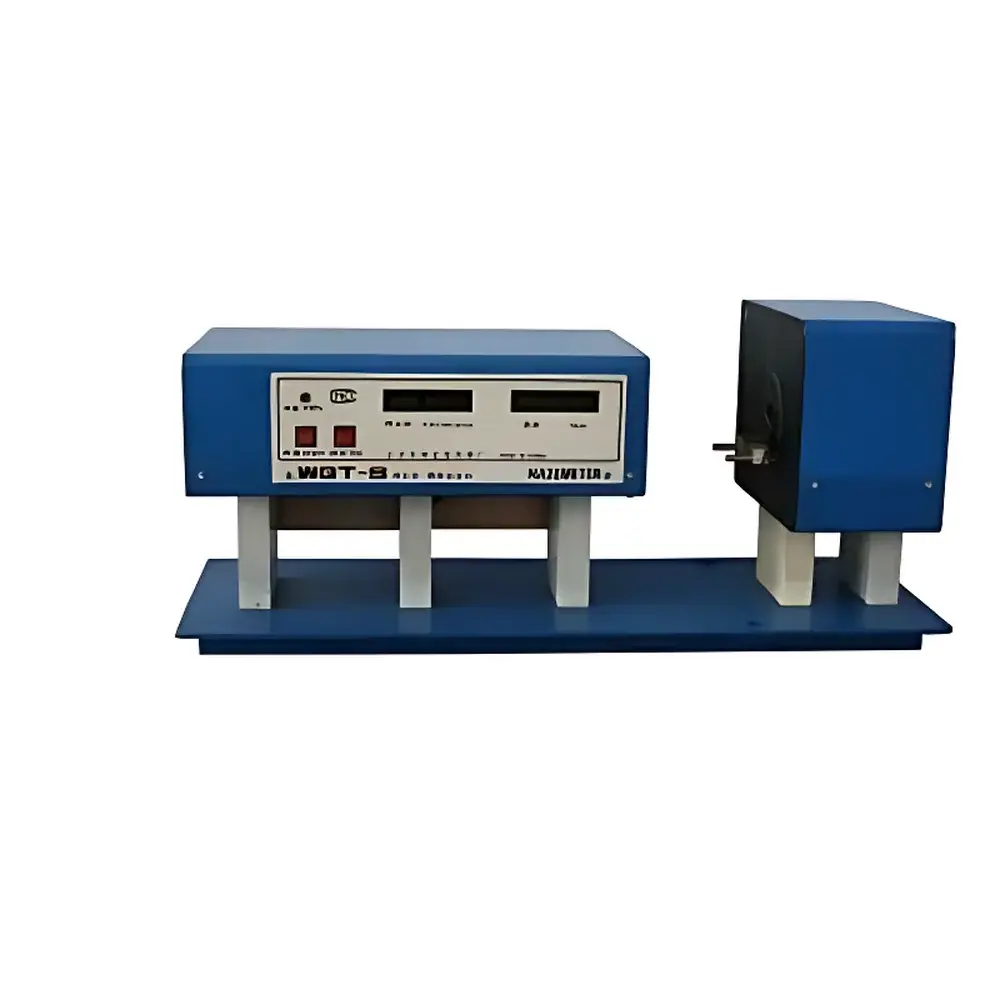
WGT-S Transmittance and Haze Tester
| Origin | Beijing, China |
|---|---|
| Manufacturer Type | Authorized Distributor |
| Origin Category | Domestic (China) |
| Model | WGT-S |
| Pricing | Available Upon Request |
| Measurement Range | Transmittance 0–100.0%, Haze 0–30.00% |
| Accuracy | Transmittance ≤ ±1% |
| Repeatability | Transmittance ±0.5% |
| Minimum Resolution | Transmittance 0.1%, Haze 0.01% |
| Light Source | C-illuminant (12 V DC, 50 W tungsten-halogen lamp + color temperature correction filter) |
| Sample Port Aperture | Incident Ø25 mm, Exit Ø21 mm |
| Detection Geometry | Collimated Illumination / Diffuse Viewing with Integrating Sphere |
| Detector | Silicon Photocell with Photopic Luminosity Correction (V(λ) compliant) |
| Sample Dimensions | 50 mm × 50 mm (films), Standard Calibration Disk: Ø40 mm × 2 mm |
| Instrument Dimensions | 740 mm (L) × 270 mm (W) × 300 mm (H) |
| Net Weight | 21 kg |
| Power Supply | 220 V, 50 Hz |
| Standards Compliance | GB/T 2410–1980, ASTM D1033–61 (Reapproved 1997), JIS K7105–1981 |
Overview
The WGT-S Transmittance and Haze Tester is a precision optical instrument engineered for quantitative evaluation of light transmission characteristics in planar transparent and translucent materials. It operates on the fundamental principles defined in ISO 13468 (plastics – determination of transmittance) and ISO 14782 (plastics – determination of haze), employing collimated illumination coupled with an integrating sphere detection system to separate and quantify direct transmittance and diffuse scatter components. The instrument utilizes a C-illuminant-compliant light source—comprising a stabilized 12 V DC, 50 W tungsten-halogen lamp with integrated color temperature correction—to ensure spectral consistency aligned with the CIE standard illuminant C and the photopic luminosity function V(λ). This configuration enables traceable, repeatable measurements of both transmittance (%T) — defined as the ratio of total transmitted luminous flux to incident luminous flux — and haze (%H) — defined as the ratio of scattered (non-forward-directed) transmitted flux to total transmitted flux. Designed for laboratory and QC environments, the WGT-S supports routine compliance testing against globally recognized material standards including GB/T 2410, ASTM D1033, and JIS K7105.
Key Features
- Microprocessor-controlled measurement cycle with automatic mode switching between transmittance and haze acquisition
- Simultaneous dual-parameter digital display (LED) showing real-time %T and %H values
- Integrated calibration routine with built-in reference disk (Ø40 mm × 2 mm) and automated zero/standard correction sequence
- BCD serial output interface compatible with industry-standard data loggers and label printers
- High-stability silicon photocell detector with V(λ)-matched spectral correction filter for photometric accuracy
- Robust mechanical architecture featuring precision-machined sample stage, fixed-aperture ports (Ø25 mm input / Ø21 mm output), and thermal-stabilized lamp housing
- Continuous measurement mode with on-board statistical processing: mean calculation, auto-reset, and batch averaging over user-defined test sequences
Sample Compatibility & Compliance
The WGT-S accommodates rigid and flexible planar specimens up to 50 mm × 50 mm, including polymer sheets (e.g., PMMA, PC, PET), glass substrates, coated films, and liquid cuvettes (for turbidity assessment of aqueous solutions per USP particulate matter guidance). Its optical geometry conforms to ASTM D1003 Annex A1 (integrating sphere method) and meets the geometric requirements specified in ISO 13468-1 for normal-incidence transmittance. All optical components—including the integrating sphere interior coating, detector alignment, and aperture definition—are factory-aligned and validated against NIST-traceable reference standards. The instrument satisfies functional requirements for GLP-compliant laboratories, supporting audit-ready operation when paired with documented calibration records and maintenance logs per ISO/IEC 17025 clause 6.4.
Software & Data Management
While the WGT-S operates as a standalone benchtop unit with embedded firmware, its BCD serial interface enables seamless integration into centralized QA/QC data ecosystems. When connected to a host PC or industrial PLC, the device transmits ASCII-encoded measurement triplets (timestamp, %T, %H) at configurable intervals. Raw output supports direct import into Excel, LabVIEW, or LIMS platforms without proprietary drivers. For regulated environments, users may implement external timestamping and electronic signature protocols to meet FDA 21 CFR Part 11 requirements for electronic records and signatures. Calibration history, operator ID, and environmental metadata (e.g., ambient temperature/humidity logged externally) can be appended during post-acquisition data annotation to fulfill full ALCOA+ data integrity criteria.
Applications
- Quality control of optical-grade polymers used in displays, lighting diffusers, and automotive glazing
- Development and validation of anti-fog coatings on transparent substrates
- Turbidity screening of pharmaceutical parenterals and beverage formulations (as a proxy for particle load)
- Characterization of recycled plastic flake clarity for sorting and reprocessing optimization
- Research on nanoparticle dispersion homogeneity in polymer matrices via haze correlation analysis
- Conformance verification for medical device packaging transparency per ISO 11607-1 Annex D
FAQ
What standards does the WGT-S comply with?
The instrument implements measurement geometries and calculation methods consistent with GB/T 2410–1980, ASTM D1033–61 (Reapproved 1997), JIS K7105–1981, and aligns with the technical basis of ISO 13468 and ISO 14782.
Can the WGT-S measure liquids?
Yes — when used with standardized quartz or borosilicate cuvettes (not supplied), it quantifies turbidity-related haze in clear liquids such as purified water, saline solutions, and low-viscosity beverages, provided path length and container wall effects are controlled.
Is the C-illuminant source stable over time?
The tungsten-halogen lamp is operated at constant DC voltage with active thermal regulation; typical drift is <0.2% over 2-hour continuous operation, verified during factory calibration and recommended before each shift in high-precision workflows.
How often should calibration be performed?
Daily verification using the included Ø40 mm calibration disk is recommended; full recalibration by an accredited service provider is advised every 12 months or after any impact event or optical component replacement.




