
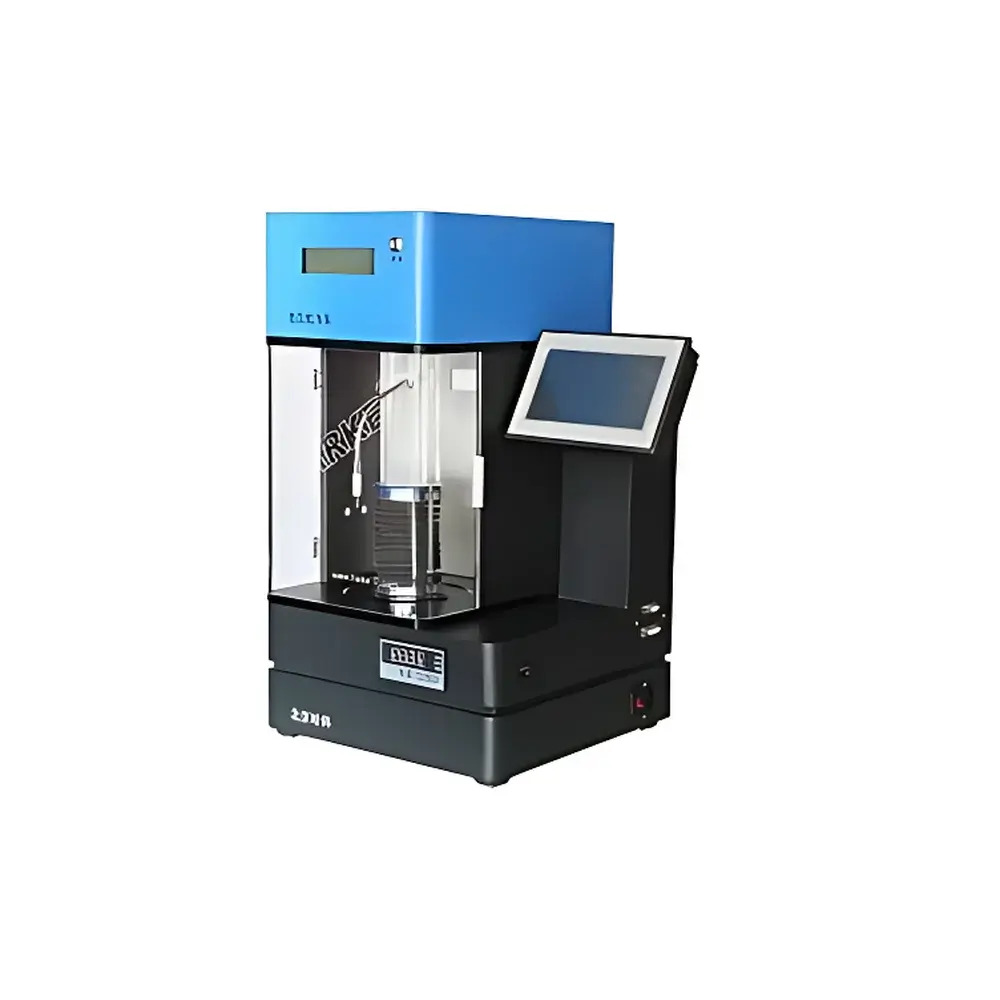
HARKE SFT-A2 Advanced Surface Tensiometer
| Brand | HARKE |
|---|---|
| Model | SFT-A2 |
| Measurement Principle | Wilhelmy Plate Method (ISO 1409, ASTM D971, DIN 53914) |
| Measurement Range | 0–400 mN/m |
| Resolution | ±0.01 mN/m |
| Accuracy | ±0.1 mN/m |
| Temperature Display Range | 0–100 °C |
| Temperature Control Accuracy | ±0.1 °C |
| Sensor Type | Electromagnetic Force Compensation Balance (Full-Scale Capacity: 120 g) |
| Sample Stage Vertical Speed | 0–10 mm/sec |
| Sample Stage Travel Distance | 0–80 mm |
| Stage Positioning Repeatability | ±0.1 mm |
| Sample Vessel Diameter | Φ50 mm |
| Software | SFT-A1 v3.x (GLP-Compliant, Audit Trail Enabled) |
| Dimensions (W×D×H) | 360 × 360 × 620 mm |
| Net Weight | 20 kg |
| Optional Accessories | Peltier-based Heating/Cooling Module, External Circulating Bath Interface, Precision Density Measurement Kit |
Overview
The HARKE SFT-A2 Advanced Surface Tensiometer is an electromagnetically balanced, microprocessor-controlled instrument engineered for high-reproducibility measurement of surface and interfacial tension using the standardized Wilhelmy plate method. Based on the fundamental principle of force equilibrium—where the vertical force exerted on a vertically immersed platinum or stainless steel plate is directly proportional to the surface tension of the liquid—the SFT-A2 delivers traceable, ISO/ASTM-compliant results across diverse liquid systems including aqueous solutions, organic solvents, surfactant formulations, polymer melts, and emulsions. Its core architecture replaces legacy torsion-wire mechanisms with a high-stability electromagnetic force compensation transducer, eliminating mechanical hysteresis, zero-drift, and operator-induced calibration errors common in analog tensiometers. The integrated embedded computing platform ensures deterministic real-time data acquisition without dependency on external PCs, while maintaining full software parity with laboratory-grade desktop environments.
Key Features
- Electromagnetic force compensation sensor with 120 g full-scale capacity and <0.01 mN/m resolution, certified per ISO 9001 calibration protocols
- Dual-display interface: simultaneous real-time visualization of absolute tension value (mN/m) and dynamic force curve during plate immersion/emersion
- Programmable sample stage with precise vertical positioning (±0.1 mm repeatability) and adjustable speed (0–10 mm/sec) for controlled wetting/dewetting kinetics
- Integrated precision mass measurement function (0.1 mg resolution), enabling concurrent density determination via buoyancy correction per ASTM D1475
- Modular thermal management: standard ambient operation with optional Peltier heating/cooling module (–10 to +80 °C) or external circulating bath interface (±0.1 °C stability)
- Wilhelmy plates and rings manufactured from ASTM-certified platinum-iridium alloy (90% Pt / 10% Ir), laser-welded and geometrically validated to ISO 1409 specifications
Sample Compatibility & Compliance
The SFT-A2 supports routine analysis of Newtonian and non-Newtonian liquids, low-surface-tension fluorocarbons (10,000 mPa·s), and multiphase systems such as oil-in-water emulsions. All measurement routines adhere strictly to internationally harmonized standards: surface tension by Wilhelmy plate (ISO 1409:2016, ASTM D971-21), interfacial tension (ISO 6295:2017), and contact angle–derived surface energy (ASTM D7490-22). The instrument’s firmware and SFT-A1 software are designed for GLP/GMP environments, supporting 21 CFR Part 11-compliant electronic signatures, user-access-level permissions, and immutable audit trails for all method parameters, raw force data, and final reports.
Software & Data Management
SFT-A1 v3.x is a native Windows-compatible application developed in accordance with IEC 62304 medical device software standards. It provides method templates for HARKE A3 (static Wilhelmy), A4 (dynamic immersion), and A5 (cycling immersion/drainage) protocols—each preconfigured with default parameters aligned with ISO/ASTM test conditions. Raw force vs. time datasets are stored in HDF5 format with embedded metadata (operator ID, timestamp, temperature, calibration certificate ID). Export options include CSV, PDF (with embedded digital signature), and XML for LIMS integration. Batch processing, statistical outlier detection (Grubbs’ test), and comparative trend analysis across up to 32 samples per session are natively supported.
Applications
- Quality control of surfactants, detergents, and wetting agents in chemical manufacturing
- Formulation development of pharmaceutical emulsions, liposomal drug carriers, and topical suspensions
- Surface energy evaluation of polymer films and coated substrates prior to printing or lamination
- Interfacial rheology screening of crude oil–brine systems in enhanced oil recovery research
- Colloidal stability assessment via critical micelle concentration (CMC) determination
- Density and surface tension co-measurement for thermodynamic modeling of binary mixtures
FAQ
Does the SFT-A2 support interfacial tension measurements between immiscible liquids?
Yes—using dual-liquid sample cells and calibrated Wilhelmy plates, it measures oil–water, polymer–solvent, and molten salt–metal interfaces per ISO 6295.
Can the instrument be validated for regulated pharmaceutical testing?
Yes—SFT-A1 software includes IQ/OQ documentation templates, electronic audit trail export, and 21 CFR Part 11 compliance features required for FDA-submitted analytical methods.
Is calibration traceable to national metrology institutes?
All factory calibrations are performed using NIST-traceable reference standards (e.g., ultra-pure water at 20 °C: 72.75 mN/m; ethanol at 20 °C: 22.39 mN/m), with certificates issued per ISO/IEC 17025.
What maintenance is required for long-term accuracy?
Annual sensor recalibration and quarterly verification with certified reference liquids are recommended; no consumables other than standard platinum plates (included with initial shipment).
How does the built-in density measurement function operate?
It applies Archimedean buoyancy correction using the same electromagnetic balance—measuring apparent mass loss of a calibrated sinker in air vs. liquid to compute density per ASTM D1475-21.



