
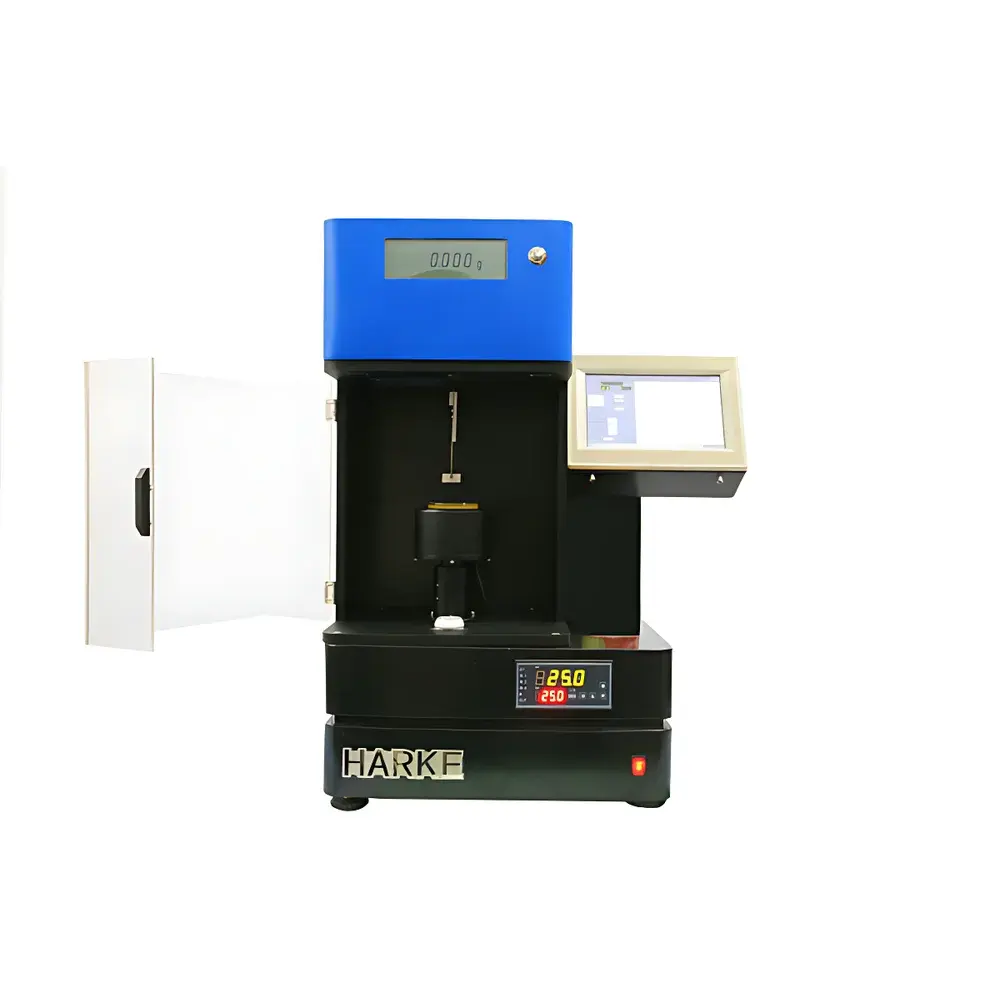
HARKE HK-SFT-A3 Ring Method Surface Tensiometer
| Brand | HARKE |
|---|---|
| Origin | Beijing, China |
| Manufacturer Type | Direct Manufacturer |
| Country of Origin | China |
| Model | HK-SFT-A3 |
| Measurement Range | 0–200.0 mN/m |
| Resolution | 0.1 mN/m |
| Accuracy | ≤ ±1% FS |
| Repeatability | ≤ ±1% |
| Temperature Display Range | 0–99.99 °C |
| Temperature Display Accuracy | ±0.01 °C |
| Measurement Method | Du Noüy Ring Method |
| Power Supply | AC 220 V, 50 Hz |
| Dimensions | 300 × 300 × 400 mm (W × D × H) |
| Control System | 32-bit ARM microcontroller |
| A/D Converter | 24-bit |
| Sensor Type | LVDT displacement transducer |
| Force Transmission | Precision torque-wire lever mechanism |
| Display | Dual-zone digital LCD (real-time force + final result) |
Overview
The HARKE HK-SFT-A3 Ring Method Surface Tensiometer is a precision instrument engineered for the quantitative determination of surface tension and interfacial tension of liquids using the classical Du Noüy ring method. Based on the principle of measuring the maximum pull force required to detach a platinum-iridium ring from the liquid–air or liquid–liquid interface, the system applies well-established capillary force physics governed by the Harkins–Jordan correction model. Designed in accordance with SY/T 5370—*Methods for Determination of Surface and Interfacial Tension*—and aligned with international practices referenced in ASTM D971 and ISO 6295, the HK-SFT-A3 delivers traceable, reproducible measurements across research laboratories, quality control environments, and formulation development units. Its robust mechanical architecture—including a vibration-isolated direct-drive lifting stage and optimized torque-wire lever geometry—ensures minimal hysteresis and high linearity over the full 0–200.0 mN/m range.
Key Features
- Patented dual-standard calibration protocol: Eliminates reliance on gravitational mass correction; instead employs two certified reference liquids (e.g., ultra-pure water and diethylene glycol) to dynamically compensate for ring deformation or surface contamination—extending platinum ring service life without sacrificing accuracy.
- High-fidelity signal chain: 24-bit analog-to-digital conversion paired with proprietary digital filtering algorithms ensures stable real-time force acquisition and suppresses low-frequency noise common in tensiometric measurements.
- LVDT-based displacement sensing: Provides superior linearity (<0.05% FS), thermal stability, and impedance-matched output—critical for maintaining repeatability across temperature gradients and extended operation cycles.
- Automated endpoint detection: Programmable auto-stop functionality halts vertical stage motion precisely at the detachment point, reducing operator dependency and minimizing overshoot-induced measurement drift.
- Dual-zone LCD interface: Simultaneously displays real-time force profile and statistically processed result (mean ± SD), enabling immediate visual verification of measurement integrity.
- Integrated averaging function: Supports up to 10 consecutive tests with automatic arithmetic mean calculation and standard deviation reporting—fully compliant with GLP documentation requirements for raw data traceability.
Sample Compatibility & Compliance
The HK-SFT-A3 accommodates aqueous solutions, organic solvents, polymer melts, surfactant formulations, crude oil–water systems, and emulsions within standard laboratory temperature ranges (0–99.99 °C). All wetted parts—including the platinum-iridium ring (diameter 19.5 mm, wire diameter 0.3 mm) and sample stage—are chemically inert and compatible with ISO 8504-2 cleaning protocols. Instrument design adheres to IEC 61010-1 safety standards for electrical equipment used in laboratory environments. Data output formats support audit-ready export (CSV/Excel) for integration into LIMS or electronic lab notebooks. While not FDA 21 CFR Part 11–certified out-of-the-box, the system’s deterministic firmware architecture and immutable test log generation facilitate validation under GMP/GLP frameworks when deployed with controlled access and change management procedures.
Software & Data Management
The HK-SFT-A3 operates autonomously via embedded firmware—no external PC is required for basic operation. Internal memory stores ≥500 test records with timestamp, ambient temperature, operator ID (user-defined), and statistical summary. Optional USB data export enables post-acquisition analysis in third-party platforms (e.g., OriginLab, MATLAB). Firmware supports field-upgradable calibration coefficients and user-configurable averaging parameters. All measurement events—including calibration steps, manual overrides, and auto-stop triggers—are logged with millisecond-resolution timestamps, satisfying minimum ALCOA+ data integrity criteria for regulated environments.
Applications
- Surfactant efficacy screening in detergent, agrochemical, and pharmaceutical formulation labs
- Crude oil–brine interfacial tension profiling for enhanced oil recovery (EOR) studies
- Quality assurance of coating resins, ink vehicles, and adhesive precursors
- Stability assessment of nanoemulsions and Pickering systems
- Educational demonstration of Young–Laplace equation derivation and contact angle correlations
- Method transfer validation between QC labs operating ASTM D1331 or ISO 4789 protocols
FAQ
What reference standards are recommended for daily calibration?
Ultra-pure water (surface tension = 72.75 mN/m at 20 °C) and diethylene glycol (surface tension = 47.7 mN/m at 20 °C) are the primary dual-point standards specified in SY/T 5370.
Can the instrument measure interfacial tension between two immiscible liquids?
Yes—provided the lower-density phase forms a stable upper layer and the ring is fully immersed in the interface prior to detachment; density contrast ≥0.2 g/cm³ is recommended for reliable meniscus formation.
Is temperature control integrated into the base unit?
No—the HK-SFT-A3 includes a high-resolution digital thermometer (±0.01 °C) but requires an external thermostatted bath or Peltier stage for active temperature regulation.
How often should the platinum ring be cleaned?
Before each measurement series involving new chemical families; use chromic acid solution followed by ultrasonic rinsing in acetone and deionized water—validated by consistent water calibration results across three consecutive runs.
Does the system support GLP-compliant electronic signatures?
Not natively; however, exported CSV logs contain all metadata required for manual signature attribution during QA review—compatible with validated PDF-reporting workflows.



