
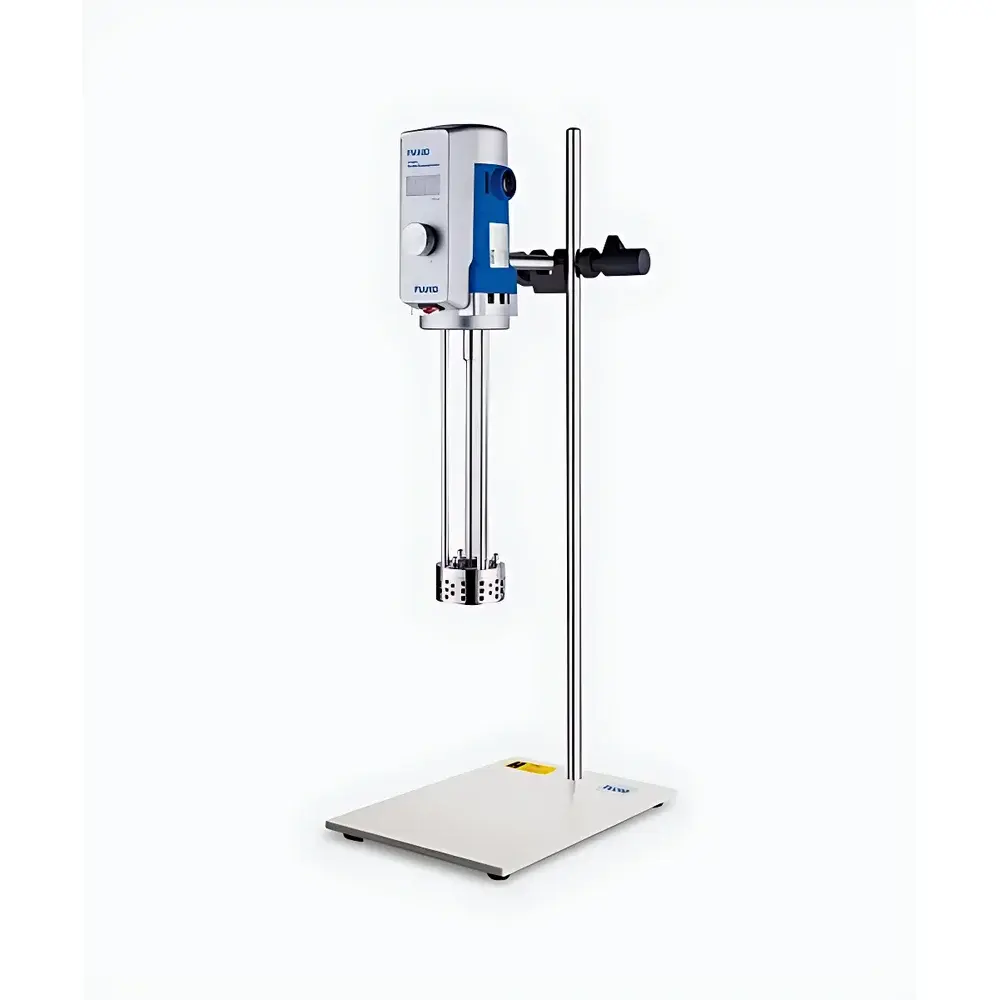
FLUKO FM30D Digital High-Shear Dispersing Emulsifier
| Brand | FLUKO |
|---|---|
| Origin | Germany |
| Model | FM30D |
| Power | 500 W |
| Voltage/Frequency | 220 V, 50 Hz |
| Processing Volume (H₂O) | 200–10,000 mL |
| Max. Viscosity | 5,000 cP |
| Speed Range | 2,000–14,000 rpm |
| Speed Display | Digital LED |
| Speed Control | Continuously Variable |
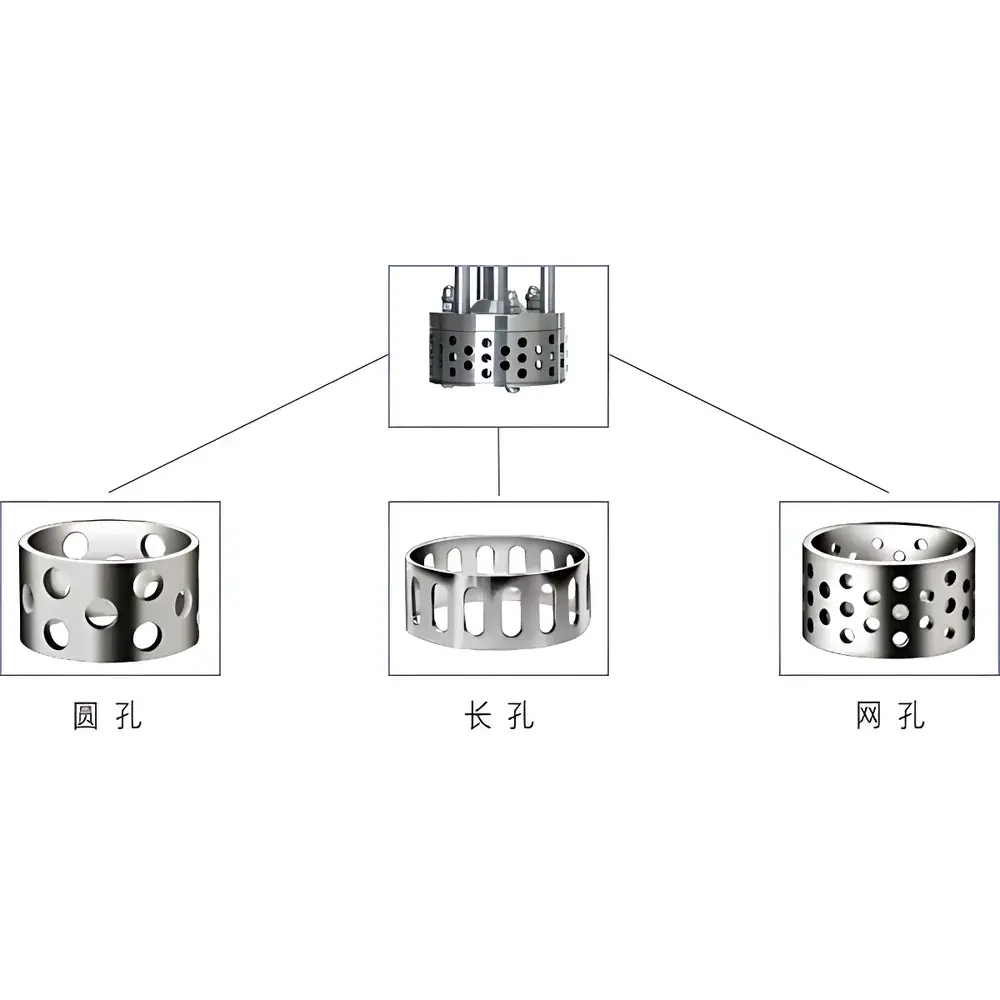
| Rotor-Stator Configuration | Dual-stator design |
| Standard Stator Type | Round-hole |
| Optional Stator Types | Slit-type, Mesh-type |
| Wetted Materials | AISI 304 Stainless Steel |
| Shaft Sleeve Material | Copper Alloy |
| Ambient Operating Temperature | 5–40 °C |
| Max. Relative Humidity | ≤80% |
| Operation Mode | Batch |
| Footprint (W×D×H) | 360 × 260 × 760 mm |
| Weight | ~10 kg |
Overview
The FLUKO FM30D is a digitally controlled, high-shear dispersing emulsifier engineered for precision batch processing in research laboratories, quality control environments, and pilot-scale formulation development. Based on the Couette–Taylor shear principle, the FM30D generates intense hydrodynamic cavitation and turbulent flow through close-tolerance rotor–stator interaction—enabling efficient particle size reduction, droplet breakup, and homogeneous phase dispersion in liquid–liquid and solid–liquid systems. Its dual-stator architecture multiplies effective shear zones without increasing rotational speed, delivering consistent energy input across variable viscosities up to 5,000 cP. Designed for reproducible operation under GLP-compliant workflows, the FM30D supports method transfer from lab to pilot scale while maintaining traceable process parameters.
Key Features
- Dual-stator configuration with interchangeable heads (round-hole, slit-type, and mesh-type) to optimize shear intensity, throughput, and particle/droplet distribution for specific formulations.
- Digitally displayed, continuously variable speed control (2,000–14,000 rpm) with ±50 rpm repeatability—ensuring precise replication of shear history during method validation.
- High-torque 500 W motor with thermal overload protection and mechanical safety interlock, preventing unintended startup during maintenance or stator exchange.
- Wetted parts constructed from AISI 304 stainless steel—certified per ASTM A276 and compliant with FDA 21 CFR Part 11 requirements when integrated with validated software platforms.
- Integrated support frame and heavy-duty base provide vibration-damped stability during extended operation at elevated speeds and viscosities.
- Compact footprint (360 × 260 × 760 mm) and lightweight design (~10 kg) facilitate integration into fume hoods, biosafety cabinets, or modular lab benches without structural reinforcement.
Sample Compatibility & Compliance
The FM30D accommodates aqueous, organic, and semi-polar media—including suspensions containing up to 40 wt% solids (e.g., pigment dispersions, ceramic slurries, pharmaceutical nanosuspensions) and oil-in-water/water-in-oil emulsions (e.g., cosmetic creams, agrochemical concentrates). It complies with IEC 61000-6-2 (immunity) and IEC 61000-6-4 (emission) standards for laboratory electromagnetic compatibility. All electrical components meet CE marking requirements under the Low Voltage Directive (2014/35/EU) and EMC Directive (2014/30/EU). For regulated environments, the instrument supports audit-trail-capable data logging when paired with FLUKO’s optional LabView-based acquisition module—fully aligned with ALCOA+ data integrity principles.
Software & Data Management
While the FM30D operates as a standalone unit with local digital readout, it is compatible with third-party SCADA and LIMS interfaces via analog 0–10 V output (speed signal) and digital TTL trigger ports. When connected to FLUKO’s optional FM-Link software (v3.2+), users gain access to time-stamped RPM logging, stator usage tracking, and exportable CSV reports compliant with 21 CFR Part 11 Annex 11 expectations. The software enforces role-based access control, electronic signatures, and immutable record retention—meeting core GMP documentation requirements for formulation development dossiers submitted to EMA or USFDA.
Applications
- Pharmaceutical: Preparation of nanoemulsions for oral delivery, wet-milling of API suspensions, and homogenization of lipid-based drug delivery systems (LBDDS).
- Materials Science: Exfoliation of graphene oxide dispersions, stabilization of quantum dot colloids, and deagglomeration of nanoparticle slurries for inkjet printing.
- Food & Beverage: Development of plant-based dairy alternatives, viscosity-controlled flavor emulsions, and cold-process protein isolates without thermal degradation.
- Coatings & Inks: Pigment dispersion in acrylic and polyurethane resins, rheology modifier activation, and stable conductive carbon black suspensions.
- Adhesives & Sealants: Incorporation of fillers (CaCO₃, silica, clay) into silicone and epoxy matrices with minimized air entrapment.
FAQ
What stator types are included with the FM30D, and how do they affect processing outcomes?
The FM30D ships standard with a round-hole stator optimized for general-purpose emulsification and dispersion. Slit-type stators enhance elongational stress for fibrillar materials (e.g., cellulose nanocrystals), while mesh-type stators maximize surface-area contact for high-viscosity pastes.
Is the FM30D suitable for sterile processing or cleanroom environments?
Yes—the AISI 304 wetted path and smooth, crevice-free stator geometry support SIP-compatible cleaning protocols; however, full autoclaving requires disassembly and separate validation per ISO 13408-1.
Can the FM30D be integrated into automated workflow systems?
Yes—via 0–10 V analog output and TTL trigger signals, enabling synchronization with peristaltic pumps, temperature controllers, or PLC-driven reaction stations.
Does FLUKO provide IQ/OQ documentation packages for GMP installations?
Yes—validated installation and operational qualification templates (aligned with ASTM E2500 and EU GMP Annex 15) are available upon request for qualified purchasers.
What is the recommended maintenance interval for the copper alloy shaft sleeve?
Under normal use (≤4 hrs/day, ≤5,000 cP media), inspection is advised every 500 operating hours; replacement is typically required after 2,000–3,000 hours depending on abrasive load and cooling conditions.



