
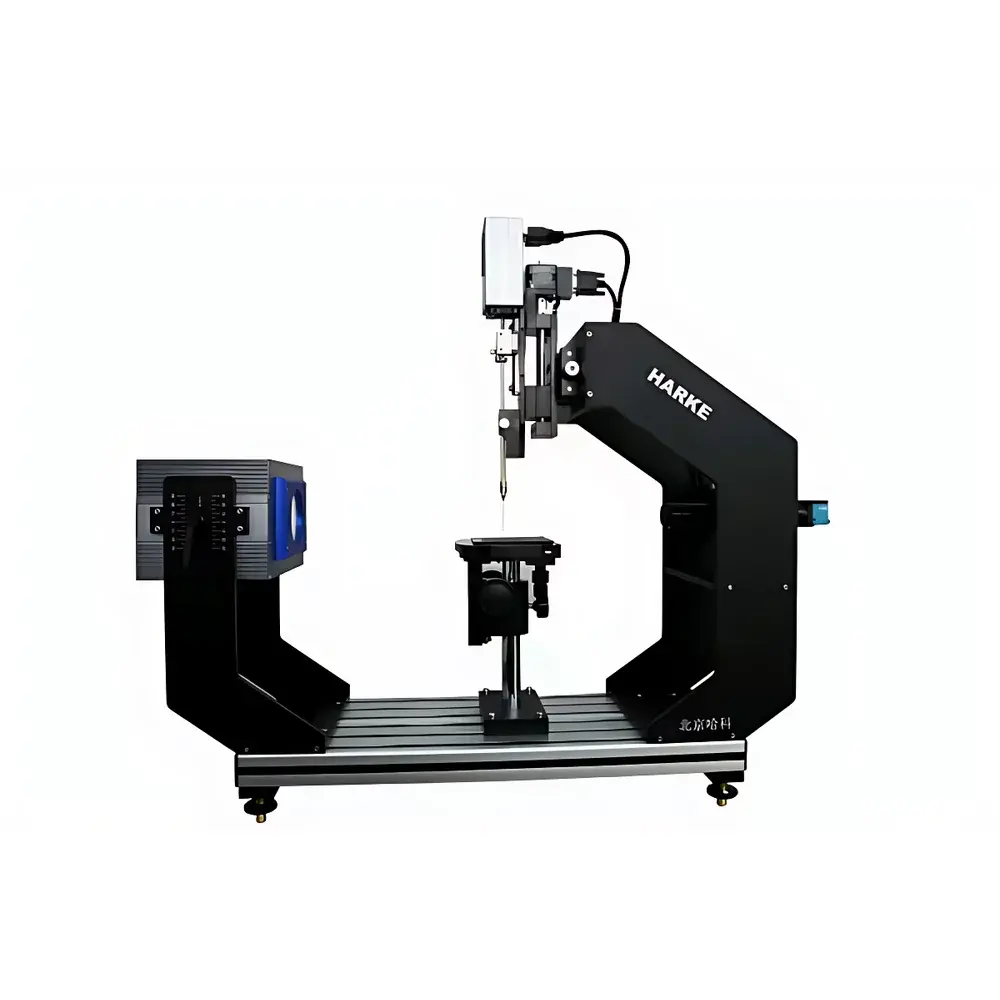
HARKE HARKE-SPCA-X Video-Based Contact Angle Goniometer for Wafer-Specific Surface Analysis
| Brand | HARKE |
|---|---|
| Origin | Beijing, China |
| Manufacturer Type | Direct Manufacturer |
| Instrument Category | Domestic |
| Model | HARKE-SPCA-X |
| Pricing | Upon Request |
| Instrument Class | Video Optical Contact Angle Meter |
| Form Factor | Benchtop Laboratory System |
| Contact Angle Measurement Range | 0–180° |
| Contact Angle Accuracy | ±0.1° |
| Fixed Sample Stage Dimensions | 100 mm × 120 mm |
| Optical Magnification | 0.7×–4.5× |
| Surface/Interfacial Tension Range | 0–1000 mN/m |
| Surface/Interfacial Tension Resolution | 0.01 mN/m |
Overview
The HARKE HARKE-SPCA-X is a precision-engineered video-based contact angle goniometer specifically optimized for flat, rigid substrates—including silicon wafers, glass slides, thin-film coated plates, and polished metal coupons—where uniform geometry, edge-free surface definition, and minimal sample warpage are critical. It operates on the principle of sessile drop analysis using high-resolution optical imaging and automated contour detection algorithms to quantify the equilibrium contact angle formed between a precisely dispensed liquid droplet and a solid surface. The instrument employs a calibrated syringe-based dispensing system with sub-microliter volume control, enabling reproducible deposition under ambient or controlled environmental conditions. Designed for rigorous surface science workflows, the HARKE-SPCA-X supports both static and dynamic (advancing/receding) contact angle measurements, as well as interfacial tension determination via pendant drop analysis—making it suitable for characterizing hydrophobicity, surface heterogeneity, coating uniformity, and plasma treatment efficacy in semiconductor fabrication, MEMS packaging, and advanced display manufacturing.
Key Features
- Benchtop modular architecture with vibration-damped aluminum frame and motorized Z-axis lens positioning (30 mm travel, ±0.1 mm repeatability)
- Dedicated wafer-compatible stage design accommodating standard 100 mm × 120 mm planar samples; optional vacuum chuck or thermal stage integration available
- High-fidelity optical train featuring a parfocal zoom lens (0.7×–4.5× magnification) with fixed focus calibration and integrated LED backlighting for optimal contrast
- USB 3.0 monochrome CMOS camera (1920 × 1080 resolution) capable of up to 1000 fps acquisition for dynamic wetting kinetics studies
- Software-controlled microdispensing unit with PTFE-coated stainless steel needle, 0.1 µL minimum step resolution, and programmable deposition speed profiles
- Eight built-in contact angle calculation algorithms—including Circle Fit, Ellipse Fit, Young–Laplace Fitting, and Baseline-Independent Tangent methods—to accommodate asymmetric, distorted, or low-contrast droplets
- Integrated surface energy module supporting Owens–Wendt, Wu, Fowkes, and van Oss–Chaudhury–Good models using user-defined reference liquids
Sample Compatibility & Compliance
The HARKE-SPCA-X is validated for use with rigid, non-porous planar substrates up to 5 mm thickness and 120 mm width. It accommodates standard 100 mm × 100 mm and 150 mm × 150 mm wafers when mounted on custom fixtures. Fibrous, porous, or highly textured materials require compression or hot-pressing into flat pellets prior to measurement. All hardware and firmware comply with IEC 61000-4 electromagnetic compatibility standards. Measurement traceability aligns with ISO 19403-2 (contact angle) and ISO 19403-4 (surface free energy), and data integrity meets GLP audit requirements through timestamped metadata logging, user-access controls, and full audit trail export in CSV/XML format. Optional FDA 21 CFR Part 11 compliance package includes electronic signatures, role-based permissions, and immutable raw image archiving.
Software & Data Management
The SPCA 1.0 software suite runs natively on Windows 10/11 (64-bit) and provides real-time droplet capture, multi-frame sequence analysis, and batch processing for up to 99 samples per session. Each measurement record stores original TIFF images, annotated contours, fitted parameters, environmental metadata (temperature, humidity), and operator ID. Export options include PDF reports with embedded graphs, Excel-compatible .csv tables, and structured XML for LIMS integration. Advanced features include automated baseline correction for tilted substrates, dynamic contact angle hysteresis tracking over time-series sequences, and interfacial tension calculation from pendant drop profiles using Axisymmetric Drop Shape Analysis (ADSA). Software updates are delivered via secure HTTPS portal with version-controlled release notes and validation documentation.
Applications
- Semiconductor process development: quantifying hydrophobic recovery after UV/ozone cleaning, HMDS priming efficiency, and photoresist wettability
- Thin-film coating QC: evaluating uniformity of anti-reflective, hydrophobic, or oleophobic layers on display glass and sensor substrates
- MEMS packaging: assessing adhesion promoter coverage on ceramic and silicon nitride surfaces prior to die bonding
- Biomedical device R&D: characterizing surface modification stability of implant-grade metals and polymers exposed to simulated body fluid
- Advanced battery research: mapping electrolyte wettability across separator membranes and electrode coatings under inert atmosphere
- Quality assurance in optical component manufacturing: verifying cleanliness and surface activation prior to AR coating deposition
FAQ
What sample geometries are supported?
The HARKE-SPCA-X is designed for flat, rigid substrates only. Curved, flexible, or irregularly shaped samples require custom mounting solutions and may compromise measurement accuracy.
Can it measure advancing and receding contact angles?
Yes—via automated sequential dispensing and retraction cycles with programmable volume increments and dwell times.
Is temperature or humidity control available?
Ambient operation is standard; optional environmental chamber integration (−10 °C to 80 °C, 10–95% RH non-condensing) is available upon request.
How is calibration performed?
Geometric calibration uses certified glass stage rulers and spherical calibration beads; contact angle verification employs NIST-traceable standard surfaces (e.g., PTFE, silica, gold) with certified θ values.
Does the system support ASTM D7334 or ISO 15989?
Yes—the instrument’s measurement methodology, software reporting structure, and uncertainty budgeting fully conform to both standards for surface energy evaluation and coating wettability assessment.



