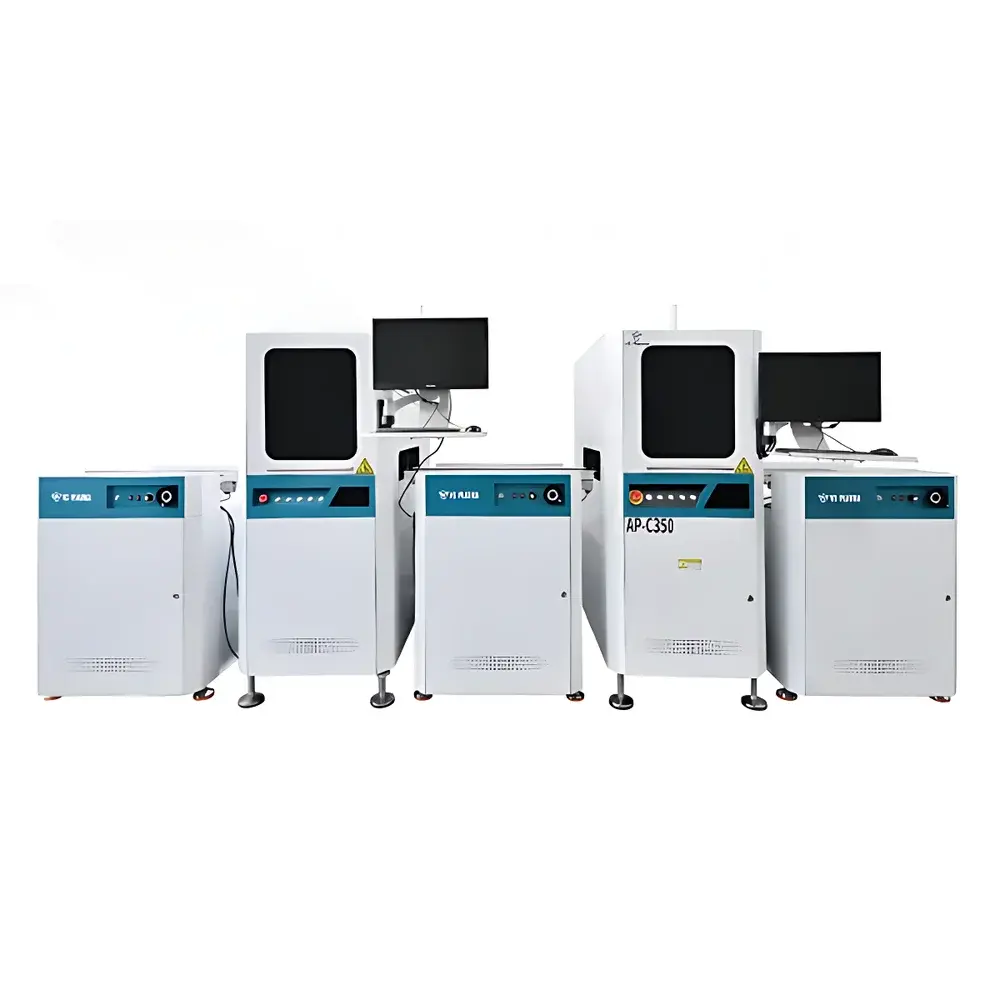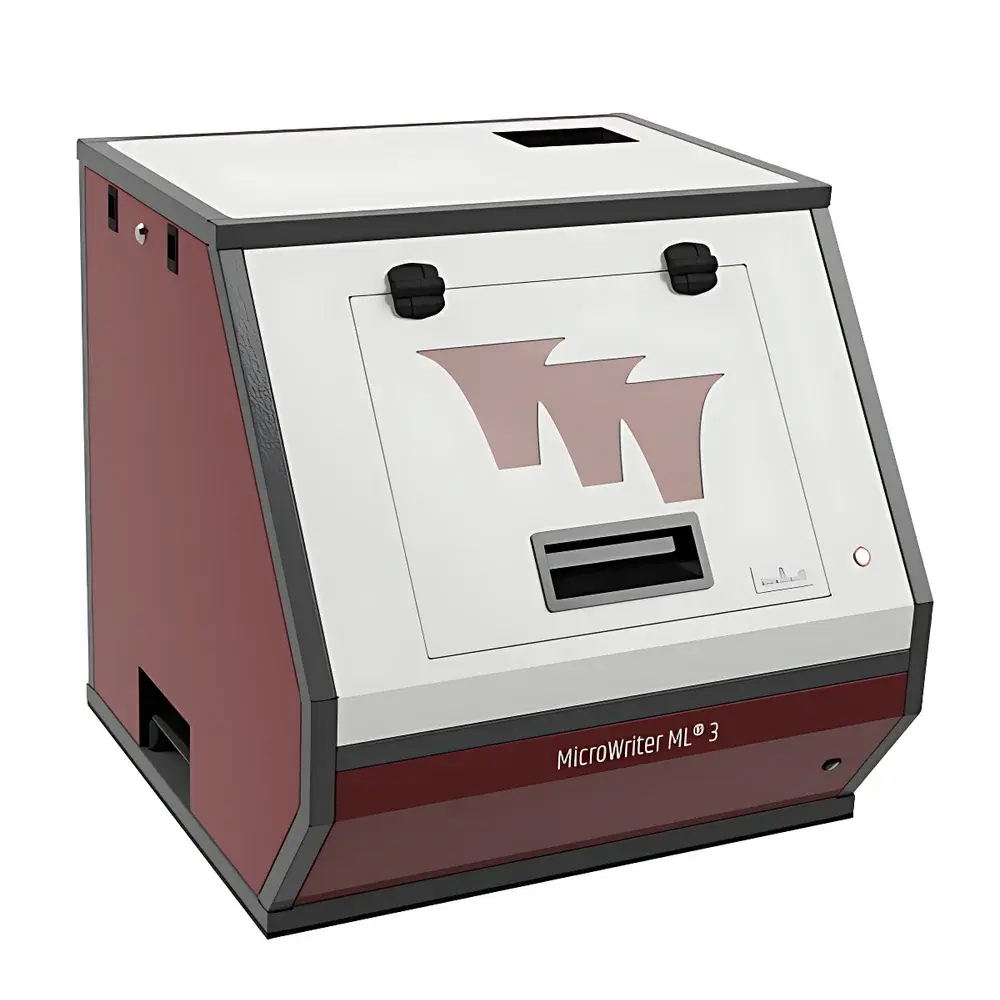
Durham Magneto Optics MicroWriter ML3 Desktop Maskless Direct-Write Lithography System
| Brand | Durham Magneto Optics |
|---|---|
| Origin | United Kingdom |
| Model | MicroWriter ML3 |
| Exposure Mode | Projection-Based |
| Resolution Options | 0.6 µm, 1 µm, 2 µm, 5 µm |
| Light Source | LED |
| Wavelengths | 385 nm and 405 nm |
| Maximum Exposure Area | 195 mm × 195 mm |
| Dimensions | 700 mm × 700 mm × 700 mm |
| Software Platform | Windows 10-native MicroWriter Control Suite with Clewin GDS/DXF Import |
| Alignment Microscope | Motorized Zoom (×3/×5/×10/×20), Auto-Switching |
| Overlay Accuracy | ±0.5 µm (Flagship Configuration) |
| Z-Axis Positioning Resolution | 50 nm |
| Optical Profilometry Vertical Resolution | 100 nm |
| Grayscale Lithography Support | 255-level intensity modulation |
| Stage Minimum Step Size | 50 nm |
| Auto-Focus | Real-time FocusLock™ Surface Height Mapping and Z-Compensation |
Overview
The Durham Magneto Optics MicroWriter ML3 is a compact, benchtop maskless direct-write lithography system engineered for high-precision microfabrication in academic, R&D, and pilot-line environments. Unlike conventional photolithography tools reliant on physical chrome-on-glass masks, the MicroWriter ML3 employs digital micromirror device (DMD)-based projection lithography to render pattern data directly onto photoresist-coated substrates—eliminating mask fabrication lead times, cost overheads, and design iteration bottlenecks. Its core optical architecture utilizes collimated 385 nm or 405 nm LED illumination, coupled with high-numerical-aperture projection optics, enabling diffraction-limited resolution down to 0.6 µm at full-field exposure. The system operates on the principle of spatial light modulation: CAD-defined layouts are converted into binary or grayscale bitmaps, then dynamically projected via a Texas Instruments DMD chip synchronized with precision XYZ stage motion. This approach delivers deterministic patterning fidelity without mechanical mask alignment, making it especially suited for rapid prototyping of microfluidic devices, surface acoustic wave (SAW) transducers, spintronic test structures, MEMS sensors, and low-volume semiconductor process development.
Key Features
- FocusLock™ real-time autofocus: Uses integrated optical feedback to map substrate topography and dynamically adjust Z-position during exposure—ensuring consistent focus across non-planar or warped wafers up to 15 mm thick.
- Motorized multi-magnification alignment microscope (×3/×5/×10/×20): Enables fast coarse-to-fine registration and automated bullseye mark detection for multi-layer overlay.
- Optical profilometry module (100 nm vertical resolution): Integrated non-contact surface profiling for post-spin, pre-etch, or post-etch metrology—supporting quantitative step-height measurement and layer-thickness verification.
- Grayscale lithography capability: Full 255-level intensity control permits analog dose modulation—enabling fabrication of 3D microstructures, Fresnel lenses, and graded-index waveguides in SU-8 and other tone-reversal resists.
- Modular hardware configuration: Three tiers (Base, Enhanced, Flagship) allow scalable investment—covering substrate sizes from 155 × 155 mm to 230 × 230 mm, and extending Z-resolution, stage repeatability, and environmental stability (e.g., pneumatic isolation, temperature-controlled chamber).
- Windows-native software stack: MicroWriter Control Suite provides guided workflow navigation—from substrate loading and fiducial recognition to exposure parameter definition and job queuing—while Clewin imports industry-standard layout formats including GDSII, CIF, DXF, and raster images (TIFF/BMP).
Sample Compatibility & Compliance
The MicroWriter ML3 accommodates rigid substrates up to 230 mm × 230 mm × 15 mm (Flagship model), including silicon wafers (up to 6-inch), fused silica, glass slides, quartz, and polymer films. It supports standard positive and negative photoresists (e.g., AZ series, SU-8, ma-N, PMMA) and is compatible with common spin-coating, soft-bake, and development protocols. All exposure parameters—including dose, dwell time, and grayscale mapping—are fully traceable and exportable in CSV/JSON format. The system’s software architecture complies with GLP documentation requirements, supporting user access control, audit trails, and electronic signature functionality per FDA 21 CFR Part 11 when deployed in regulated QC/QA environments. While not certified to ISO 13485 or IEC 61000-4-x out-of-the-box, its modular design permits integration into ISO Class 5–7 cleanroom workflows and supports validation documentation packages upon request.
Software & Data Management
MicroWriter Control Suite runs natively on Windows 10 (64-bit) and features a role-based interface with configurable user permissions. Layout import, alignment point definition, exposure grid tiling, and dose calibration are managed through a tabbed workflow engine. All exposure logs—including timestamp, stage coordinates, lamp intensity, DMD frame count, and focus error signal—are automatically archived with SHA-256 checksums. Export options include PDF reports, XML metadata schemas, and SQLite databases for LIMS integration. Clewin layout editor supports boolean operations, hierarchy flattening, and hierarchical GDSII export—enabling seamless handoff to foundry mask shops if transition to volume manufacturing becomes necessary. No cloud connectivity or telemetry is enabled by default; all data remains local unless explicitly configured for networked storage.
Applications
- Microfluidic device prototyping: Rapid iteration of channel networks, mixers, valves, and droplet generators with sub-micron feature fidelity.
- Surface acoustic wave (SAW) and piezoelectric sensor development: Precise interdigitated transducer (IDT) patterning with <1 µm linewidth control and tight pitch uniformity.
- Spintronics and 2D material device fabrication: Low-damage, resist-compatible patterning for Hall bar geometries, tunnel junctions, and gate stacks.
- MEMS structural definition: High-aspect-ratio SU-8 molding masters, release hole arrays, and comb-drive electrode patterns.
- Educational microfabrication labs: Self-contained, safe (LED-based, no mercury lamps or deep-UV hazards), and operationally intuitive platform for teaching lithographic fundamentals.
FAQ
What file formats does the MicroWriter ML3 accept for pattern data?
GDSII, CIF, DXF, SVG, TIFF, BMP, and PNG—via native Clewin import or third-party conversion utilities.
Is vacuum chucking or backside alignment supported?
Standard configuration includes mechanical clamping; vacuum chuck and infrared backside alignment are optional upgrades for thin/flexible substrates.
Can the system perform proximity printing or contact printing?
No—the MicroWriter ML3 is strictly a projection-based maskless writer; it does not support physical mask contact or gap-mode exposure.
What is the typical maintenance schedule for the LED light source?
The 385 nm and 405 nm LEDs have rated lifetimes exceeding 10,000 hours; output intensity is monitored in real time and logged for preventive recalibration.
How is overlay accuracy verified between layers?
Using calibrated crosshair fiducials and the integrated optical profilometer, overlay error is quantified via post-exposure SEM or optical microscopy with NIST-traceable standards.