
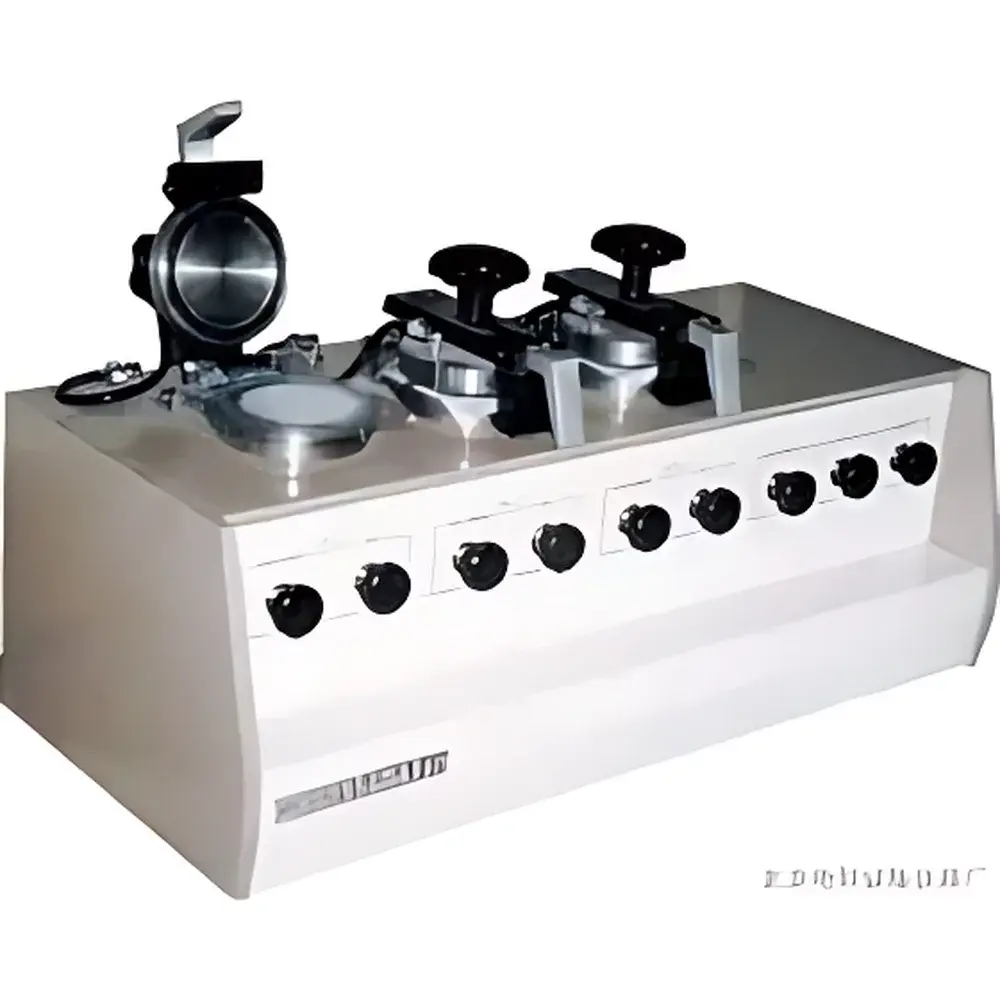
HARKE HK-V3 Differential Pressure Gas Permeability Tester
| Brand | HARKE |
|---|---|
| Origin | Beijing, China |
| Manufacturer | Yes |
| Domestic Product | Yes |
| Model | HK-V3 |
| Pricing | Upon Request |
Overview
The HARKE HK-V3 Differential Pressure Gas Permeability Tester is an engineered solution for precise measurement of gas transmission rates (GTR) through polymeric and composite barrier materials. It operates on the well-established differential pressure (manometric) principle defined in ISO 15105-1, ISO 2556, ASTM D1434, and GB/T 1038–2000. In this method, a conditioned specimen is sealed between two isolated chambers — a high-pressure upper chamber and a low-pressure (vacuum) lower chamber. A controlled pressure differential is established across the sample, driving gas permeation via Fickian diffusion. The instrument continuously monitors pressure rise in the evacuated lower chamber using high-stability piezoresistive transducers, enabling real-time calculation of gas permeability (cm³·µm/m²·day·kPa), diffusion coefficient (cm²/s), and solubility coefficient (cm³(STP)/cm³·kPa) — all derived from fundamental kinetic gas transport theory.
Key Features
- Triple independent test chambers: Enables concurrent evaluation of three identical or dissimilar specimens under identical environmental conditions, improving throughput and statistical robustness.
- Wide-range environmental control: Integrated Peltier-based temperature regulation (±0.1 °C stability) and optional humidity control (10–90% RH, ±1% RH accuracy) ensure compliance with standardized conditioning protocols per ISO 2233 and ASTM D618.
- Dual-mode process logic: Supports both proportional control and fuzzy logic algorithms for dynamic adjustment of pressure ramping and stabilization phases — critical for low-permeability films (e.g., PVDC-coated PET) and high-diffusivity substrates (e.g., LDPE).
- Expandable measurement range: Modular sensor configuration allows extension of detectable GTR from sub-0.01 to >10,000 cm³/m²·day, accommodating ultra-high-barrier packaging (e.g., SiOx-coated PET) and highly permeable biopolymers (e.g., PLA-based compostable films).
- Advanced data modeling: Built-in Arrhenius and dual-mode sorption fitting routines permit extrapolation of permeability values at non-tested temperatures — essential for shelf-life prediction and accelerated aging studies.
- Hazardous gas compatibility: Optional hardware modifications (e.g., explosion-proof enclosures, inert purge lines, catalytic recombination units) support safe testing with O2, CO2, N2, He, air, and flammable gases including H2 and CH4, subject to local safety certification.
Sample Compatibility & Compliance
The HK-V3 accommodates rigid and flexible planar specimens up to 100 mm in diameter and 5 mm in thickness. Validated applications include plastic films (BOPP, PET, EVOH laminates), metallized foils (Al, SiOx), paperboard composites (liquid packaging cartons, cigarette packaging), elastomeric sheets (silicone rubber gaskets), fiber-reinforced substrates (PTFE-coated fiberglass, ceramic paper), and functional coatings (automotive clearcoats, aerospace thermal barrier paints). All test procedures align with GLP documentation requirements, and raw data logs include full audit trails compliant with FDA 21 CFR Part 11 when paired with validated software modules.
Software & Data Management
Control and analysis are performed via HARKE PermeaSoft™ v4.x — a Windows-based application supporting automated calibration, multi-point standard membrane validation (e.g., certified cellulose acetate reference films), and batch reporting per ISO/IEC 17025 templates. Data export includes CSV, PDF, and XML formats compatible with LIMS integration. The system features RS232 serial interface as standard; optional Ethernet and USB 2.0 interfaces support networked lab environments and remote diagnostics.
Applications
- Pharmaceutical packaging: Quantifying O2 transmission through blister lidding foils and cold-forming aluminum alloys.
- Food packaging R&D: Evaluating CO2 retention in modified-atmosphere packaging (MAP) trays and aroma barrier performance of multilayer snack pouches.
- Aerospace materials: Measuring He leakage rates through inflatable decelerator membranes and composite fuel tank liners.
- Sustainable packaging: Characterizing O2 and H2O vapor permeation in starch-based, PHA, and cellulose nanocrystal films under varying RH gradients.
- Automotive interiors: Assessing VOC emission barriers in PU foams and acrylate-coated headliner fabrics.
FAQ
What standards does the HK-V3 comply with?
It meets ISO 15105-1, ISO 2556, ASTM D1434, JIS K 7126-A, and GB/T 1038–2000 for gas permeability testing.
Can it test oxygen transmission rate (OTR) without coulometric sensors?
Yes — the differential pressure method directly measures O2 partial pressure rise; no secondary detection chemistry is required.
Is temperature-dependent data modeling supported?
Yes — the software performs Arrhenius-based activation energy calculations and enables interpolation/extrapolation across –20 °C to +60 °C.
Does the system support 21 CFR Part 11 compliance?
When deployed with HARKE PermeaSoft™ in validated configuration, it supports electronic signatures, audit trails, and role-based access control.
What is the minimum detectable permeability for nitrogen at 23 °C?
Typical resolution is 0.005 cm³/m²·day·kPa for standard configuration; enhanced vacuum and low-noise transducer options improve sensitivity by 3×.






