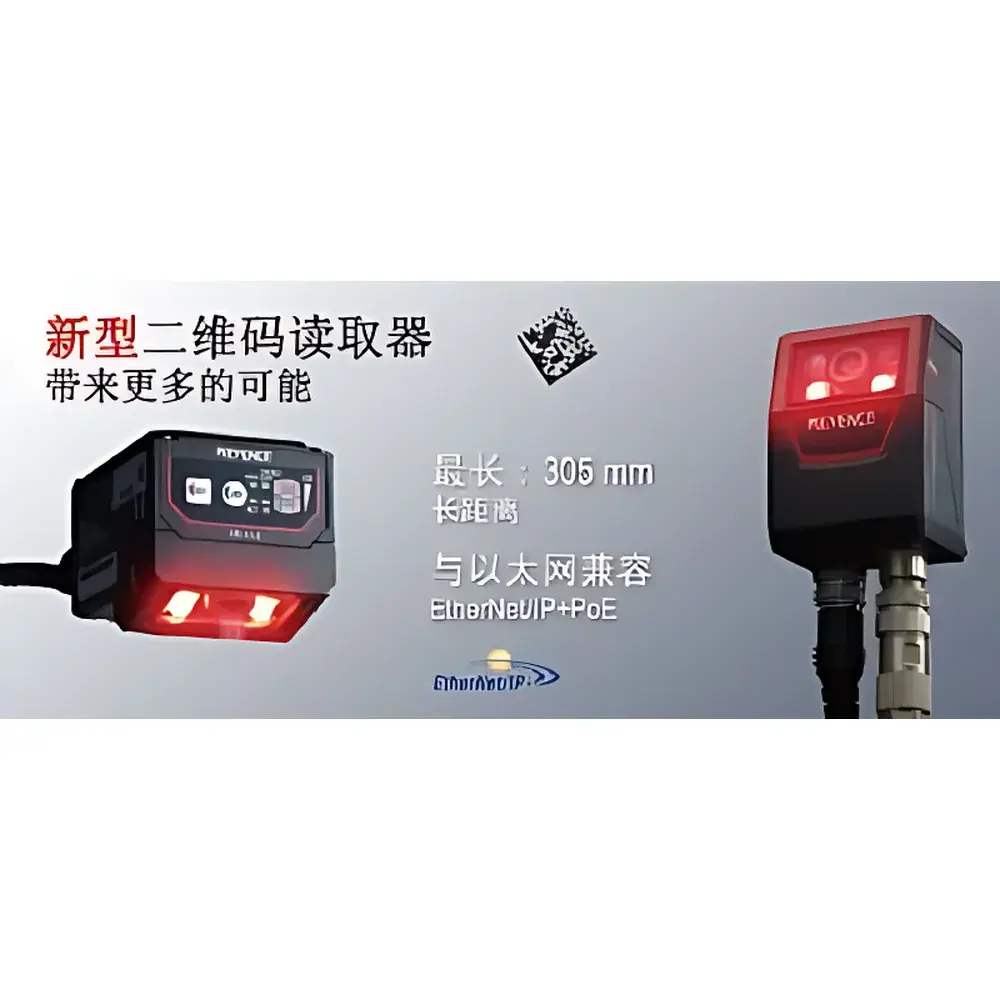
KEYENCE SR-650 Series Ethernet-Compatible Compact 2D Barcode Reader
| Origin | Japan |
|---|---|
| Manufacturer Type | Authorized Distributor |
| Origin Category | Imported |
| Model | SR-650 Series |
| Pricing | Upon Request |
| Minimum Resolution | 0.002 mm |
| Max Reading Distance | 305 mm (DataMatrix, 0.5 mm cell size) |
| SR-650HA | 0.082 mm @ 38 mm FOV |
| SR-650 | 0.127 mm @ 60 mm FOV |
| SR-651 | 0.25 mm @ 100 mm FOV |
| SR-652 | 0.19 mm @ 250 mm FOV |
Overview
The KEYENCE SR-650 Series is a high-performance, Ethernet-compatible compact 2D barcode reader engineered for industrial automation, precision manufacturing, and traceability-critical environments. Utilizing advanced CMOS image sensor technology combined with real-time image processing algorithms, the SR-650 Series decodes 1D linear barcodes, 2D matrix codes (including DataMatrix, QR Code, and PDF417), and stacked symbologies under variable lighting, surface reflectivity, and orientation conditions. Unlike laser-based scanners, this series employs area-imaging optics to capture full-field grayscale images—enabling robust decoding of damaged, low-contrast, or partially obscured codes on curved, tilted, or dynamically moving surfaces. Its compact form factor (W 42 × H 65 × D 42 mm) and IP65-rated housing support integration into space-constrained stations, robotic end-effectors, and inline inspection modules without compromising optical stability or thermal drift performance.
Key Features
- Ethernet interface compliant with TCP/IP, UDP, and EtherNet/IP protocols—enabling seamless integration into PLC-controlled production lines and MES/SCADA systems.
- Four optimized variants (SR-650HA, SR-650, SR-651, SR-652) calibrated for distinct working distances and resolution requirements—from micro-component marking (0.082 mm minimum resolvable feature at 38 mm) to long-range verification (up to 305 mm for DataMatrix with 0.5 mm cell size).
- KEYENCE’s proprietary Parameter Library function automatically selects optimal exposure time, gain, illumination intensity, and decoding parameters based on real-time code characteristics—eliminating manual reconfiguration when part geometry, material, or orientation changes.
- Integrated dual LED illumination (red and white) with adaptive brightness control ensures consistent contrast across reflective metals, matte plastics, anodized aluminum, and printed labels—even under ambient light fluctuations.
- On-device firmware supports user-defined trigger logic (hardware line, software command, or frame-rate-based), multi-code detection per frame, and configurable output formats (ASCII, Hex, Base64) via RS-232 or Ethernet.
Sample Compatibility & Compliance
The SR-650 Series reliably reads symbologies applied via laser etching, inkjet printing, dot peening, and thermal transfer—on substrates ranging from silicon wafers and PCBs to stainless-steel medical devices and automotive castings. It meets IEC 60529 (IP65), UL 61010-1, and CE conformity requirements for industrial equipment. While not a regulated medical device, its decoding repeatability and audit-ready logging capabilities align with ISO 13485 and FDA 21 CFR Part 11 principles for electronic record integrity in GMP-compliant environments. All models support timestamped logging of decoded data, trigger events, and system diagnostics—exportable via FTP or HTTP POST for quality documentation traceability.
Software & Data Management
Configuration and monitoring are performed via KEYENCE’s intuitive Web-based interface (accessible through any modern browser) or the optional KV Studio software suite. The embedded web server provides real-time video preview, live parameter adjustment, and firmware update capability without requiring dedicated drivers. Decoded results can be streamed directly to databases, SQL servers, or cloud platforms using configurable JSON/XML payloads. For validation workflows, the system supports user-defined pass/fail rules, batch ID association, and automatic rejection flagging—compatible with common SPC and statistical process control frameworks. Audit trails—including operator login history, parameter modifications, and decoding success/failure logs—are retained onboard with configurable retention periods.
Applications
- Electronics assembly: Reading ultra-small DataMatrix codes (down to 1.5 × 1.5 mm) on IC packages, connectors, and flex circuits.
- Automotive Tier-1 suppliers: Verifying VIN-linked QR codes on brake calipers, ECUs, and transmission housings during final assembly.
- Medical device manufacturing: Validating UDI-compliant 2D codes on surgical instruments and implant packaging under cleanroom lighting conditions.
- Pharmaceutical secondary packaging: High-speed reading of serialized GS1 DataMatrix on blister cards and cartons at conveyor speeds up to 2 m/s.
- Logistics hubs: Multi-angle decoding of skewed or wrinkled shipping labels on irregularly shaped parcels.
FAQ
What communication protocols does the SR-650 Series support?
It supports TCP/IP, UDP, EtherNet/IP, and Modbus TCP natively—no gateway required.
Can it read damaged or low-contrast barcodes?
Yes. Its adaptive image enhancement engine applies dynamic thresholding, noise suppression, and perspective correction prior to decoding.
Is firmware update possible remotely?
Yes—via HTTP upload through the built-in web interface or automated deployment using KEYENCE’s centralized management tools.
Does it require external lighting?
No. Integrated dual-spectrum LEDs provide uniform, adjustable illumination optimized for each model’s focal range.
How is calibration handled across different part geometries?
The Parameter Library function stores up to 100 preconfigured profiles; switching between them is triggered automatically by code size, contrast, or user-defined I/O signals.