
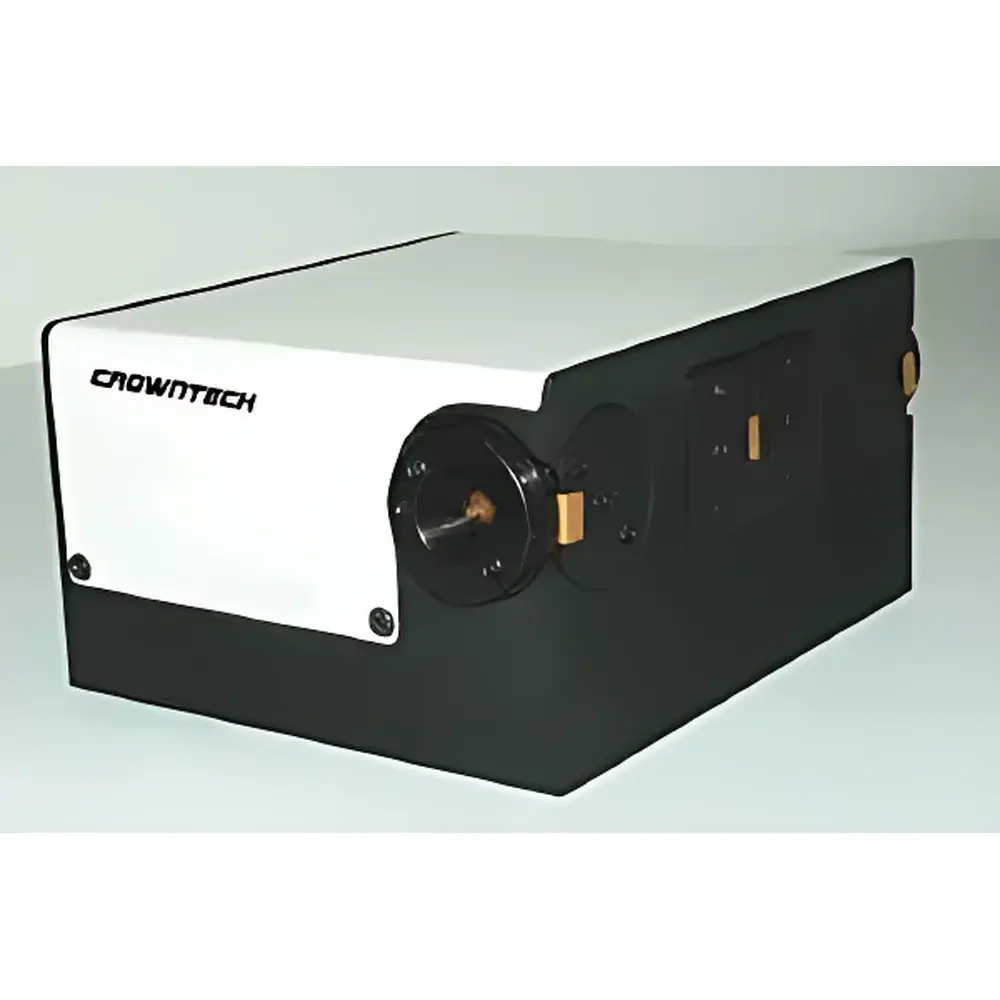
Compact Dual Monochromator CM110 (Spectral Products)
| Brand | Spectral Products/SpectroSystem |
|---|---|
| Origin | USA |
| Manufacturer Type | Authorized Distributor |
| Origin Category | Imported |
| Model | CM110 |
| Price Range | USD 4,200 – 14,100 |
| Focal Length | 1/8 m (110 mm) per stage |
| Optical Configuration | Dual Czerny-Turner |
| Grating Mount | Dual-Grating Turret (2 or 4 gratings) |
| Wavelength Accuracy | ±0.3 nm (Additive), ±0.6 nm (Subtractive) |
| Wavelength Repeatability | 0.1 nm (Additive), 0.2 nm (Subtractive) |
| Resolution | <0.5 nm (Additive), <1.0 nm (Subtractive) |
| Bandwidth | 0.25 nm (Additive), 0.50 nm (Subtractive) |
| Stray Light | <1×10⁻⁹ |
| Slit Options | 0.125–2.4 mm (height × 4.0 mm width) |
| Scanning Modes | Additive (high-resolution, low-stray-light) and Subtractive (pulse-preserving, imaging-corrected) |
| Drive Mechanism | Dual worm-gear actuators with synchronous motor control |
| Wavelength Units | nm, Å, µm, cm⁻¹, eV |
| Scan Speed | >100 nm/s |
| Interface | RS-232, optional IEEE-488 (GPIB) |
| Software | Demonstration Control Suite with LabVIEW drivers |
| Power Supply | 110/220 V AC, 50/60 Hz |
| Warranty | 12 months |
Overview
The CM110 Compact Dual Monochromator is a precision optical instrument engineered for high-fidelity spectral isolation in demanding laboratory and industrial applications. Built upon two cascaded 110 mm focal length Czerny-Turner monochromators, the CM110 operates in either additive or subtractive optical configuration—enabling fundamentally distinct performance trade-offs. In additive mode, the second monochromator reinforces angular dispersion from the first, effectively doubling spectral resolution relative to a single 1/8 m monochromator while suppressing stray light to <1×10⁻⁹. In subtractive mode, the second stage applies negative dispersion to compensate for path-length-induced temporal broadening and spatial aberrations introduced by the first stage—making the CM110 uniquely suited for ultrafast pulse characterization and diffraction-limited spectral imaging where wavefront fidelity is critical. Its compact footprint (133 × 159 × 6.4 mm) and rigid aluminum housing ensure mechanical stability under thermal drift and vibration, supporting long-term repeatability required in calibration-grade spectroscopy.
Key Features
- Dual-grating turret system supporting up to four interchangeable ruled or holographic gratings—enabling seamless coverage from UV (190 nm) to NIR (2500 nm) without realignment.
- Computer-controlled dual-worm-drive mechanism with encoder feedback ensures wavelength repeatability of ±0.1 nm (additive) and ±0.2 nm (subtractive), traceable to NIST-traceable reference sources.
- Configurable optical layout: factory-set at 90° (L-shaped) or 0° (collinear) beam path; optimized for integration into OEM spectrometers, fluorescence microscopes, or pump-probe setups.
- Programmable scanning across six wavelength units (nm, Å, µm, cm⁻¹, eV, THz) with user-defined step size, dwell time, and direction—fully scriptable via RS-232 or optional IEEE-488 interface.
- Standard slit set includes six vertical apertures (0.125–2.4 mm height × 4.0 mm width), each with precision-machined edges and black-anodized baffling to minimize internal scatter.
- Integrated LabVIEW-compatible drivers and demonstration software enable rapid prototyping, automated spectral acquisition, and real-time data logging compliant with GLP audit trails.
Sample Compatibility & Compliance
The CM110 is designed for use with free-space collimated beams (typical input diameter ≤8 mm) and accepts standard SMA905 or FC/PC fiber-coupled inputs via optional adapters. It complies with IEC 61000-6-3 (EMC emissions) and IEC 61010-1 (safety for laboratory equipment). While not certified for medical device use, its mechanical and optical stability meets requirements for ISO/IEC 17025-accredited calibration laboratories performing spectral radiance or irradiance measurements. When operated with NIST-traceable calibration lamps (e.g., Hg/Ar, Deuterium), wavelength accuracy remains within ±0.3 nm (additive) and ±0.6 nm (subtractive) over 12 months—validating conformance with ASTM E275 and ISO 13694 for monochromator performance verification.
Software & Data Management
The bundled Demonstration Control Program provides intuitive GUI-based operation—including real-time spectrum preview, multi-scan averaging, and baseline correction. All instrument parameters (grating selection, slit width, scan range, speed) are stored in human-readable XML configuration files, enabling version-controlled experiment replication. LabVIEW drivers support full API access to motor control, encoder readback, and status registers—facilitating integration into custom DAQ systems compliant with FDA 21 CFR Part 11 (electronic records/signatures) when deployed with validated audit-log modules. Raw wavelength-intensity data exports to CSV or HDF5 formats, preserving metadata such as timestamp, grating groove density, and slit setting for downstream traceability.
Applications
- Ultrafast Spectroscopy: Subtractive-mode operation preserves femtosecond pulse duration (<50 fs added dispersion) for time-resolved absorption or transient grating experiments.
- High-Resolution Fluorescence & Raman: Additive-mode resolution <0.5 nm enables separation of closely spaced vibronic peaks in organic dyes or quantum dot emission spectra.
- Spectral Imaging Calibration: Dual-stage reimaging corrects chromatic magnification error, allowing diffraction-limited line-spread function across broadband illumination in hyperspectral camera validation.
- OEM Integration: Modular mounting flanges (CF-35 compatible) and low-power consumption (≤25 W) support embedded deployment in portable LIBS analyzers or space-constrained process spectrometers.
- Reference Standard Characterization: Used in national metrology institutes for verifying spectral bandwidth and stray light performance of secondary standards per ISO 17025 clause 5.5.2.
FAQ
What is the difference between additive and subtractive dispersion modes?
Additive mode increases total dispersion and resolution by aligning both gratings’ angular deviation; subtractive mode applies opposite dispersion to cancel path-length differences, preserving pulse integrity and image focus.
Can the CM110 be used with fiber-optic inputs?
Yes—via optional FC/PC or SMA905 couplers; however, optimal performance requires collimated input (f/# ≤ f/3.9); fiber numerical aperture must be matched to avoid vignetting.
Is wavelength calibration performed at the factory?
Yes—each unit ships with a NIST-traceable calibration report using Hg and Ne spectral lines; users may perform field recalibration using built-in lamp ports or external references.
Does the CM110 support automated grating switching during a scan?
Yes—the dual-grating turret allows pre-programmed, seamless grating transitions within a single scan sequence, maintaining wavelength continuity across overlapping ranges.
What environmental conditions are recommended for long-term stability?
Operate within 15–30 °C ambient temperature, <60% non-condensing humidity; avoid direct airflow or thermal gradients across the housing to maintain sub-pixel spectral registration.




