
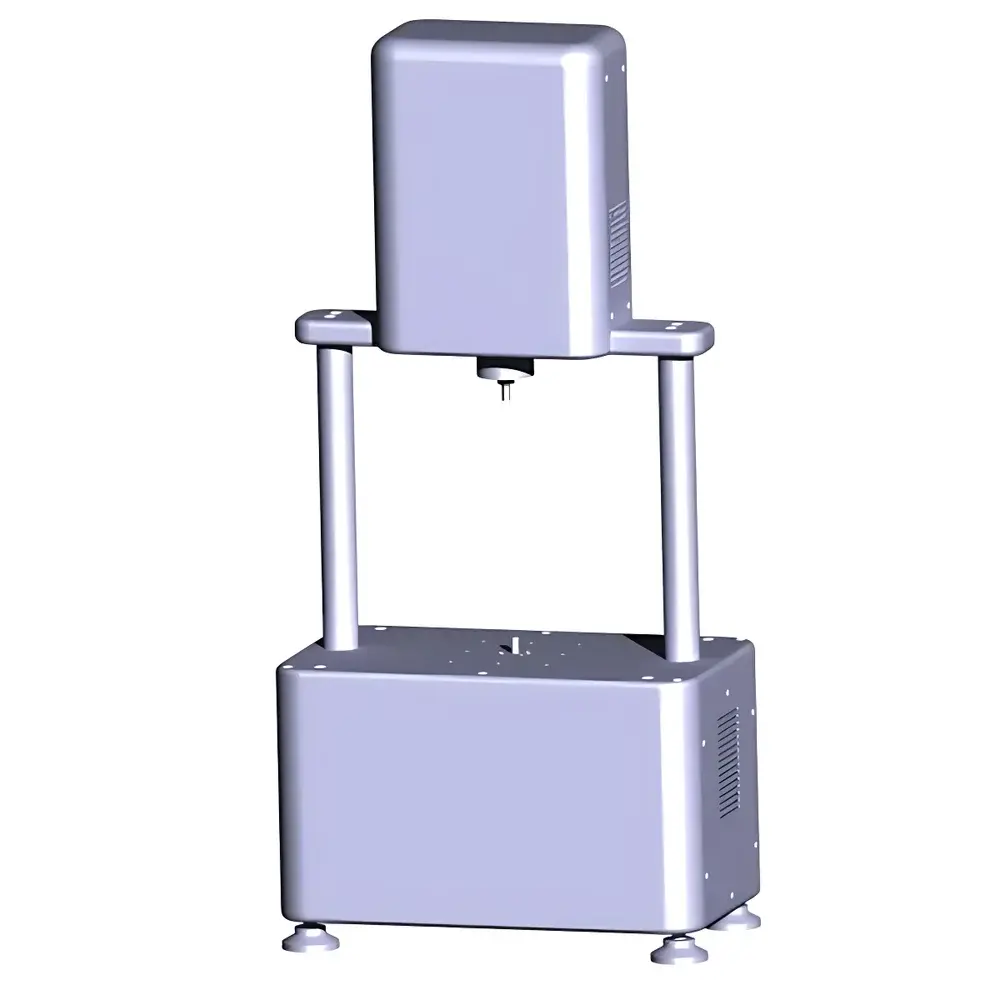
Duratt D50 Desktop Electromagnetic Fatigue Testing Machine
| Brand | Duratt |
|---|---|
| Model | D50 |
| Maximum Dynamic Force | 50 N |
| Frequency Range | 0.01–100 Hz |
| Dynamic Displacement | ±5 mm |
| Host Weight | 200 kg |
| Compliance | CE-certified electrical architecture |
| Form Factor | Benchtop, compact footprint |
| Test Modes | Tension, compression, 3-/4-point bending, torsion, frequency sweep, temperature sweep (optional) |
| Environmental Options | Saltwater bath, thermal chamber (−40 °C to +150 °C), humidity control (optional) |
Overview
The Duratt D50 Desktop Electromagnetic Fatigue Testing Machine is an engineered solution for high-fidelity dynamic mechanical characterization of small-scale specimens and flexible materials. Utilizing a custom high-bandwidth linear electromagnetic actuator—free of hydraulic fluid, mechanical backlash, or servo-valve latency—the D50 delivers precise force and displacement control across a continuous frequency spectrum from quasi-static (0.01 Hz) up to 100 Hz. Its core measurement principle is based on closed-loop digital control of Lorentz-force-driven motion, enabling true sinusoidal, triangular, or arbitrary waveform excitation with sub-millisecond response time. Designed specifically for laboratories with space constraints yet demanding metrological rigor, the D50 maintains structural integrity under cyclic loading through a rigid cast-iron frame and preloaded linear guideways, minimizing parasitic vibration and ensuring long-term repeatability in fatigue life assessment and dynamic modulus determination.
Key Features
- Electromagnetic actuation system with zero maintenance requirements—no oil, seals, or hydraulic power units
- Real-time force and displacement feedback via integrated load cell (±0.5% FS accuracy) and non-contact LVDT or optical encoder (resolution ≤ 0.1 µm)
- Digital controller with 10 kHz sampling rate and PID + feedforward compensation for phase-stable tracking at 100 Hz
- Benchtop form factor (W × D × H ≈ 650 × 720 × 980 mm) optimized for integration into fume hoods, gloveboxes, or environmental chambers
- CE-compliant electrical architecture with reinforced insulation, emergency stop circuitry, and over-travel limit switches
- Modular mounting interface compatible with ASTM E4, ISO 7500-1, and DIN 51221-compliant fixtures (tensile grips, 3-/4-point bend assemblies, torsion adapters)
Sample Compatibility & Compliance
The D50 accommodates specimens ranging from microfibers (diameter ≥ 10 µm) to miniature components (max. 150 mm length, 50 mm width). Standard test geometries include dog-bone tensile bars, rectangular flexure beams, and cylindrical torsion samples. Optional accessories enable compliance with method-specific standards: ASTM D3410 (composite compression), ISO 13314 (biomaterial compression), ASTM F2129 (electrochemical corrosion-fatigue in saline), and ISO 1099 (axial fatigue testing). All firmware and hardware design align with IEC 61000-6-2/6-4 for electromagnetic compatibility and meet essential health and safety requirements per EU Machinery Directive 2006/42/EC. Audit-ready operation logs—including timestamped force/displacement waveforms, environmental chamber setpoints, and operator ID—are retained locally and exportable in CSV or HDF5 format.
Software & Data Management
Control and analysis are performed via Duratt TestSuite v3.x—a Windows-based application built on .NET Framework with deterministic real-time scheduling. The software supports multi-channel synchronized acquisition (force, displacement, temperature, strain via external gauges), automated test sequencing (e.g., stepwise frequency sweep followed by R-ratio-controlled fatigue blocks), and configurable pass/fail criteria (e.g., stiffness degradation >15%, cycle count at 50% modulus loss). Data files conform to ASTM E1434-22 metadata conventions and include embedded calibration certificates traceable to NIST or CNAS-accredited labs. For regulated environments, optional 21 CFR Part 11 compliance package provides electronic signatures, role-based access control, and immutable audit trails with SHA-256 hashing of all raw datasets.
Applications
- Mechanical phenotyping of hydrogels and extracellular matrix mimics under physiological strain rates (0.1–10 Hz) and saline immersion
- Fatigue resistance evaluation of microscale polymer electronics—flexible PCB interconnects, stretchable sensors, and dielectric elastomer actuators
- Dynamic viscoelastic profiling (G′, G″, tan δ) of electrospun nanofibers using controlled-strain oscillatory mode
- Creep-recovery and stress relaxation testing of soft biomaterials under isothermal or thermally ramped conditions (−20 °C to +80 °C with chamber)
- High-cycle fatigue mapping of MEMS packaging adhesives and solder joints under variable R-ratio loading
- Corrosion-assisted fatigue studies in simulated body fluid (SBF) or artificial seawater using integrated saltwater bath module
FAQ
What is the maximum specimen height accommodated without chamber integration?
Standard configuration allows 120 mm vertical travel between upper and lower platens; with optional extended column kit, usable height increases to 220 mm.
Can the D50 perform force-controlled fatigue tests at constant amplitude?
Yes—closed-loop force regulation is maintained across the full 0.01–100 Hz range with amplitude stability better than ±1.2% over 10⁶ cycles (per ISO 1099 Annex B verification protocol).
Is third-party calibration certification included with delivery?
Each unit ships with factory calibration report traceable to national metrology institutes; optional on-site calibration by accredited service engineers is available upon request.
Does the system support synchronization with external imaging systems (e.g., DIC, high-speed camera)?
Yes—TTL trigger output and input ports enable hardware-synchronized acquisition with digital image correlation systems and photonic sensors at up to 10 kHz frame rates.
What data security protocols apply to network-connected operation?
When connected via Ethernet, communications use TLS 1.2 encryption; local storage employs AES-256 encryption for raw test archives, compliant with ISO/IEC 27001 information security requirements.



