
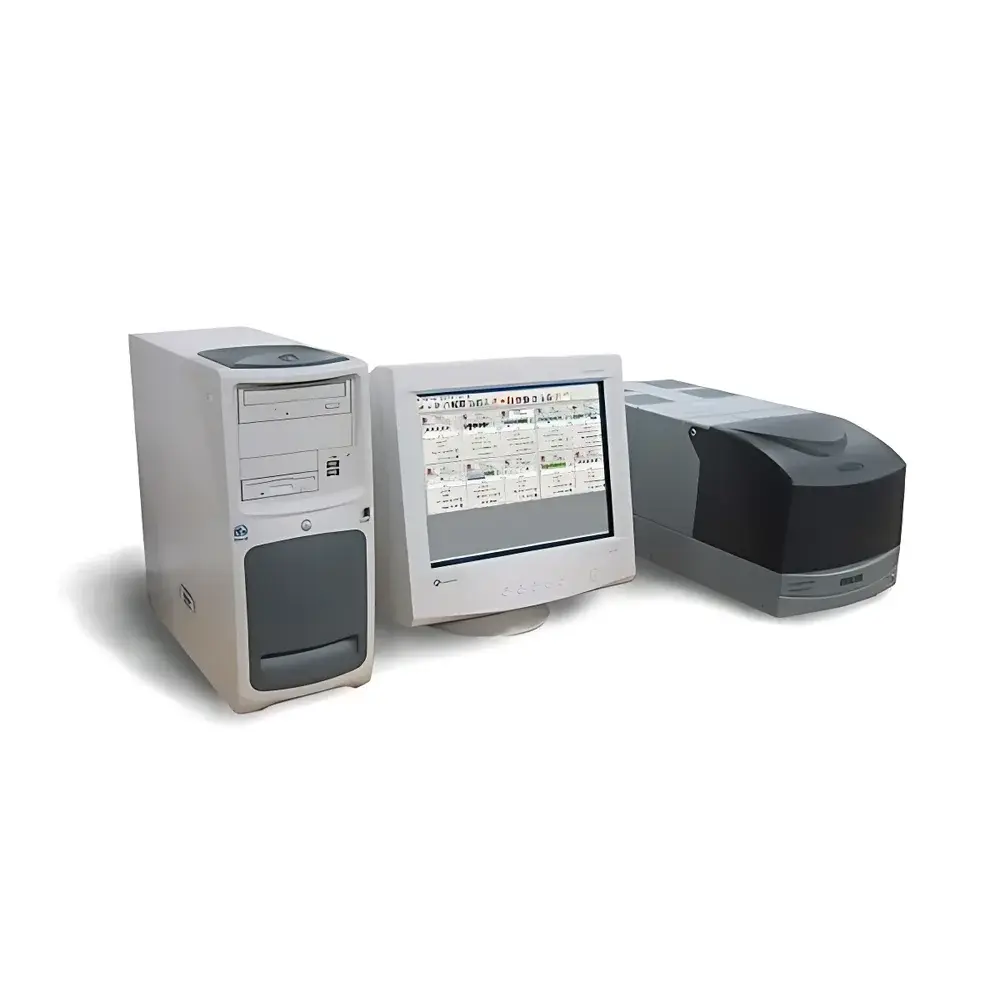
Mocon PERMATRAN-W® Model 3/61 Water Vapor Transmission Rate (WVTR) Tester
| Brand | Mocon |
|---|---|
| Origin | USA |
| Model | PERMATRAN-W® Model 3/61 |
| Test Principle | Infrared Detection (ASTM F1249-compliant) |
| Sample Capacity | 6 independent test cells (10 cm² each) |
| WVTR Range (per cell) | 0.05–500 g/m²·day |
| Combined 6-cell Range | 0.01–85 g/m²·day |
| RH Control | 35–90% RH (film), up to 100% RH (container mode) |
| Temperature Range | Ambient to 65°C |
| Calibration Traceability | NIST-traceable standard films |
| Sample Types | Flat films (10.8 × 10.8 cm), rigid/flexible packages (≤3 L) |
Overview
The Mocon PERMATRAN-W® Model 3/61 is a high-precision, fully automated water vapor transmission rate (WVTR) testing system engineered for rigorous permeation analysis of packaging materials and containers in regulated industrial environments. It operates on the principle of modulated infrared (IR) detection—measuring water vapor concentration in real time as it permeates through a test specimen under controlled temperature and relative humidity (RH) gradients. This methodology complies strictly with ASTM F1249, the internationally recognized standard for WVTR determination using infrared sensor technology. Unlike gravimetric or coulometric methods, the PERMATRAN-W® 3/61 delivers continuous, non-destructive, and highly reproducible measurements by quantifying the IR absorption signature of water molecules carried via dry carrier gas across the sample barrier. Its dual-mode architecture supports both flat-film and 3D package testing, making it indispensable for pharmaceutical blister packaging validation, food shelf-life modeling, photovoltaic backsheet qualification (e.g., TPT/TPE), and medical device sterile barrier system (SBS) certification.
Key Features
- Six independent, thermally isolated test cells—each with precise RH and temperature control—enabling concurrent, statistically robust multi-sample evaluation without cross-contamination.
- Patented Mocon infrared sensor with NIST-traceable calibration capability; validated using certified reference films to ensure measurement integrity across the full dynamic range (0.01–500 g/m²·day).
- Integrated environmental control: programmable RH from 35% to 100% RH (for container mode) and temperature from ambient to +65°C, supporting ISO 15106-3 and ASTM D1653-compliant conditioning protocols.
- Modular scalability: up to 10 instrument modules (60 total test cells) can be networked and managed via a single software interface—ideal for high-throughput QC laboratories or method development centers.
- Automatic zero-baseline stabilization using ultra-dry carrier gas, minimizing drift and ensuring long-term measurement stability over extended test durations (7–30 days typical for low-permeability films).
- Dual-sample geometry support: standardized 10.8 × 10.8 cm film specimens or 3-liter volumetric containers—accommodated via optional custom fixtures compliant with ASTM F2622 for package-level WVTR.
Sample Compatibility & Compliance
The PERMATRAN-W® 3/61 accommodates a broad spectrum of barrier materials, including polyethylene (PE), ethylene-vinyl alcohol (EVOH), aluminum oxide (AlOx)-coated PET, silicon oxide (SiOx)-treated films, laminated foils, and multilayer pharmaceutical pouches. It is routinely deployed for regulatory submissions requiring ASTM F1249, ISO 15106-3, and JIS Z 0208 compliance. For medical packaging, its data output meets FDA 21 CFR Part 11 requirements when paired with Mocon’s validated software suite—including electronic signatures, audit trails, and user-access controls. Photovoltaic manufacturers rely on this model for IEC 61215-2 MQT10-compliant backsheet moisture ingress assessment, where <0.05 g/m²·day WVTR thresholds are critical to module longevity.
Software & Data Management
Control and analysis are executed via Mocon’s proprietary Permatran-W® Software v5.x—a 64-bit Windows application designed for GLP/GMP-aligned laboratories. The software enables full method scripting (including ramped RH profiles, stepwise temperature cycles, and multi-point calibration sequences), real-time permeation curve visualization, automatic endpoint detection per ASTM F1249 Annex A1, and export of raw sensor voltage, calculated WVTR, and statistical summaries (mean, SD, RSD%) in CSV, PDF, or XML formats. All data files include embedded metadata (operator ID, instrument serial number, calibration date, environmental logs), satisfying traceability mandates under ISO/IEC 17025 and EU Annex 11. Optional integration with LIMS or MES platforms is supported via OPC UA and TCP/IP protocols.
Applications
- Pharmaceutical packaging: Quantification of moisture ingress into blister cavities and cold-form foil structures to support stability studies per ICH Q1A(R2).
- Food packaging R&D: Accelerated shelf-life prediction for retort pouches, vacuum-sealed trays, and modified-atmosphere packaging (MAP) films.
- Photovoltaic manufacturing: Certification of ethylene-vinyl acetate (EVA) encapsulant compatibility and TPT backsheet integrity against delamination-inducing moisture diffusion.
- Flexible electronics: Barrier performance validation of thin-film encapsulation layers for OLED displays and organic photovoltaics (OPV).
- Medical device SBS: Verification of Tyvek®/polypropylene pouch systems per ISO 11607-1 and AAMI ST77.
FAQ
What standards does the PERMATRAN-W® 3/61 comply with?
It is fully compliant with ASTM F1249, ISO 15106-3, and JIS Z 0208. Optional validation packages support 21 CFR Part 11 and ISO/IEC 17025 implementation.
Can it test rigid containers such as bottles or trays?
Yes—using the optional container test fixture and humidity-controlled chamber accessory, it measures WVTR of 3D packages up to 3 L volume per ASTM F2622.
How is calibration verified?
NIST-traceable standard films (e.g., Mocon’s certified 0.5 g/m²·day and 10 g/m²·day references) are used for daily system suitability checks and periodic recalibration.
Is remote monitoring supported?
The system supports Ethernet-based remote access, real-time data streaming, and alarm notifications via SNMP or email—configured within IT-managed network policies.
What maintenance is required?
Annual sensor verification, quarterly desiccant replacement in the dry-gas manifold, and biannual IR source alignment—documented in the included Preventive Maintenance Logbook.






