
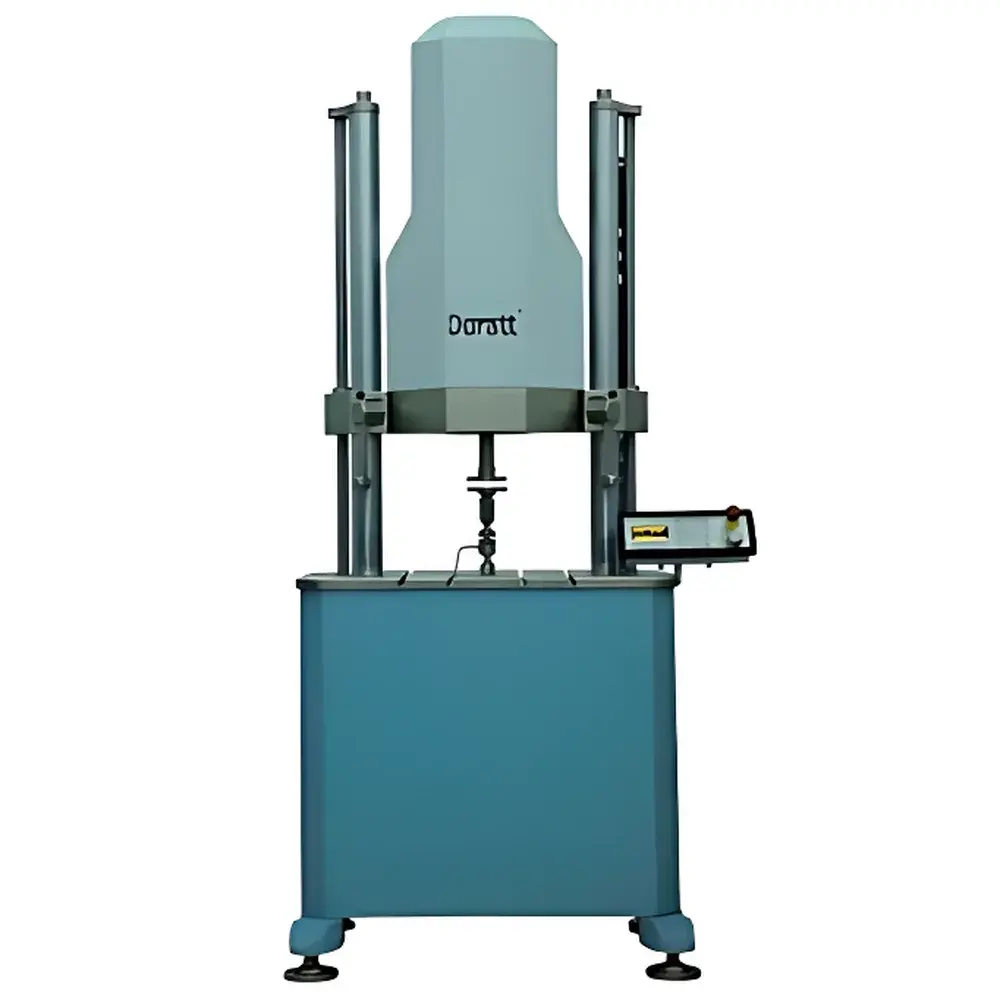
Duratt D500–D3000 High-Performance Electromagnetic Fatigue Testing System
| Brand | Duratt |
|---|---|
| Origin | Shanghai, China |
| Model | D200 / D500 / D1500 / D3000 |
| Max Test Force | 3000 N |
| Frequency Range | 200 Hz |
| Dynamic Displacement | ±30 mm |
| Host Weight | 200 kg |
| Compliance | CE |
Overview
The Duratt D500–D3000 is a high-precision electromagnetic fatigue testing system engineered for controlled dynamic mechanical loading of materials and miniature components under cyclic stress conditions. Unlike conventional electromechanical or hydraulic servo-driven testers—whose performance is fundamentally constrained by mechanical backlash, seal wear, fluid compressibility, and thermal drift—the D-series leverages contactless electromagnetic actuation based on Lorentz force principles. A custom-designed high-force linear motor integrates rare-earth permanent magnets (moving coil-free armature) with precision-wound stator windings; axial motion is generated via controlled current modulation without physical contact, eliminating friction-induced hysteresis, wear debris generation, and nonlinear stiffness contributions. This architecture enables true broadband dynamic excitation from static (0 Hz) up to 200 Hz with sub-millisecond response time, high force fidelity, and long-term repeatability—critical for fatigue life assessment, viscoelastic characterization, and high-cycle durability validation in R&D and quality assurance laboratories.
Key Features
- Contactless electromagnetic actuation ensures zero mechanical wear, no lubrication requirements, and maintenance intervals exceeding 10,000 operating hours
- Four standard force capacity variants: 200 N, 500 N, 1500 N, and 3000 N—each calibrated traceably to ISO/IEC 17025-accredited standards
- Dynamic displacement range of ±30 mm with position resolution < 0.1 µm (via integrated high-resolution optical encoder)
- Integrated precision ball-screw elevation stage for rapid, repeatable sample height adjustment (±50 mm travel, 0.01 mm repeatability)
- CE-compliant electrical architecture with reinforced insulation, overcurrent/overtemperature protection, and emergency stop circuitry per EN 60204-1
- Ergonomic front-access design with tool-less guard removal, intuitive tactile controls, and LED status indicators for operational transparency
Sample Compatibility & Compliance
The D500–D3000 accommodates specimens ranging from thin polymer films (≥50 µm thick) to machined metallic coupons (up to 80 mm width × 120 mm length), microelectronics packages, ceramic substrates, fiber-reinforced composites, and elastomeric seals. Standard grips include pneumatic parallel-jaw, wedge-action, and torsional collet types; optional fixtures support 3-/4-point bending, torsion, and combined axial-torsional loading. The system complies with ASTM E466 (constant-amplitude axial fatigue), ASTM D7028 (DMA of polymers), ISO 1099 (metallic fatigue testing), and supports GLP/GMP-aligned audit trails when paired with validated software. Environmental integration includes standardized ports for climate chambers (−70 °C to +250 °C), saline immersion baths (ASTM B117 compliance), and vacuum-compatible load frames (optional).
Software & Data Management
Control and analysis are performed via the Duratt DMA Suite—a Windows-based application compliant with FDA 21 CFR Part 11 requirements (electronic signatures, audit trail logging, role-based access control). Real-time data acquisition operates at 10 kHz sampling rate with synchronized force, displacement, and temperature channels. Built-in modules support frequency sweeps (0.01–200 Hz), temperature ramps (0.1–10 °C/min), creep/recovery, stress relaxation, and multi-step fatigue protocols (e.g., block loading, spectrum loading per ASTM E1049). All raw datasets are stored in HDF5 format with embedded metadata (operator ID, calibration certificate ID, environmental conditions), enabling seamless export to MATLAB, Python (via h5py), or LIMS platforms. Software validation documentation (IQ/OQ/PQ protocols) is available upon request for regulated environments.
Applications
- Fatigue life prediction of aerospace-grade aluminum alloys and titanium alloys under high-cycle (>10⁶ cycles) loading
- Dynamic mechanical analysis (DMA) of thermoplastic elastomers, epoxy resins, and carbon-fiber laminates—quantifying storage modulus (E′), loss modulus (E″), tan δ, and glass transition temperature (Tg)
- Creep and stress relaxation behavior of biomedical hydrogels and soft tissue simulants
- Mechanical reliability screening of MEMS packaging under thermal-mechanical cycling
- High-frequency damping characterization of piezoelectric ceramics and ferroelectric thin films
- Corrosion-fatigue coupling studies in chloride-rich environments using integrated salt spray chamber
FAQ
What is the maximum achievable test frequency with full rated load (3000 N)?
At 3000 N peak force, the system maintains sinusoidal fidelity up to 100 Hz; above this, force amplitude is derated per manufacturer’s dynamic force envelope curve (provided in technical manual).
Can the system perform true static tests (zero-frequency hold) with force stability better than ±0.1% of full scale?
Yes—static force control uses PID + feedforward compensation with closed-loop stability verified per ISO 7500-1 Class 0.5 requirements.
Is third-party calibration certification included with delivery?
Each unit ships with an ISO/IEC 17025-accredited calibration certificate covering force, displacement, and frequency channels, valid for 12 months.
Does the system support external synchronization with laser extensometers or digital image correlation (DIC) systems?
Yes—TTL-compatible trigger I/O ports enable hardware-level synchronization with industry-standard DIC controllers (e.g., Correlated Solutions VIC-3D) and non-contact extensometers.
What is the typical lead time for configuration with a low-temperature chamber (−40 °C) and saline bath?
Standard integration adds 6–8 weeks to base delivery schedule; environmental chamber qualification reports are supplied pre-shipment.



