
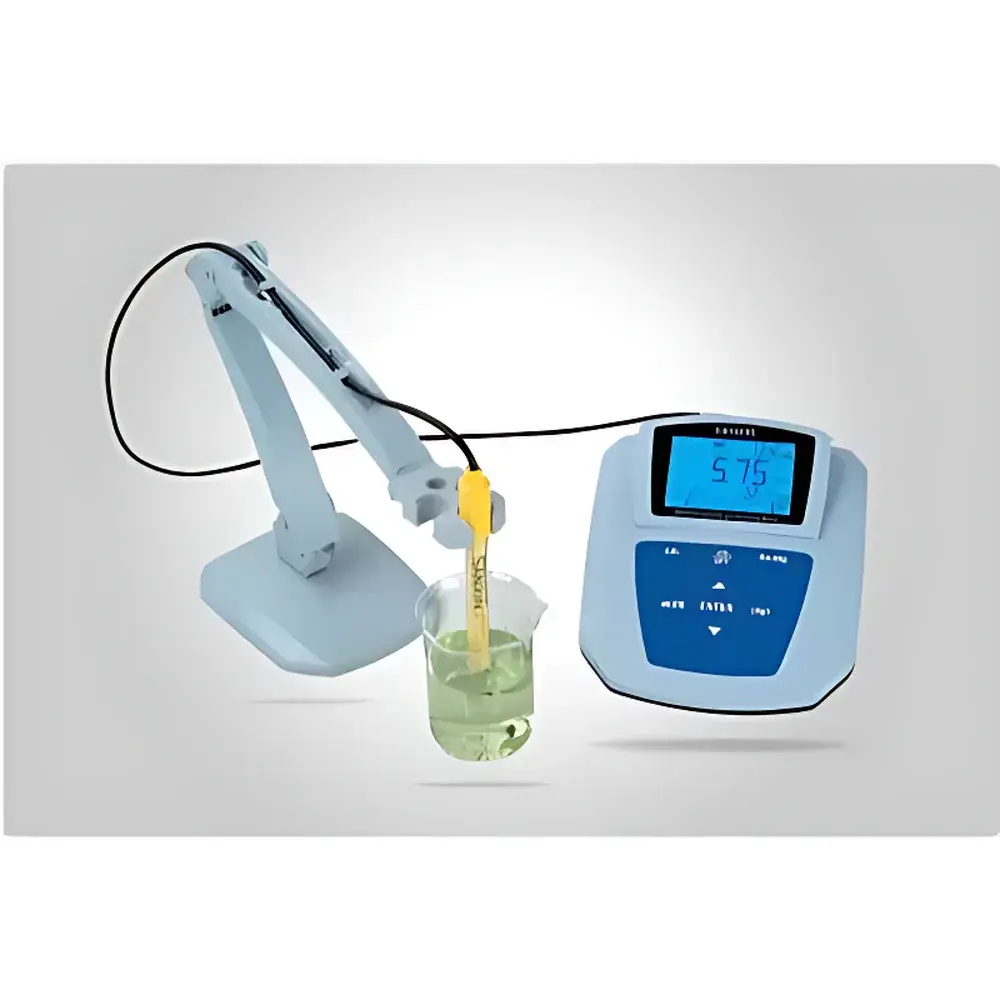
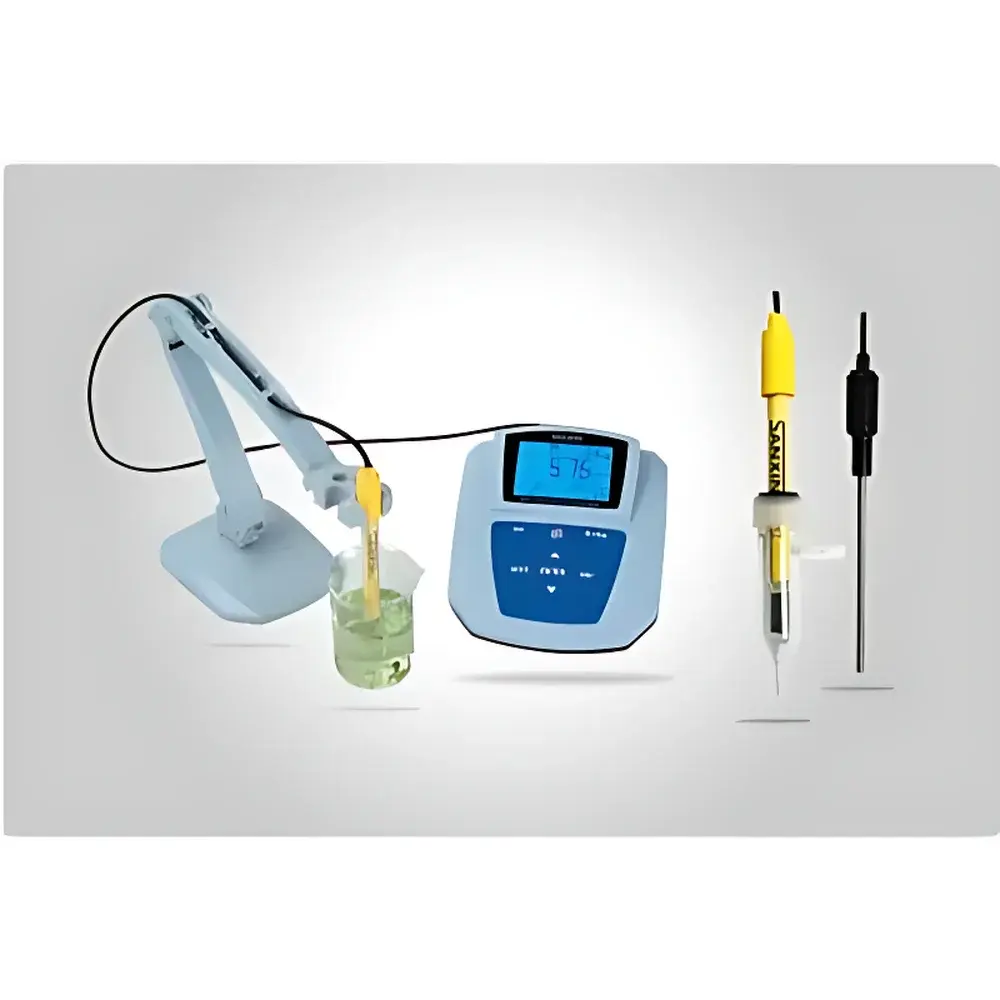
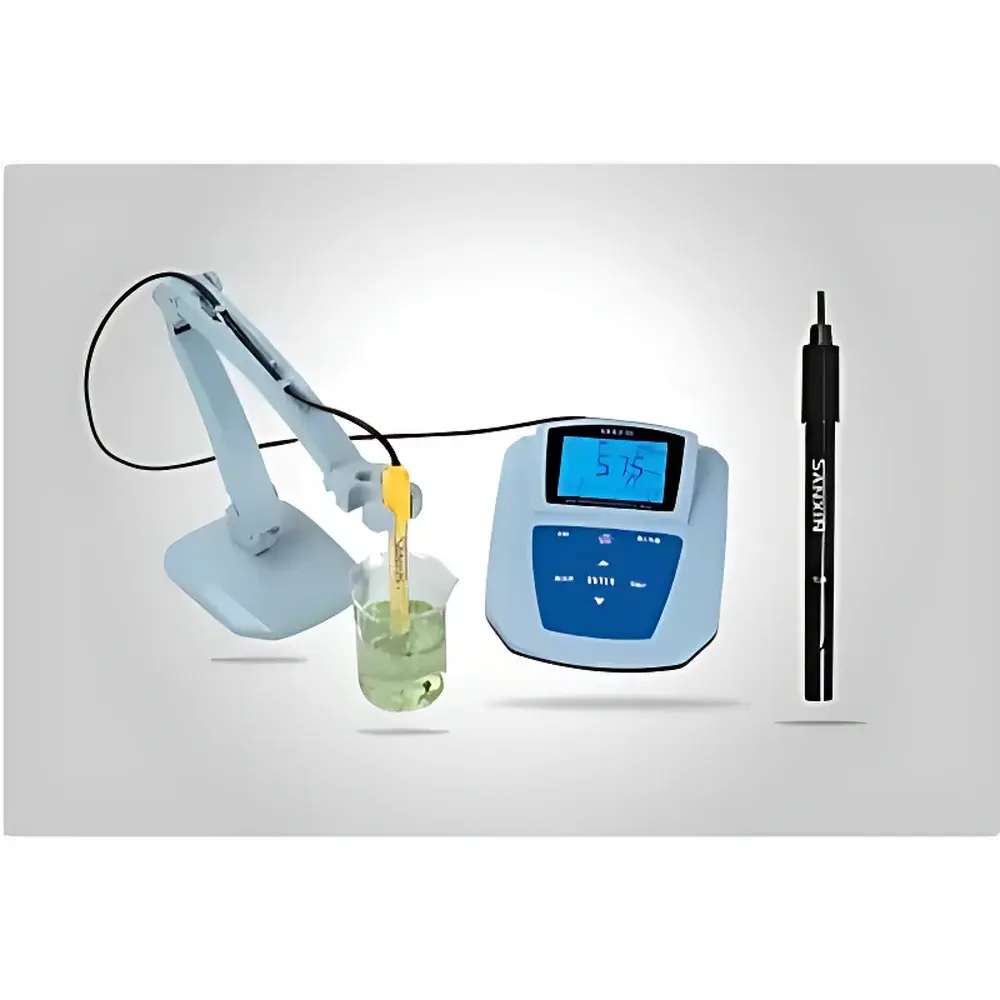
SANXIN MP515 Precision Benchtop Conductivity Meter
| Brand | SANXIN |
|---|---|
| Origin | Shanghai, China |
| Manufacturer Type | Direct Manufacturer |
| Instrument Type | Benchtop Conductivity Meter |
| Model | MP515 |
| Measurement Parameters | Single-Parameter (Conductivity) |
| Conductivity Range | 0–2000 mS/cm (6 auto-ranging segments) |
| TDS Range | 0–100 g/L |
| Resistivity Range | 0–100 MΩ·cm |
| Salinity Range | 0–100 ppt |
| Temperature Range | −10 °C to 110 °C |
| Accuracy | ±0.5% FS (conductivity), ±0.4 °C (temperature) |
| Minimum Resolution | 0.01 µS/cm |
| Temperature Compensation | Automatic linear (0–50 °C) and nonlinear (for ultrapure water <10 µS/cm) |
| Data Storage | 600 sets |
| Interface | RS232 |
| Power Supply | DC 9 V / 300 mA |
| Dimensions & Weight | 160 × 190 × 70 mm / 880 g |
| Ingress Protection | IP54 |
| Compliance | GLP-compliant design with audit-ready data logging and timestamped records |
Overview
The SANXIN MP515 Precision Benchtop Conductivity Meter is an engineered solution for high-accuracy, multi-range electrical conductivity measurement in regulated laboratory environments. Based on the fundamental principle of two-electrode AC conductance measurement—applying a low-frequency alternating current across a defined cell geometry and calculating conductivity (κ) via κ = G × K, where G is measured conductance and K is the cell constant—the MP515 delivers traceable, reproducible results across six decades of conductivity (0.00 µS/cm to 2000 mS/cm). Its architecture supports seamless transition between ultrapure water analysis (e.g., pharmaceutical WFI or semiconductor rinse water) and highly conductive industrial brines or electroplating baths, enabled by intelligent auto-ranging and adaptive temperature compensation algorithms. Designed specifically for compliance-driven workflows, the instrument implements GLP-aligned data integrity features—including time-stamped measurements, user-defined ID fields, and non-volatile storage—making it suitable for QC laboratories operating under ISO/IEC 17025, USP , ASTM D1125, and pharmacopeial water purity specifications.
Key Features
- Auto-ranging conductivity measurement across six precision segments: (0.00–20.00) µS/cm, (20.00–200.0) µS/cm, (200–2000) µS/cm, (2.00–20.00) mS/cm, (20.0–200.0) mS/cm, and (200–2000) mS/cm (with optional K=10 electrode)
- Advanced automatic variable-frequency excitation and dynamic voltage regulation—enabling single-point calibration with a standard K=1 electrode while maintaining ±0.5% FS accuracy across 0.5 µS/cm to 200 mS/cm
- Dual-mode temperature compensation: linear compensation (0–50 °C) for general applications; nonlinear compensation algorithm optimized for ultrapure water (<10 µS/cm), critical for power plant condensate and biopharmaceutical process water monitoring
- Four simultaneous parameter display modes: conductivity (µS/cm, mS/cm), resistivity (MΩ·cm), TDS (g/L, ppm), and salinity (ppt)—all derived from primary conductivity measurement using configurable conversion factors
- Automatic recognition of eight standardized conductivity reference solutions, supporting both US/EU (e.g., KCl 0.01 mol/kg, 0.1 mol/kg) and Chinese national standard series (GB/T 6682)
- Integrated real-time stability indicator icon, clock/date stamping, programmable timed measurement intervals, and password-protected function configuration
- IP54-rated enclosure with silicone-sealed ports, robust ABS housing, and ESD-safe design for long-term reliability in shared lab environments
Sample Compatibility & Compliance
The MP515 accommodates a wide spectrum of aqueous samples—from deionized water (0.055 µS/cm at 25 °C) to saturated NaCl solutions (~2000 mS/cm). It supports interchangeable electrodes: the included 2401-M glass-bodied sensor (K=1, ATC-integrated) covers routine applications; the optional DJS-0.1 electrode (K=0.1) extends low-conductivity capability for ultrapure water validation per ASTM D5127 and EP 2.2.38; the 2310-C high-range electrode (K=10) enables stable measurement in aggressive electrolytes such as battery acid or seawater analogs. All configurations comply with GLP documentation requirements: each stored record includes sample ID, operator ID, electrode serial number, calibration date, temperature, and full metrological traceability metadata. The instrument’s firmware adheres to data integrity principles aligned with FDA 21 CFR Part 11 (when used with validated MP515 PC software), including electronic signature support, audit trail logging, and immutable record archiving.
Software & Data Management
The MP515 communicates via isolated RS232 interface to Windows-based MP515 PC software (included on optical disc), enabling bidirectional data transfer, remote instrument control, and report generation in PDF or CSV format. Software features include customizable templates compliant with internal SOPs, trend analysis across multiple batches, calibration certificate export (with uncertainty estimation), and automated pass/fail evaluation against user-defined specification limits. All stored measurements retain full context: timestamp (YYYY-MM-DD HH:MM:SS), ambient temperature, electrode type, calibration status, and raw sensor impedance values. Data files are digitally signed and checksum-verified to prevent tampering—essential for regulatory submissions and third-party audits.
Applications
- Pharmaceutical water systems: USP Purified Water (PW) and Water for Injection (WFI) conductivity verification per USP
- Power generation: boiler feedwater, condensate, and steam purity monitoring per ASTM D1125 and IAPWS guidelines
- Microelectronics: ultrapure rinse water qualification in wafer fabrication cleanrooms (SEMI F57)
- Environmental testing: surface water, wastewater, and effluent TDS/salinity profiling per EPA Method 120.1
- Food & beverage: brine concentration control, syrup conductivity validation, and cleaning-in-place (CIP) solution monitoring
- Academic research: electrolyte characterization, membrane transport studies, and corrosion inhibitor efficacy screening
FAQ
Does the MP515 support FDA 21 CFR Part 11 compliance?
Yes—when used with validated MP515 PC software and configured with electronic signatures, audit trails, and role-based access control, the system meets core Part 11 requirements for electronic records and signatures.
Can the MP515 measure conductivity below 1 µS/cm with acceptable accuracy?
Yes—using the optional DJS-0.1 electrode (K=0.1) and enabling nonlinear temperature compensation, the instrument achieves reliable measurement down to 0.05 µS/cm, suitable for Type I ultrapure water per ISO 3696 and ASTM D1193.
Is calibration traceable to NIST or other national standards?
Calibration is performed using certified reference materials traceable to NIST SRM 3194 (KCl solutions) or equivalent national metrology institutes; certificates of analysis are provided with each standard solution kit.
What electrode options are supported, and how are they identified by the instrument?
The MP515 auto-detects electrode type (2401-M, DJS-0.1, or 2310-C) via integrated resistance sensing and adjusts cell constant, range mapping, and compensation parameters accordingly.
How is data integrity ensured during power loss or unexpected shutdown?
All measurements are written to non-volatile flash memory with atomic write operations; no data is held solely in RAM, ensuring zero loss during interruption.
Related Products





