
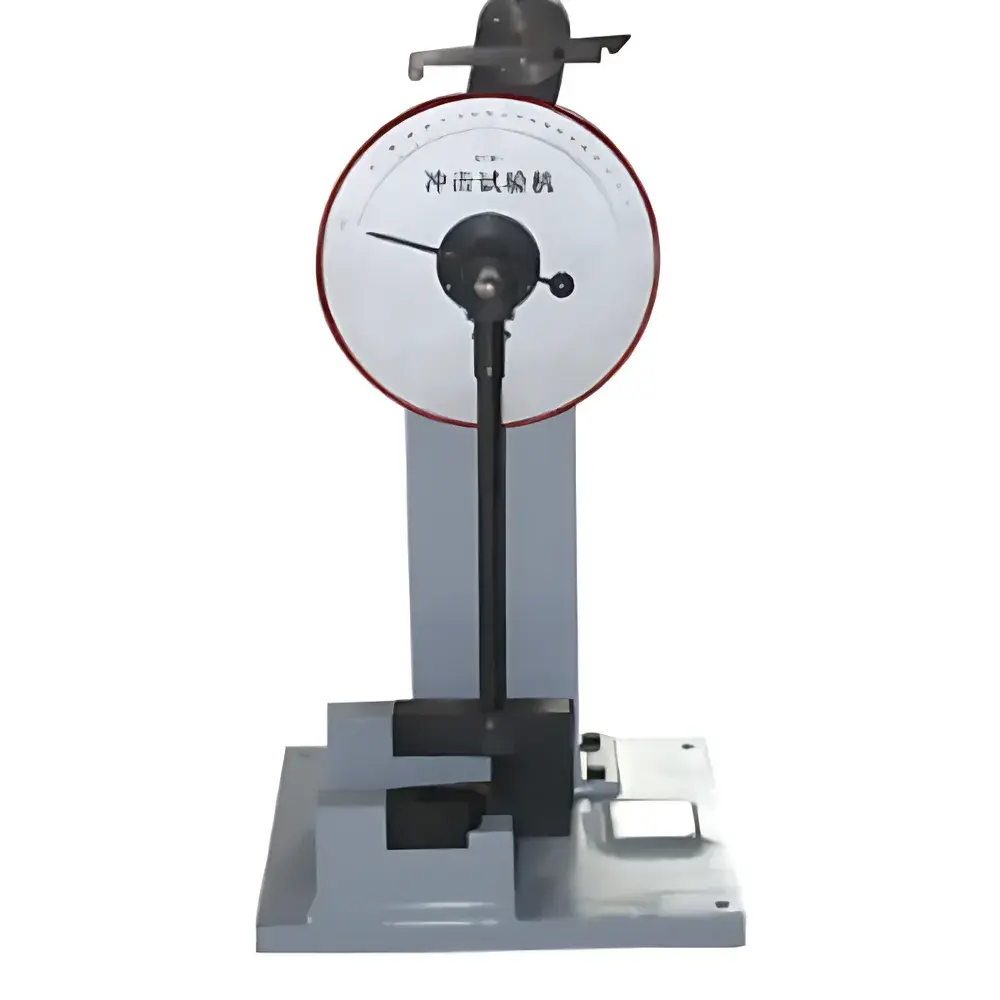
YANRUN MJB-100S Digital Display Charpy/Izod Impact Testing Machine
| Brand | YANRUN |
|---|---|
| Origin | Shanghai, China |
| Manufacturer Type | Direct Manufacturer |
| Instrument Type | Pendulum Impact Tester |
| Nominal Impact Energy | 100 J (1 J/division) |
| Impact Velocity | 4.45 m/s |
| Pendulum Torque (Impact Constant) | 53.5714 N·m |
| Pendulum Pre-lift Angle | 150° |
| Distance from Pendulum Axis to Specimen Center | 590 mm |
| Support Span | 240 mm |
| Radius of Anvil Arc | R15 ± 0.05 mm |
| Striking Edge Thickness | 40 mm |
| Specimen Dimensions | 20 mm × 20 mm × 300 mm |
| Display Resolution | 1 J |
Overview
The YANRUN MJB-100S Digital Display Charpy/Izod Impact Testing Machine is a precision-engineered pendulum-type impact tester designed for standardized determination of impact toughness in wood-based panels—including particleboard, medium-density fiberboard (MDF), plywood, and laminated veneer lumber—as well as rigid plastics and non-metallic engineering materials. It operates on the fundamental principle of gravitational potential energy conversion: a calibrated pendulum is raised to a fixed pre-lift angle (150°), released, and allowed to strike a notched or unnotched specimen supported at a defined span (240 mm). The energy absorbed by the specimen during fracture is calculated from the difference between initial and residual pendulum heights—measured via high-stability angular transduction and displayed digitally with 1 J resolution. With a nominal impact energy of 100 J and an impact velocity of 4.45 m/s at the point of contact, the MJB-100S complies with core mechanical testing geometries specified in ISO 179-1 (Charpy), ISO 180 (Izod), and GB/T 17657 (wood-based panel testing). Its robust cast-iron frame, hardened steel anvil (R15 ± 0.05 mm arc radius), and precisely machined 40 mm thick striking edge ensure repeatable load application and minimal energy loss due to frame deformation or blade flexure.
Key Features
- Precision digital display module with 1 J resolution and real-time energy readout—eliminating parallax error inherent in analog dials
- Calibrated pendulum system with verified impact constant of 53.5714 N·m, traceable to national metrological standards
- Fixed support span of 240 mm and specimen center-to-axis distance of 590 mm—ensuring strict adherence to ISO/GB geometric requirements
- Hardened steel anvil with R15 ± 0.05 mm radius and 40 mm thick impact blade—minimizing plastic deformation and maintaining consistent stress concentration
- Adjustable specimen clamping mechanism with M12 threaded foot bolts for level installation and vibration damping
- Integrated safety guard interlock system that halts pendulum release unless the protective shield is fully closed
Sample Compatibility & Compliance
The MJB-100S accommodates standard rectangular specimens measuring 20 mm × 20 mm × 300 mm—dimensions aligned with ISO 179-1 Annex A (Charpy unnotched) and GB/T 17657–2013 Clause 4.14 for wood-based panels. Optional notch fixtures (not included) enable Izod configuration per ISO 180. All mechanical dimensions—including anvil radius tolerance (±0.05 mm), blade thickness (40 mm), and pendulum geometry—are validated against ISO/IEC 17025 calibration protocols. The instrument satisfies essential requirements for GLP-compliant quality control laboratories performing routine mechanical property verification in furniture, construction, and composite material manufacturing. While not FDA-regulated, its measurement stability and documented repeatability support internal audit readiness under ISO 9001:2015 and IATF 16949 frameworks.
Software & Data Management
The MJB-100S operates as a standalone hardware platform with no embedded software or USB connectivity. Energy values are displayed directly on the integrated LED digital indicator. For traceable data recording, users may manually log results into LIMS or Excel-based QC templates. To meet 21 CFR Part 11 requirements for electronic records, external digital calipers or torque-verifiable height sensors (e.g., linear encoders with RS-232 output) can be interfaced via third-party DAQ systems—though such integration requires validation per laboratory SOPs. Calibration certificates—including pendulum moment of inertia verification and anvil radius measurement reports—are provided with each unit and recommended for annual re-certification per ISO/IEC 17025 guidelines.
Applications
- Quality assurance testing of structural wood composites in panel manufacturing facilities
- Batch release verification for MDF and particleboard per EN 312 or ANSI A208.1 specifications
- R&D evaluation of resin formulation effects on impact resistance in thermoset composites
- Comparative analysis of surface treatment influence (e.g., melamine impregnation) on edge-impact performance
- Educational use in materials science labs for hands-on demonstration of brittle-to-ductile transition behavior
FAQ
Is the MJB-100S compliant with ASTM D1822?
No—the MJB-100S follows ISO/GB geometries optimized for板材 (panel) testing; ASTM D1822 specifies tensile-impact methodology and is not applicable to pendulum-based Charpy/Izod configurations.
Can it test specimens thinner than 20 mm?
Not without recalibration and geometric validation; the 240 mm support span and 590 mm axis-to-specimen distance are fixed per design, and deviation from 20 mm thickness affects strain rate and energy absorption interpretation.
Does it include calibration weights or verification tools?
Yes—a certified pendulum torque verification report and dimensional inspection certificate for the anvil and blade are supplied; user-performed verification uses the included hex key (S=10) and spirit level.
What maintenance intervals are recommended?
Lubrication of the pendulum bearing every 6 months and annual verification of anvil radius and blade edge wear using optical profilometry or certified gauge blocks.
Is technical support available outside China?
YANRUN provides remote troubleshooting documentation in English; local service partners must be engaged for on-site calibration or repair—contact authorized distributors for regional support agreements.



