
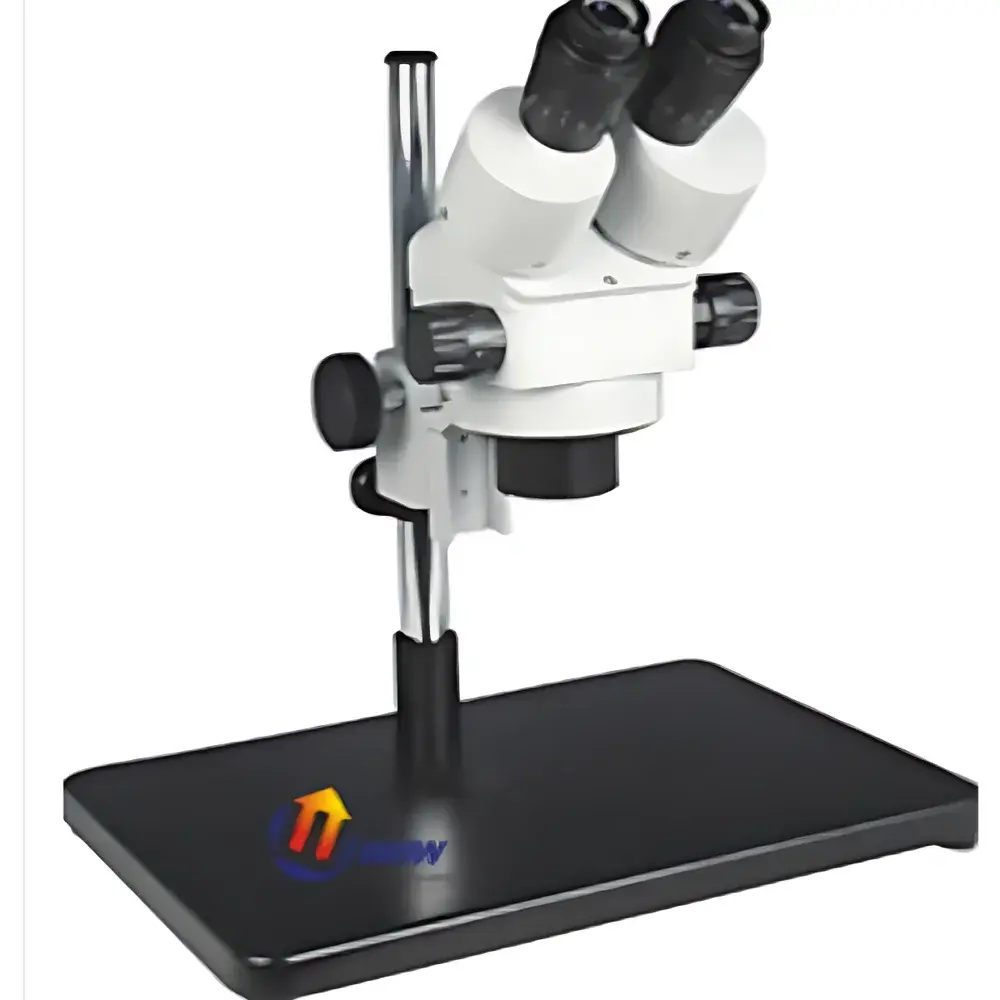
YANRUN XTZ-03 Continuous Zoom Stereo Microscope
| Brand | YANRUN |
|---|---|
| Origin | Shanghai, China |
| Manufacturer Type | Direct Manufacturer |
| Region Classification | Domestic (China) |
| Model | XTZ-03 Continuous Zoom Stereo Microscope |
| Zoom Ratio | 6.5:1 (0.7× to 4.5×) |
| Working Distance | 95 mm |
| Objective Range | 0.7× to 4.5× |
| Eyepiece | Widefield 10× (20 mm field diameter) |
| Field of View | 5.1 mm to 33 mm |
| Interpupillary Adjustment | 55–75 mm |
| Optical Path | Inclined dual-path zoom system with 13° and 45° viewing angles |
| Standard Accessories | One stereo head, one base plate, one pair of 10× eyepieces |
Overview
The YANRUN XTZ-03 Continuous Zoom Stereo Microscope is an entry-to-mid-tier industrial and educational stereo inspection system engineered for high-fidelity three-dimensional observation of macro- to meso-scale specimens. It employs a coaxial inclined optical path design with dual viewing angles—13° for low-profile ergonomic observation and 45° for standard benchtop use—enabling flexible operator positioning without optical compromise. The instrument operates on the principle of Greenough-style stereoscopy, where separate objective-lens paths deliver slightly different perspectives to each eye, generating natural depth perception essential for precision assembly, soldering inspection, biological dissection, and quality control tasks. Its continuous zoom mechanism provides seamless magnification adjustment across a 6.5:1 range (0.7× to 4.5×), eliminating discrete step transitions and supporting stable focus tracking during dynamic magnification changes—a critical advantage over fixed-magnification or stepped zoom systems in production environments.
Key Features
- Continuous zoom optics with 6.5:1 magnification ratio (0.7×–4.5×), ensuring smooth scaling without image jump or focus shift
- Inclined dual-path optical architecture enabling both 13° and 45° observation angles for ergonomic adaptability and reduced neck strain during prolonged use
- Fixed working distance of 95 mm—optimized for hands-on manipulation under the objective, compatible with tweezers, probes, and micro-tools
- Widefield 10× eyepieces (20 mm field number) delivering a field of view ranging from 5.1 mm at highest magnification to 33 mm at lowest magnification
- Interpupillary adjustment range of 55–75 mm accommodating diverse user anthropometry without optical vignetting
- Robust mechanical construction with integrated base plate and rigid stereo head mount, minimizing vibration transmission during manual handling
- Modular design supporting field-upgradable components including auxiliary eyepieces, auxiliary objectives, and external illumination interfaces
Sample Compatibility & Compliance
The XTZ-03 is optimized for non-destructive macroscopic examination of opaque, reflective, or low-contrast samples—including printed circuit boards (PCBs), metal castings, polymer components, botanical specimens, entomological samples, and forensic evidence. Its long working distance and large depth of field allow full integration with mechanical stages, micromanipulators, and lighting accessories such as ring LEDs or gooseneck fiber-optic illuminators. While not certified to ISO 10993 or ASTM E2927 for medical device evaluation, the microscope meets general-purpose laboratory equipment requirements under GB/T 29879–2013 (Chinese national standard for stereo microscopes) and conforms to IEC 61000-6-3 for electromagnetic compatibility in industrial settings. It supports GLP-compliant documentation workflows when paired with optional digital imaging modules and timestamped capture software.
Software & Data Management
The XTZ-03 is a hardware-only optical platform and does not include embedded firmware or proprietary control software. However, it is fully compatible with third-party USB/CMOS camera adapters (e.g., 1/2″ sensor cameras with C-mount interface) and widely adopted imaging suites such as Ocular Image Pro, ToupView, or open-source alternatives like MicroManager. When integrated with compliant digital imaging systems, it supports audit-trail-enabled acquisition protocols aligned with FDA 21 CFR Part 11 requirements—including user authentication, electronic signatures, and immutable metadata logging (timestamp, magnification, exposure, lens configuration). Optional calibrated scale bars and stage micrometers facilitate traceable measurement reporting per ISO/IEC 17025 guidelines.
Applications
- Electronics manufacturing: PCB rework verification, solder joint inspection, component placement validation
- Academic teaching labs: Morphological study of insects, plant anatomy, mineral identification, and material fracture analysis
- Industrial QA/QC: Surface defect mapping on machined parts, coating uniformity assessment, weld seam evaluation
- Jewelry and watchmaking: Gemstone inclusion inspection, gear train alignment, engraving fidelity verification
- Forensic laboratories: Toolmark comparison, fiber morphology analysis, document authenticity examination
- Maintenance and repair: Precision calibration of optical assemblies, vacuum chamber internal inspection, connector contact surface review
FAQ
Does the XTZ-03 support trinocular output for camera integration?
Yes—its standard stereo head includes a dedicated phototube port compatible with C-mount or 23.2 mm threaded camera adapters.
Can the working distance be extended beyond 95 mm?
No—the optical design fixes the working distance at 95 mm; however, auxiliary low-power objectives (e.g., 0.5×) are available as optional add-ons to effectively increase field size while maintaining the same physical working clearance.
Is the microscope compatible with cold light sources?
Yes—it accepts standard 12 V DC LED ring lights and fiber-optic illuminators with SMA or DIN connectors; no built-in illumination is included by default.
What calibration standards can be used with this system?
NIST-traceable stage micrometers (10 µm and 100 µm divisions) and reticle-equipped eyepieces (e.g., 10× with 0.1 mm scale) are recommended for routine magnification and measurement verification.
Does YANRUN provide ISO 17025-compliant calibration certificates?
Calibration services are offered through authorized regional partners; certificates include uncertainty budgets and are issued per ISO/IEC 17025:2017 when requested at time of order.



