
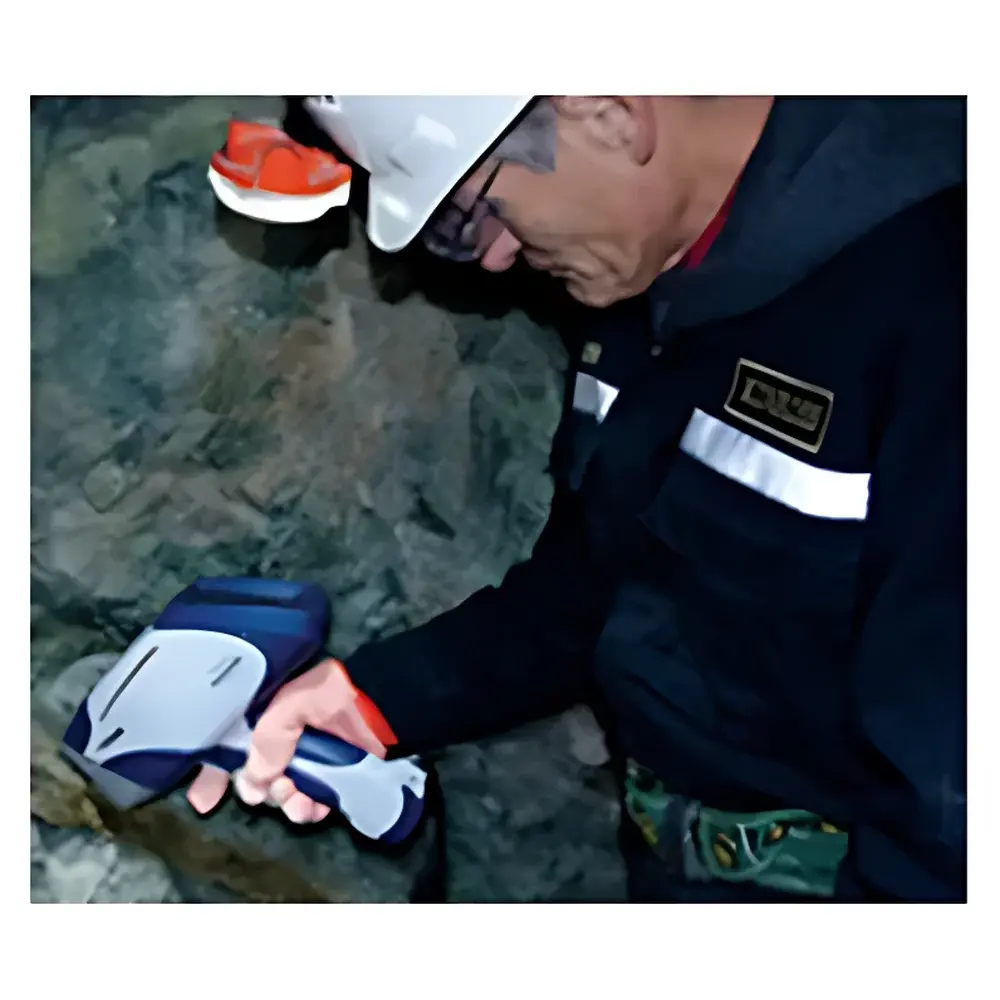
Bruker S1 TITAN Handheld Energy Dispersive X-Ray Fluorescence (ED-XRF) Spectrometer
| Brand | Bruker |
|---|---|
| Origin | Germany |
| Model | S1 TITAN |
| Application | Field-Portable |
| Element Range | Mg–U |
| Detection Limit | 1 ppm–99.99% |
| Energy Resolution | <140 eV (Mn Kα) |
| Repeatability | ±0.1% RSD |
| Detector | Silicon Drift Detector (SDD) |
Overview
The Bruker S1 TITAN is a field-deployable, handheld energy dispersive X-ray fluorescence (ED-XRF) spectrometer engineered for rapid, non-destructive elemental analysis of geological and industrial materials in situ. Based on fundamental ED-XRF physics—where primary X-rays from a micro-focus X-ray tube excite characteristic secondary (fluorescent) X-rays from sample atoms—the instrument quantifies elemental composition by measuring energy spectra and intensities of emitted photons. Its optimized optical path, Peltier-cooled X-ray tube, and high-resolution SDD detector enable reliable detection of light elements down to magnesium (Mg), without requiring vacuum or helium purge—a critical advantage over conventional benchtop XRF systems. Designed for rugged operational environments, the S1 TITAN delivers laboratory-grade analytical performance directly at exploration sites, mine faces, processing plants, and environmental sampling locations.
Key Features
- Light-element capability: Accurate quantification of Mg, Al, Si, P, S, Cl, and K under ambient air conditions—no vacuum chamber or He gas required.
- High-performance detection: Silicon Drift Detector (SDD) with <140 eV energy resolution at Mn Kα ensures precise peak separation and low-background spectral fidelity.
- Robust hardware architecture: IP54-rated enclosure with shock-absorbing housing, sealed optics, and thermal management for stable operation across −10 °C to +50 °C and high-humidity or dusty conditions.
- Intelligent software integration: Onboard Bruker proprietary firmware supports automatic calibration verification, drift correction, and real-time spectral deconvolution using fundamental parameter (FP) algorithms.
- Operator-centric interface: Touchscreen UI with optional multilingual support (17 languages), one-button measurement initiation, auto-sleep mode for power conservation, and integrated CCD camera for precise targeting (optional).
- Data integrity assurance: Built-in audit trail functionality compliant with GLP principles; measurement metadata (time, GPS coordinates, operator ID, exposure parameters) embedded in each result file.
Sample Compatibility & Compliance
The S1 TITAN accommodates heterogeneous solid samples including drill cores, ore chips, crushed rock, tailings, soil, sediment, slurry filters, and industrial powders. Its collimated beam and small-spot analysis mode (optional) minimize matrix effects and improve spatial resolution for layered or inhomogeneous materials. The system complies with IEC 61000-6-3 (EMC), IEC 61000-6-4 (industrial emission), and meets EU RoHS Directive 2011/65/EU for restricted substances. While not certified for regulatory submission per se, its measurement protocols align with ASTM D7727–14 (Standard Guide for Field Portable XRF Use in Soil Screening) and ISO 12847:2017 (Soil quality — Determination of elemental composition by portable XRF). For GMP/GLP-regulated workflows, data export supports CSV, SPC, and Bruker’s proprietary .spx formats compatible with LIMS integration.
Software & Data Management
The onboard software provides real-time spectrum visualization, live elemental mapping overlays (when paired with optional GPS module), and on-device quantitative reporting—including grade estimation (e.g., % Fe, % Cu, ppm Au) and statistical summaries (mean, SD, RSD). All spectra and results are automatically timestamped and stored in internal flash memory (≥16 GB), with optional Wi-Fi or Bluetooth transfer to secure enterprise networks. Data export supports traceable audit logs meeting FDA 21 CFR Part 11 requirements when deployed with validated IT infrastructure and user access controls. Bruker’s desktop software package (S1 TITAN PC Suite) enables advanced batch processing, method optimization, inter-instrument calibration transfer, and custom report generation aligned with ISO/IEC 17025 documentation standards.
Applications
- Geological exploration: Rapid reconnaissance of prospective zones, real-time drill core logging, and lithogeochemical trend identification during field campaigns.
- Mine site operations: In-pit grade control, haul truck payload screening, stockpile homogenization assessment, and mill feed optimization.
- Environmental monitoring: Screening of contaminated soils, sediment profiling for heavy metals (Pb, As, Cd, Hg), and post-remediation verification.
- Mineral processing: Analysis of concentrates, flotation products, slag, and refinery intermediates to monitor recovery efficiency and impurity ingress.
- Industrial raw material verification: Composition checks of industrial minerals (e.g., bauxite, phosphate rock, limestone), catalysts, and refractory materials.
FAQ
Does the S1 TITAN require external calibration standards for routine use?
No—built-in automatic calibration verification (ACV) uses internal reference sources to confirm system stability before and after each measurement session. Certified reference materials (CRMs) are recommended for initial method development and periodic accuracy validation.
Can the instrument quantify light elements reliably in moist or weathered samples?
Yes—its high-power X-ray tube and optimized geometry mitigate signal attenuation from surface moisture; however, consistent sample presentation (e.g., flat, dry surface) is advised for optimal Mg–P quantification.
Is GPS data recorded with every measurement?
GPS tagging is enabled by default when the internal GNSS module is active; coordinates are embedded in all exported data files and can be disabled via administrator settings.
What safety certifications does the S1 TITAN hold?
It carries CE marking per EU Directive 2014/30/EU (EMC) and 2014/53/EU (RED), and complies with IEC 62471 for LED/X-ray radiation safety classification (Class 1 device under normal operation).
How is data security maintained during wireless transmission?
Wi-Fi transfers utilize WPA2-Enterprise encryption; all communication channels support TLS 1.2+ when interfacing with authenticated corporate servers or cloud platforms.





