
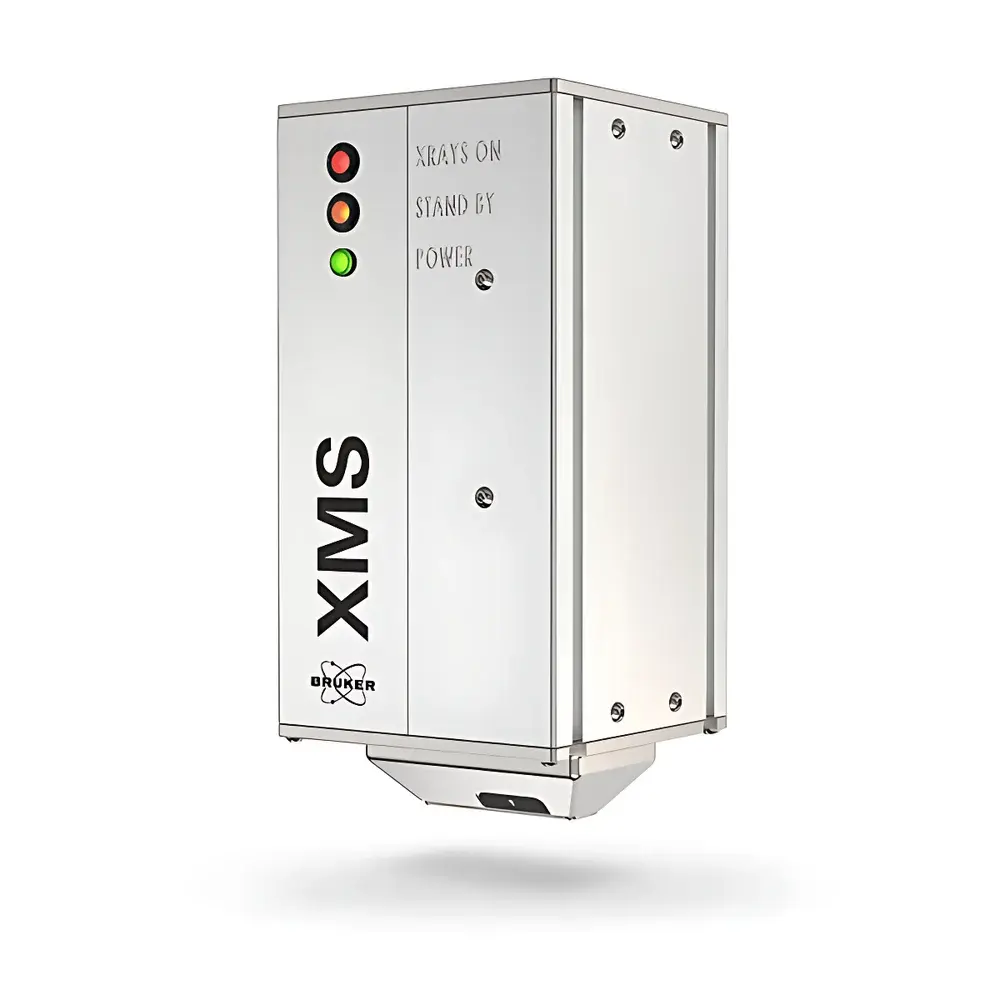
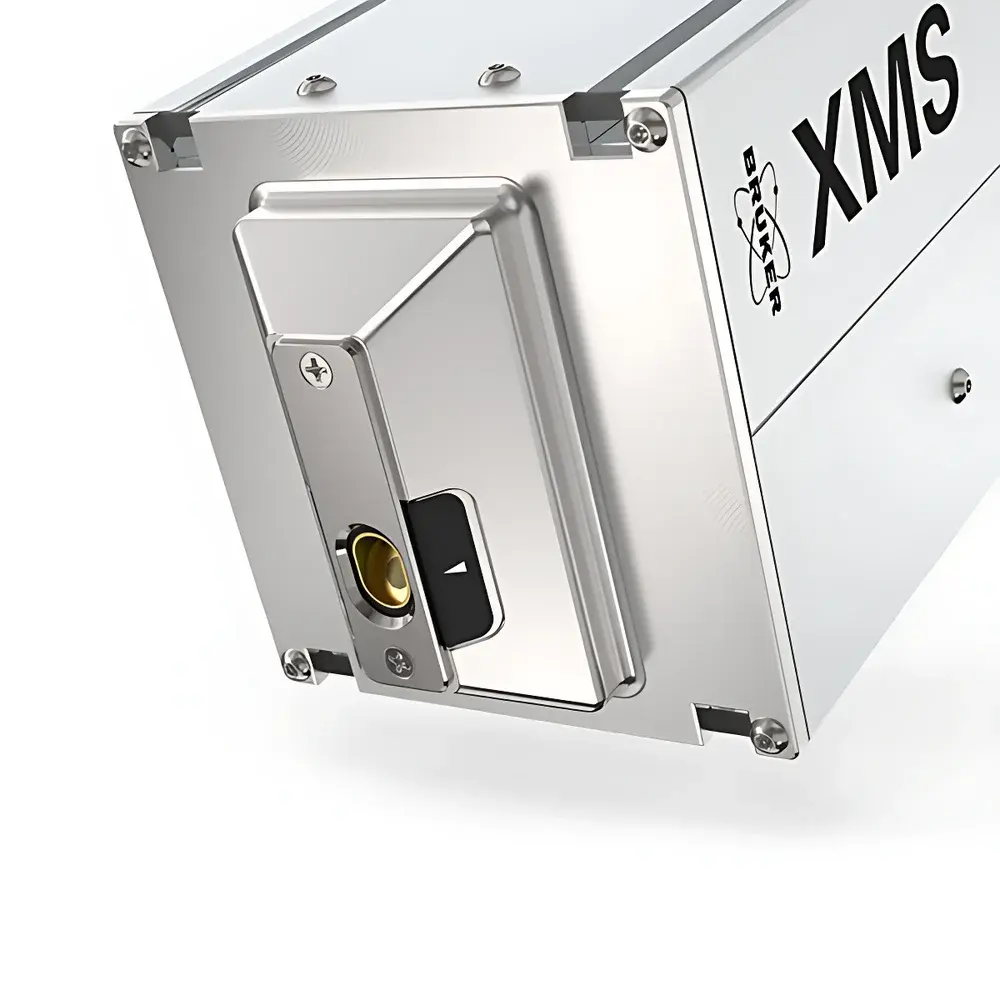
Bruker XMS Industrial Online Energy Dispersive X-Ray Fluorescence Spectrometer
| Brand | Bruker |
|---|---|
| Origin | USA |
| Manufacturer Type | Authorized Distributor |
| Origin Category | Imported |
| Model | XMS |
| Form Factor | Benchtop / Floor-Standing |
| Application Type | General-Purpose |
| Elemental Range | Mg (Z=12) to U (Z=92) |
| Quantitative Range | 1 ppm – 99.99 wt% |
| Energy Resolution | <140 eV (at Mn Kα, −20 °C) |
| Repeatability | ≤0.1% RSD (for major elements under controlled conditions) |
| Detector | Silicon Drift Detector (SDD) |
Overview
The Bruker XMS is an industrial-grade, online energy dispersive X-ray fluorescence (ED-XRF) spectrometer engineered for real-time elemental analysis in continuous manufacturing environments. Operating on the fundamental principle of X-ray fluorescence—where primary X-rays excite atoms in a sample, causing emission of characteristic secondary X-rays—the XMS delivers non-destructive, multi-element quantification without sample digestion or consumables. Unlike laboratory-based ED-XRF systems, the XMS integrates robust mechanical design, thermal stabilization, and radiation-hardened electronics to withstand vibration, temperature fluctuations, and ambient dust common in foundries, metal recycling facilities, and continuous casting lines. Its architecture supports direct mounting onto conveyor belts, ladles, or molten metal skimming stations via custom process interfaces, enabling measurement intervals as short as 5–30 seconds per analysis cycle. The system complies with IEC 61000-6-2 (EMC immunity) and IEC 61000-6-4 (EMC emissions), and meets ANSI N43.3 radiation safety requirements for enclosed industrial instrumentation.
Key Features
- High-throughput SDD detector with active cooling and digital pulse processing for optimized count-rate linearity (>500 kcps) and low dead-time operation
- Optimized X-ray tube configuration (Pd or Rh anode, 50 kV/1 mA max) with programmable voltage/current control to balance excitation efficiency and spectral background across light-to-heavy element ranges
- Automated collimation and filter selection to enhance peak-to-background ratio for trace-level detection (e.g., Pb, Cd, As in aluminum alloys)
- IP65-rated enclosure with purge-compatible housing for inert-gas or dry-air purging in high-humidity or reactive atmospheres
- Real-time spectral acquisition and on-board quantification using fundamental parameters (FP) algorithms with matrix correction, eliminating need for daily recalibration
- Integrated Ethernet/IP and OPC UA interfaces for seamless PLC synchronization and MES integration (e.g., Siemens SIMATIC, Rockwell FactoryTalk)
Sample Compatibility & Compliance
The XMS accommodates solid, granular, and semi-molten samples—including hot metal streams (up to 800 °C with optional water-cooled interface), castings, billets, scrap fragments, and powder blends. Sample presentation is configurable via conveyor-mounted holders, rotating sample cups, or fixed-position flow cells. All quantitative calibrations are traceable to NIST SRM reference materials (e.g., NIST 2173, 2174, 2175 series) and validated per ASTM E1621 (Standard Guide for XRF Elemental Analysis) and ISO 21043 (XRF—General principles and guidelines). The system supports audit-ready data logging compliant with FDA 21 CFR Part 11 when deployed in GMP-regulated metal additive manufacturing or medical device component production.
Software & Data Management
Bruker’s XMS Control Suite provides embedded Linux-based firmware with dual-mode operation: standalone local control via touchscreen HMI or remote supervision via web browser (HTTPS/TLS 1.2). Real-time spectra, elemental concentrations, trend charts, and alarm states (e.g., out-of-spec Mg/Si ratio in 6061 aluminum) are streamed to SQL databases or cloud platforms (AWS IoT Core, Azure Industrial IoT) using MQTT or RESTful APIs. Full audit trails—including user logins, method changes, calibration updates, and raw spectrum archives—are retained for ≥36 months. Batch reports export in PDF/A-2b and CSV formats, meeting GLP documentation standards for third-party certification bodies.
Applications
- Molten metal composition monitoring pre-casting to ensure alloy grade conformity (e.g., ASTM B221 for aluminum extrusion billets)
- Scrap sorting verification in metal recycling plants to detect tramp elements (Sn, Pb) exceeding EN 13020 limits
- In-line quality gate for sintered powder metallurgy parts, verifying Fe/Cu/Ni/Cr ratios within ±0.05 wt%
- Coating thickness and composition validation on galvanized steel coils using dual-layer FP modeling
- Slag analysis in ferroalloy production to optimize flux addition and reduce refractory wear
FAQ
Can the XMS analyze molten metals directly?
Yes—when equipped with a water-cooled quartz viewport and argon-purged measurement chamber, the XMS performs stable analysis on molten aluminum, copper, and zinc alloys at temperatures up to 800 °C.
Is factory calibration required after installation?
No—each unit ships with factory-applied FP calibration verified against ≥20 certified reference materials; field validation only requires a single check standard per application matrix.
Does the system support regulatory compliance for automotive PPAP submissions?
Yes—measurement uncertainty budgets, GRR studies (per AIAG MSA 4th Ed.), and full traceability documentation are provided upon request for PPAP Level 3 submissions.
What maintenance intervals are recommended?
Detector vacuum integrity and X-ray tube output are monitored continuously; scheduled maintenance is biannual and limited to optical window cleaning and purge gas filter replacement.
Can existing LIMS or SAP QM modules interface with XMS data?
Yes—via standard ODBC drivers or preconfigured SAP PI/PO adapters supporting IDoc and RFC protocols for automatic result posting to inspection lots.






