
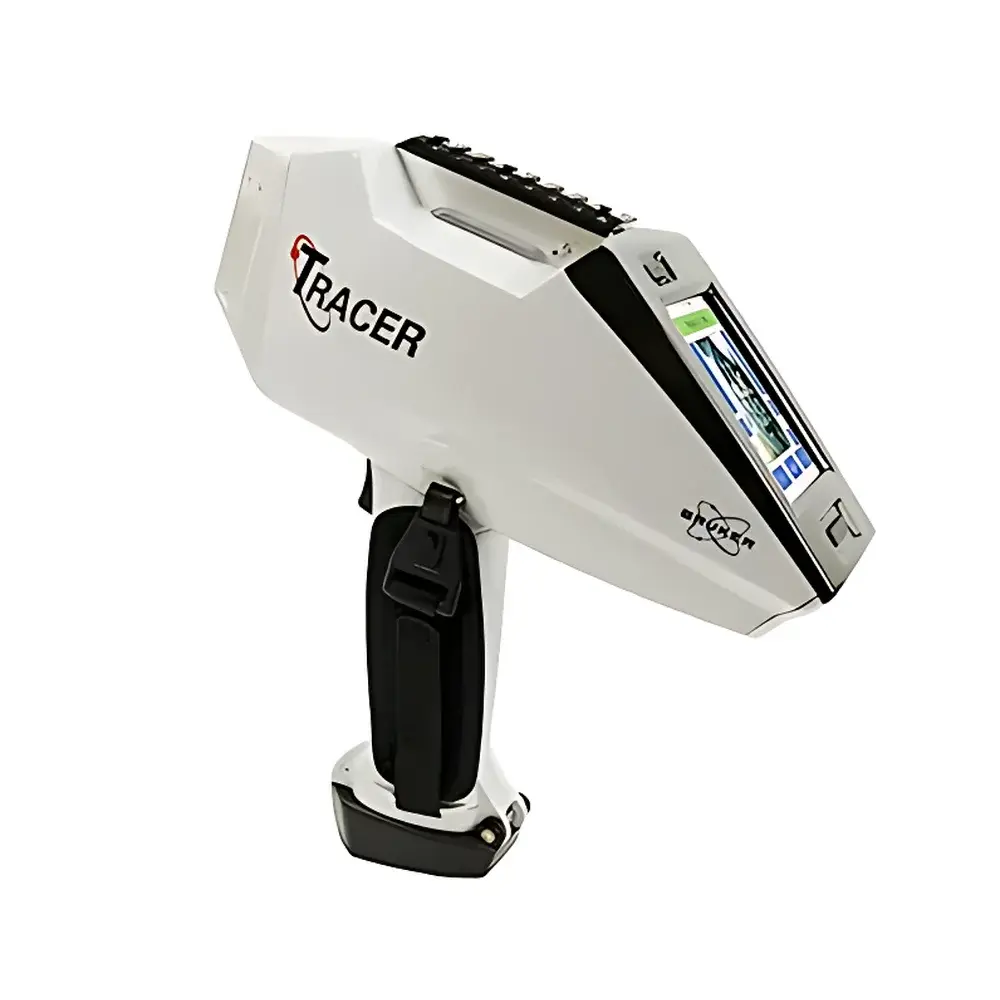
Bruker Tracer 5i Portable Energy Dispersive X-Ray Fluorescence Spectrometer
| Brand | Bruker |
|---|---|
| Origin | USA |
| Manufacturer Type | Authorized Distributor |
| Origin Category | Imported |
| Model | Tracer 5i |
| Application | Handheld/Portable |
| Industry Type | General-Purpose |
| Elemental Range | Na (11) – U (92), down to F (9) under vacuum/He flush |
| Quantification Range | 1 ppm – 99.99% |
| Energy Resolution | <140 eV (at Mn Kα) |
| Repeatability | 0.1% RSD |
| Detector | Silicon Drift Detector (SDD) |
Overview
The Bruker Tracer 5i is a research-grade, handheld energy dispersive X-ray fluorescence (EDXRF) spectrometer engineered for non-destructive elemental analysis in situ—without sample preparation or laboratory infrastructure. Leveraging fundamental XRF physics, the instrument excites atoms in a sample using a microfocus X-ray tube; emitted characteristic X-rays are collected and resolved by a high-performance silicon drift detector (SDD), enabling quantitative and qualitative identification of elements from sodium (Na, Z=11) to uranium (U, Z=92), with extended light-element sensitivity down to fluorine (F, Z=9) under controlled vacuum or helium purge environments. Its compact, ergonomic design integrates industrial-grade shielding and thermal management, ensuring stable operation across field, museum, excavation site, and conservation studio settings. Unlike conventional portable XRF systems, the Tracer 5i delivers lab-equivalent spectral fidelity through SharpBeam™ collimation optics, optimized beam geometry, and real-time spectral deconvolution algorithms—making it a benchmark for authenticity verification, provenance studies, pigment characterization, and corrosion layer profiling in cultural heritage science.
Key Features
- SharpBeam™ Beam Optimization: Proprietary collimator architecture enables precise spatial resolution with user-selectable 3 mm and 8 mm spot sizes—critical for mapping heterogeneous surfaces such as layered paint strata or corroded metal artifacts.
- Vacuum & Helium Purge Capability: Integrated NASA-derived miniature vacuum pump establishes localized vacuum within the measurement path—enhancing detection sensitivity for light elements (Na, Mg, Al, Si) in glass, glazes, and ceramics. Optional He flush mode further extends light-element response without physical contact or environmental risk to fragile substrates (e.g., parchment, silk, or degraded paper).
- Configurable Excitation Pathway: Interchangeable filter sets and custom-fabrication tools allow users to tailor excitation conditions for specific matrices—improving peak-to-background ratios for trace elements in complex archaeological alloys or pigments.
- High-Resolution SDD Detection: Large-area silicon drift detector with <140 eV energy resolution at Mn Kα ensures robust peak separation, essential for resolving overlapping transitions (e.g., Pb M-lines vs. S Kα in lead-white pigment analysis).
- Multi-Platform Control Architecture: Operable via integrated PDA interface, Windows-based PC software (ARTAX® and ESPRIT™), or tablet-connected remote control—supporting both real-time decision-making and post-acquisition advanced modeling.
Sample Compatibility & Compliance
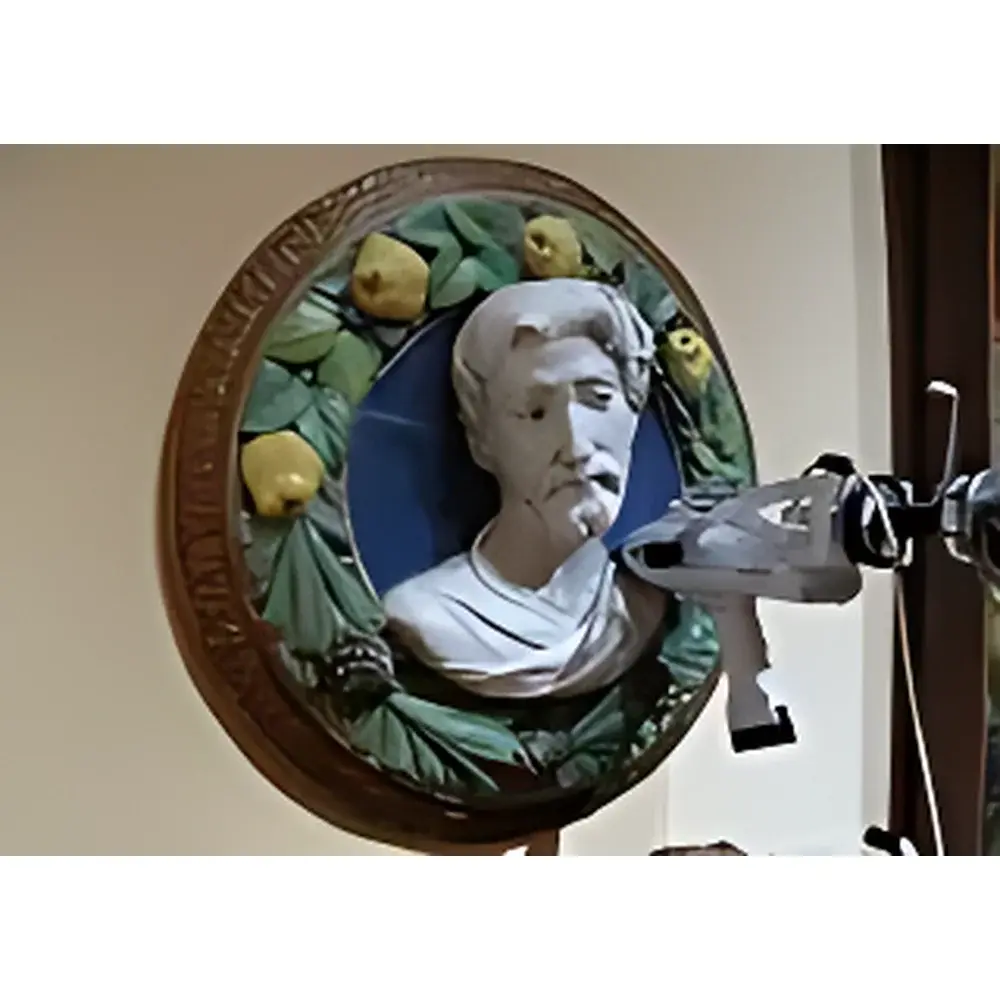
The Tracer 5i is validated for direct analysis of non-conductive, irregular, and temperature-sensitive objects—including fresco fragments, bronze statuary, ceramic shards, illuminated manuscripts, and textile dyes—without requiring coating, sectioning, or vacuum chamber insertion. Its low-power excitation (up to 50 kV, 2 µA) and localized beam minimize radiation dose and thermal loading. The system complies with IEC 61000-6-3 (EMC) and IEC 61000-6-4 standards, and meets FDA 21 CFR Part 11 requirements when deployed with audit-trail-enabled software configurations. It supports GLP/GMP-aligned workflows through instrument calibration logs, user access controls, and electronic signature-capable reporting modules—facilitating integration into museum conservation labs and academic research centers subject to ISO/IEC 17025 accreditation.
Software & Data Management
Data acquisition and interpretation are powered by Bruker’s ARTAX® and ESPRIT™ software suites, which provide matrix-matched standardless quantification, fundamental parameter (FP) modeling, and multivariate statistical tools (PCA, clustering). Spectral libraries include reference data for historic pigments (e.g., CCI Pigment Database), ancient metallurgical alloys (e.g., Roman brass, Chinese bronze), and geological matrices. All spectral files adhere to ASTM E1361-compliant .rxf format, enabling interoperability with third-party platforms (e.g., PyMCA, QXAS). Raw spectra, metadata (GPS coordinates, operator ID, ambient conditions), and calibration history are stored in encrypted SQLite databases with automated backup and version control—ensuring full traceability for peer-reviewed publication or regulatory submission.
Applications
- Art Conservation & Authentication: Identification of anachronistic pigments, detection of restoration interventions, and differentiation between natural vs. synthetic ultramarine or vermilion.
- Archaeological Provenance Studies: Trace-element fingerprinting of obsidian, pottery clays, and metal ingots to reconstruct ancient trade networks.
- Museum Collections Management: Rapid screening of storage environments for corrosive chloride deposits on archaeological metals or sulfur compounds affecting organic artifacts.
- Field-Based Geoarchaeology: In-situ soil and sediment profiling to identify anthropogenic activity markers (e.g., elevated P, Cu, Zn in occupation layers).
- Academic Research & Teaching: Undergraduate and graduate training in analytical archaeometry, materials science, and conservation ethics—supported by Bruker’s open-access method templates and spectral simulation tools.
FAQ
Can the Tracer 5i detect light elements like sodium or magnesium in glass artifacts?
Yes—when operated under internal vacuum or helium purge, the system achieves reliable detection limits below 100 ppm for Na, Mg, Al, and Si in silicate matrices.
Is sample damage possible during analysis?
No—X-ray exposure is non-invasive and fully compliant with ICOM-CC guidelines for heritage object analysis; no surface alteration or heating occurs under standard operating parameters.
How is calibration maintained across field deployments?
The instrument includes built-in check sources (Fe-55, Cd-109) and supports daily energy calibration verification; factory-certified reference standards (e.g., NIST SRM 2711a) can be used for quantitative validation.
Does the system support regulatory reporting for cultural property documentation?
Yes—ESPRIT™ software provides 21 CFR Part 11-compliant audit trails, electronic signatures, and PDF/A-1b export for archival submission to national heritage agencies or UNESCO documentation portals.
What training resources are available for new users?
Bruker offers certified instructor-led workshops, remote application support, and a publicly accessible library of peer-reviewed case studies from institutions including the British Museum, the Metropolitan Museum of Art, and C2RMF (Paris).




