
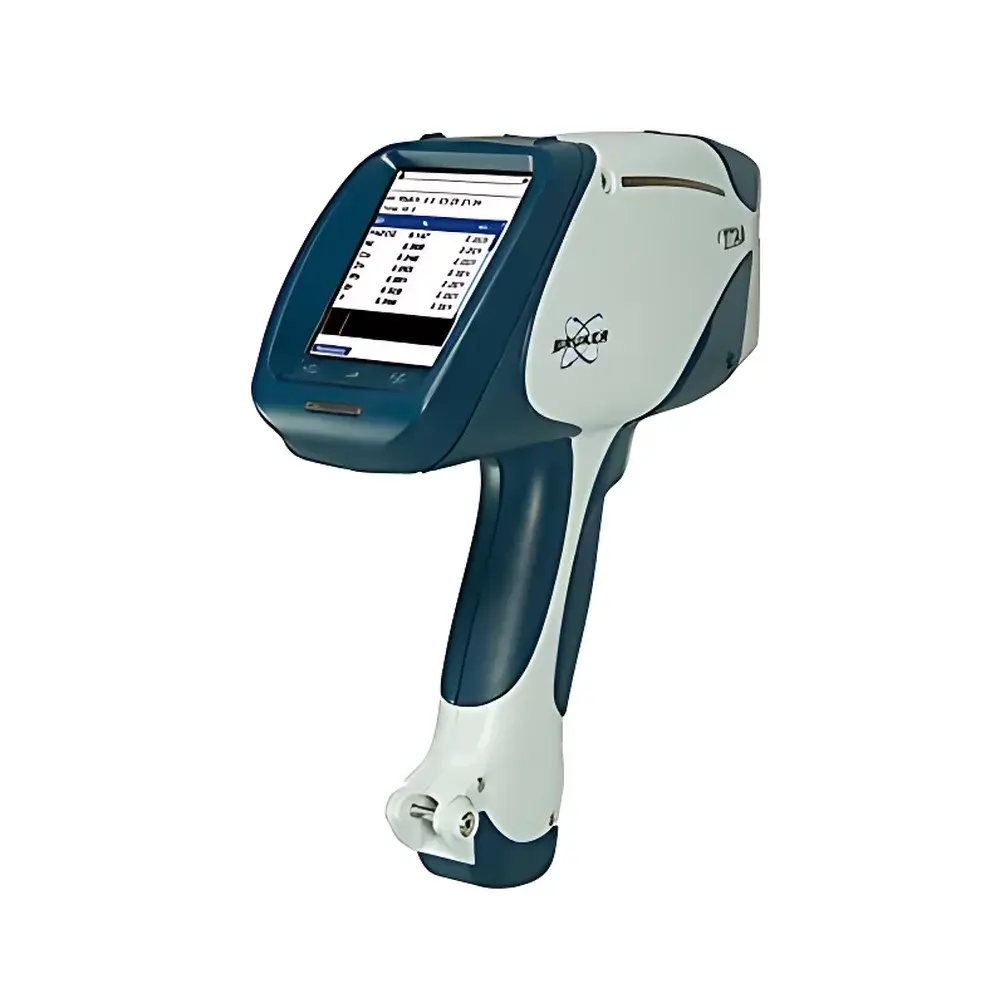
Bruker S1 TITAN Handheld Energy Dispersive X-Ray Fluorescence (ED-XRF) Spectrometer
| Brand | Bruker |
|---|---|
| Origin | Germany |
| Model | S1 TITAN |
| Application | Handheld/Portable |
| Element Range | Mg–U |
| Concentration Range | 1 ppm – 99.99% |
| Energy Resolution | <140 eV (Mn Kα) |
| Detector | Silicon Drift Detector (SDD) |
| Weight | 1.23 kg |
| X-ray Tube | 50 kV |
| Compliance | ASTM F963, RoHS, USP <232>/<233>, EPA Method 6200, ISO 12885, EN 62321 |
Overview
The Bruker S1 TITAN is a handheld energy dispersive X-ray fluorescence (ED-XRF) spectrometer engineered for field-deployable elemental analysis with laboratory-grade performance. Based on micro-focus X-ray tube excitation and high-resolution silicon drift detector (SDD) technology, the instrument operates on fundamental principles of X-ray fluorescence: incident X-rays eject inner-shell electrons from sample atoms; subsequent electron transitions emit characteristic secondary X-rays whose energies identify elements, while intensities correlate quantitatively with concentration. Designed for rugged portability—weighing only 1.23 kg—the S1 TITAN integrates a 50 kV X-ray tube, sealed optical path, and IP54-rated housing to ensure operational reliability in demanding industrial, geological, and regulatory environments. Its core architecture supports rapid, non-destructive, multi-element analysis across solid, powdered, and irregularly shaped samples without requiring vacuum or helium purge.
Key Features
- SharpBeam® Optimized Geometry: Proprietary collimation and detector–source alignment minimize scattered radiation, reduce power consumption by up to 30%, extend battery life per charge, and improve detection limits (LODs) by enhancing peak-to-background ratio.
- X-Flash® SDD Detector: High-count-rate silicon drift detector with <140 eV energy resolution at Mn Kα (5.9 keV), enabling precise separation of overlapping spectral lines (e.g., S Kα/Pb Mα, Cr Kβ/Mn Kα) critical for complex matrices.
- SMART®Grade Timing Algorithm: Real-time adaptive dwell time control dynamically adjusts measurement duration based on signal intensity and statistical confidence—reducing analysis time for high-concentration elements while maintaining precision for trace-level detection.
- Integrated 4.3-inch Color Touchscreen: Android-based interface with intuitive workflow navigation, on-device calibration management, and immediate spectral visualization—including live background subtraction and peak deconvolution.
- Ruggedized Industrial Design: Sealed enclosure compliant with IP54 (dust-protected, splash-resistant), MIL-STD-810G shock/vibration testing, and operating temperature range of –10 °C to 50 °C.
Sample Compatibility & Compliance
The S1 TITAN accommodates heterogeneous solids (alloys, ores, soils), pressed pellets, and coated surfaces without sample preparation. It supports certified reference materials (CRMs) traceable to NIST and BAM standards. Regulatory compliance includes full alignment with ASTM F963 (toy safety), IEC 62321-5 (RoHS screening), EPA Method 6200 (soil and sediment), USP / (elemental impurities in pharmaceuticals), and California Proposition 65. Data integrity meets FDA 21 CFR Part 11 requirements through audit-trail-enabled software, electronic signatures, and secure user access levels—supporting GLP/GMP-aligned quality assurance protocols.
Software & Data Management
Bruker’s proprietary S1 Connect software provides comprehensive data handling: real-time spectral acquisition, library-based grade identification (e.g., UNS, EN, ASTM alloy codes), custom calibration development using empirical or fundamental parameters (FP) methods, and export to CSV, PDF, or LIMS-compatible formats. Cloud synchronization enables centralized fleet management, remote firmware updates, and collaborative reporting across global QA/QC teams. All raw spectra and metadata are stored with timestamped operator ID, GPS coordinates (optional), and environmental sensor logs (temperature, humidity).
Applications
- Positive Material Identification (PMI): Verification of stainless steels, nickel alloys, titanium grades, and duplex alloys in petrochemical piping, pressure vessels, and aerospace components per ASME B31.3 and ASTM E572.
- Mining & Exploration: In-situ ore grade estimation (Fe, Cu, Zn, Ni, Au via fire assay correlation), core logging, and geochemical mapping with sub-ppm detection for pathfinder elements (As, Sb, Bi).
- Environmental Monitoring: Screening of contaminated soils (Pb, Cd, Hg, As), landfill leachate sediments, and consumer product compliance (Pb in paints, Cd in plastics, Br in flame retardants).
- Recycling & Scrap Sorting: Rapid sorting of mixed ferrous/non-ferrous scrap streams, identification of hazardous coatings (Cr(VI), Pb-based primers), and verification of restricted substances in WEEE and ELV directives.
- Regulatory Screening: On-site enforcement of RoHS, REACH SVHC, CPSIA, and TPCH packaging regulations—validated against certified reference materials and interlaboratory round-robin studies.
FAQ
What elements can the S1 TITAN detect?
It detects elements from magnesium (Mg, Z=12) to uranium (U, Z=92) in solid and powdered samples, with optimal sensitivity for transition metals, rare earths, and heavy metals.
Is the instrument suitable for regulatory-compliant reporting?
Yes—software features support 21 CFR Part 11 compliance, including electronic signatures, audit trails, and data integrity controls required for ISO/IEC 17025-accredited laboratories.
How does SharpBeam® improve analytical performance?
By optimizing X-ray beam geometry, it increases photon flux efficiency at the detector, lowers minimum detection limits (MDLs), reduces thermal load on the tube, and extends operational battery life without sacrificing resolution.
Can the S1 TITAN analyze light elements such as sodium or aluminum?
While Mg is the practical lower limit under ambient air conditions, optional helium purge or vacuum accessories enable enhanced sensitivity for Na, Mg, and Al in specialized configurations.
What calibration options are available?
Pre-loaded factory calibrations cover alloys, mining ores, soils, and consumer goods; users may develop custom FP or empirical calibrations using CRM sets and Bruker’s calibration assistant tools.




