
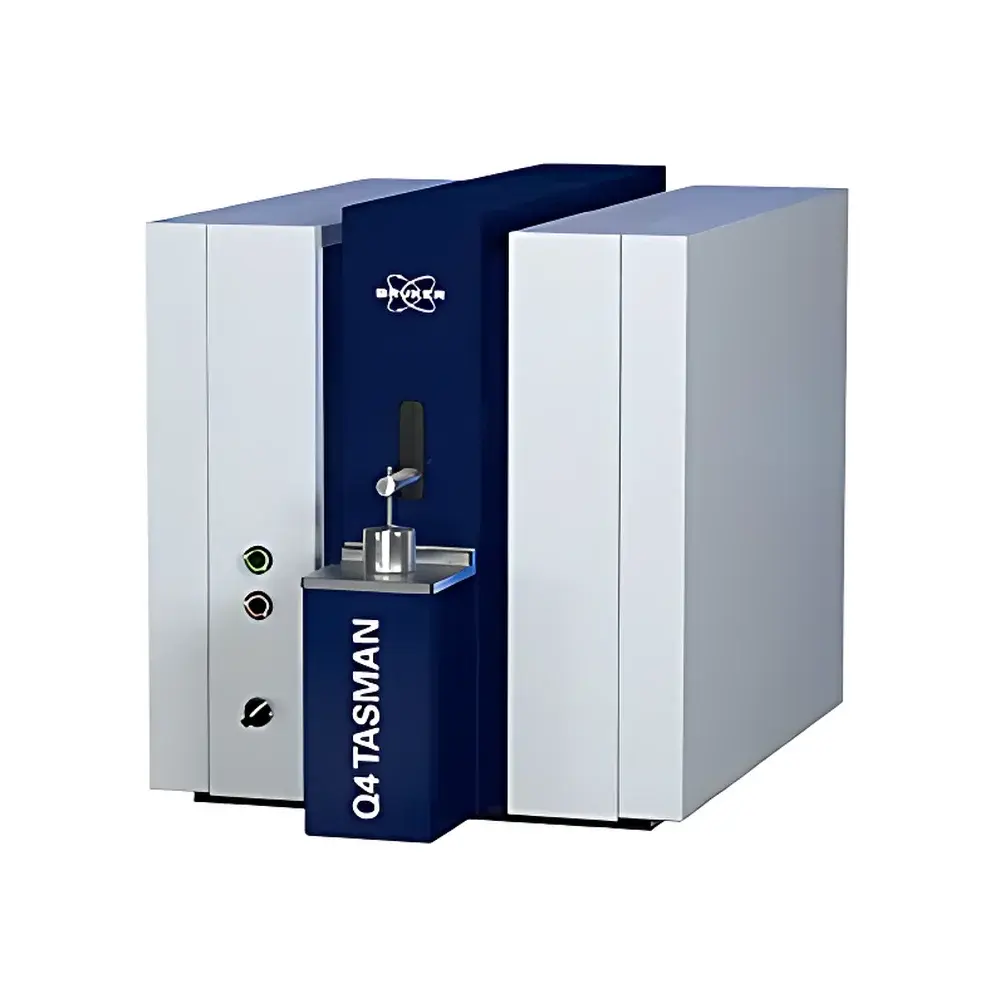
Bruker Q4 TASMAN Desktop Direct-Reading Optical Emission Spectrometer
| Brand | Bruker |
|---|---|
| Origin | Germany |
| Manufacturer Type | Authorized Distributor |
| Origin Category | Imported |
| Model | Q4 TASMAN |
| Instrument Type | Desktop |
| Excitation Method | Spark |
| Detector Type | Dual Detector (PMT + CCD) |
| Focal Length | 800 mm |
| Grating Groove Density | 3600 lines/mm |
| Wavelength Range | 130–800 nm |
| Number of Channels | 128 |
Overview
The Bruker Q4 TASMAN is a high-performance desktop optical emission spectrometer (OES) engineered for precise, rapid elemental analysis of metallic materials. Based on spark source excitation and high-resolution polychromator optics, the system employs a dual-detector architecture—combining photomultiplier tubes (PMTs) for critical trace elements with a fast-readout charge-coupled device (CCD) for full-spectrum acquisition across the ultraviolet to near-infrared range (130–800 nm). Its 800 mm focal length Czerny-Turner monochromator, equipped with a 3600 lines/mm holographic grating, delivers exceptional spectral resolution and line separation—essential for accurate quantification in complex alloy matrices such as stainless steels, aluminum alloys, and high-temperature nickel-based superalloys. Designed for routine laboratory and production-floor environments, the Q4 TASMAN balances analytical rigor with operational simplicity, supporting ISO/IEC 17025-compliant workflows and GLP/GMP-aligned data integrity requirements.
Key Features
- Desktop form factor optimized for space-constrained labs and quality control stations without compromising optical performance or thermal stability.
- Dual detection system: PMTs ensure high sensitivity and low detection limits (sub-ppm) for key alloying and tramp elements (e.g., C, P, S, N, B), while the CCD enables simultaneous full-spectrum capture for flexible method development and post-acquisition re-evaluation.
- Advanced spark source with adjustable energy, frequency, and pre-spark conditioning—enabling robust analysis of heterogeneous samples, coated surfaces, and small parts.
- 30× faster CCD readout versus prior-generation systems, reducing total analysis cycle time to under 30 seconds per sample—including flushing, ignition, integration, and calibration verification.
- Integrated argon purging system with flow monitoring and pressure regulation ensures stable plasma conditions and eliminates atmospheric nitrogen/oxygen interference in the UV region (especially critical for C, P, S, and N determination).
- Modular hardware design supports field-upgradable detector configurations, additional channels, and expanded wavelength coverage where required by evolving application needs.
Sample Compatibility & Compliance
The Q4 TASMAN accommodates solid metallic samples up to Ø 40 mm × 25 mm height, including castings, billets, machined coupons, and wire rods. Sample preparation follows ASTM E415, ISO 11577, and EN 10315 guidelines; flat, clean, and conductive surfaces are required for reproducible spark discharge. The instrument complies with IEC 61000-6-3 (EMC) and IEC 61000-6-4 (industrial emission standards), and its firmware architecture supports audit-trail-enabled operation per FDA 21 CFR Part 11 when deployed with validated software modules. All calibrations are traceable to NIST SRM reference materials, and type-certified analysis packages (ASP) include certified reference values, uncertainty budgets, and matrix-matched calibration curves aligned with ISO 17034 and ISO Guide 35.
Software & Data Management
Operating via Bruker’s Spark Analyzer Pro software, the Q4 TASMAN provides intuitive method setup, real-time spectral visualization, automated inter-element correction (e.g., Fe II line interference on Cr I), and multivariate calibration (PLS, MLR). Data files are stored in vendor-neutral .spc format with embedded metadata (operator ID, timestamp, argon pressure, spark parameters, lamp status). The software supports LIMS integration via ASTM E1384-compliant XML export and includes configurable electronic signatures, change logs, and user-access controls compliant with ISO/IEC 17025 clause 7.7 and EU Annex 11. Optional software modules enable statistical process control (SPC), trend reporting, and remote diagnostics with encrypted TLS 1.2 communication.
Applications
The Q4 TASMAN serves as a primary analytical tool across metallurgical supply chains: incoming raw material verification (scrap sorting, ferroalloy grading), melt-process control (ladle analysis, continuous casting), finished-product certification (ASTM A751, EN 10027), and failure analysis (inclusion mapping, segregation assessment). It is routinely deployed in foundries producing ductile iron and aluminum die-cast components; aerospace suppliers certifying Ti-6Al-4V and Inconel 718; automotive Tier-1 manufacturers validating engine block and transmission housing compositions; and third-party testing laboratories accredited to ISO/IEC 17025 for contract analysis services. Its speed and repeatability also support high-throughput applications in scrap recycling facilities performing real-time alloy identification and grade sorting.
FAQ
What sample preparation is required prior to analysis?
Flat, ground, and contamination-free surfaces are mandatory. Samples must be cleaned with acetone or isopropanol and dried thoroughly; grinding should be performed using silicon carbide paper (P120–P400) without coolant to avoid carbon contamination.
Does the Q4 TASMAN support analysis of non-ferrous alloys such as magnesium or lead?
Yes—pre-configured ASPs are available for Mg-, Pb-, Zn-, and Sn-based alloys, each with matrix-specific calibrations, background correction algorithms, and certified reference material validation protocols.
Can the system be integrated into an existing factory MES or ERP platform?
Yes, via OPC UA or RESTful API interfaces provided through optional SparkLink Connect software, enabling bidirectional data exchange with SAP, Siemens Opcenter, or custom manufacturing execution systems.
Is regular maintenance required beyond argon gas supply and electrode cleaning?
Scheduled maintenance includes annual optical alignment verification, PMT gain calibration, CCD dark-current characterization, and vacuum system leak testing—all documented in the instrument’s service log and supported by Bruker’s global service network.
How is measurement uncertainty estimated and reported?
Uncertainty budgets are calculated per ISO/IEC Guide 98-3 (GUM) and include contributions from calibration standard uncertainty, repeatability, drift, and spectral interference correction residuals—automatically appended to every exported certificate of analysis.





