
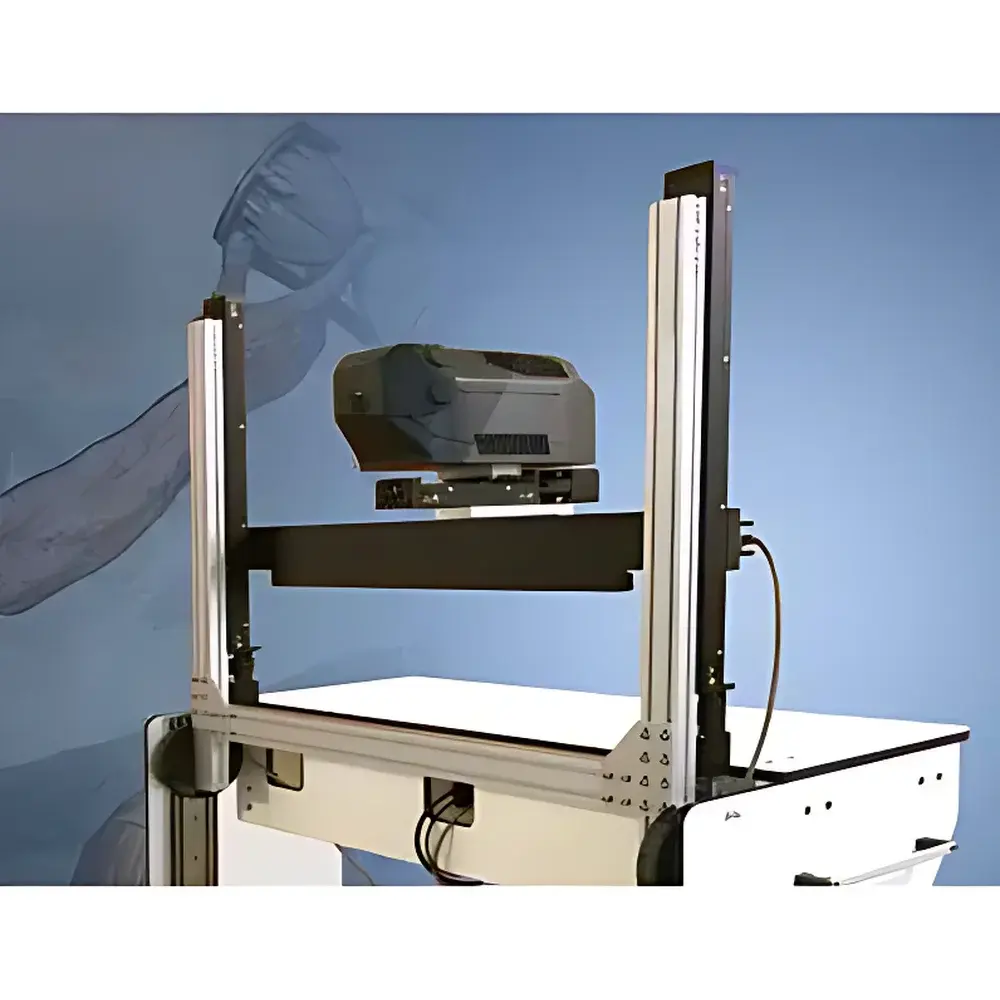
Bruker CRONO Mobile Micro-XRF Spectrometer
| Brand | Bruker |
|---|---|
| Origin | Germany |
| Model | CRONO |
| Application | Portable/Field-Deployable |
| Element Range | Na–U |
| Excitation Source | 50 kV / 100 µA X-ray Tube |
| Spot Size | 2 mm Diameter |
| Scan Speed | 20 mm/s |
| Measurement Distance | 1 cm (non-contact) |
| Detector | Silicon Drift Detector (SDD) |
| Spatial Coverage | Up to 60 cm × 45 cm |
| Energy Resolution | ≤130 eV at Mn Kα |
| Repeatability (RSD) | ≤0.1% for major elements |
| Front-End Electronics | CUBE CMOS preamplifier + DANTE digital pulse processor |
| Software | CRONO Control & Mapping Suite with real-time spectral visualization, pixel-wise spectrum storage, and automated PDF reporting |
Overview
The Bruker CRONO is a fully integrated, motorized micro-spot energy dispersive X-ray fluorescence (EDXRF) spectrometer engineered for high-resolution elemental mapping and rapid in-situ analysis of large, irregular, or immovable samples. Unlike conventional benchtop or handheld XRF systems, the CRONO combines laboratory-grade analytical performance with field-deployable mobility—enabling non-destructive, quantitative, and spatially resolved elemental characterization without sample preparation or vacuum requirements. Its core measurement principle relies on primary X-ray excitation (up to 50 kV / 100 µA) inducing characteristic secondary X-ray emission from elements ranging from sodium (Na, Z=11) to uranium (U, Z=92). The emitted fluorescence photons are collected by a high-efficiency silicon drift detector (SDD), delivering excellent energy resolution (≤130 eV at Mn Kα) and count-rate capability essential for fast scanning and low-concentration detection—even for light elements below 2 keV (e.g., Na, Mg, Al) and heavy-element L-lines above 25 keV (e.g., Sn Lα, Sb Lα, Ba Lα).
Key Features
- Modular mechanical architecture: Motorized XY scanning stage (60 cm × 45 cm max coverage) with quick-release frame and detachable handle for transport; optionally configurable as a tripod-mounted single-point portable XRF unit.
- Non-contact operation at fixed 1 cm working distance—ensures consistent geometry, eliminates surface damage risk, and enables analysis of fragile, curved, or temperature-sensitive materials.
- Dual high-performance front-end electronics: CUBE CMOS preamplifier for low-noise signal conditioning and DANTE digital pulse processor for real-time dead-time correction, pile-up rejection, and high-throughput spectral acquisition.
- Optimized excitation optics: Adjustable collimation (standard 2 mm aperture), programmable tube voltage (5–50 kV) and current (1–100 µA), enabling tailored excitation for specific element groups and matrix types.
- Robust thermal and mechanical stability: Precision-machined aluminum housing with active temperature monitoring ensures long-term calibration retention during extended field deployments.
Sample Compatibility & Compliance
The CRONO accommodates heterogeneous, oversized, or historically sensitive specimens—including paintings, archaeological artifacts, geological slabs, industrial coatings, and electronic assemblies—without sectioning or coating. Its open-beam configuration supports analysis of samples up to 10 cm thick and weighing ≤50 kg. All hardware and firmware comply with IEC 61000-6-3 (EMC) and IEC 61000-6-4 (industrial immunity) standards. Data acquisition workflows support audit-ready operation per ISO/IEC 17025:2017 and GLP principles; spectral metadata (including tube settings, detector live time, ambient temperature, and position coordinates) are embedded in every stored spectrum file (.spe or .crd format). Optional integration with LIMS via Bruker’s Open Data Interface (ODI) facilitates traceability in regulated environments.
Software & Data Management
CRONO Control & Mapping Suite provides unified control of motion, excitation, detection, and visualization. Real-time spectral display updates at ≥10 Hz during scanning, while full-resolution spectra (1024 channels) are saved for every pixel (typical dwell time: 10–500 ms). Elemental distribution maps are generated using fundamental parameter (FP)-based quantification or empirical calibration curves, with color-coded intensity scaling (red = high, blue = low) and user-defined ROI masking. Batch report generation exports comprehensive PDFs containing raw spectra, overlay maps, statistical summaries (mean, std dev, min/max), and instrument configuration logs—fully compliant with FDA 21 CFR Part 11 when paired with optional electronic signature and audit trail modules.
Applications
- Cultural heritage science: Stratigraphic pigment mapping of Renaissance panel paintings, identification of restoration interventions, and corrosion product profiling on bronze statues.
- Geosciences: In-situ raster scanning of drill core slabs for lithological classification and trace metal zoning (e.g., Ni, Cu, Zn in sulfide-rich zones).
- Materials forensics: Detection of RoHS-restricted elements (Pb, Cd, Hg, Cr⁶⁺, Br) in printed circuit boards and polymer casings.
- Environmental monitoring: Rapid screening of soil contamination hotspots (As, Pb, Cu) across excavated trench walls or sediment cores.
- Industrial QA/QC: Coating thickness verification (Zn on steel, Sn on Cu), alloy grade confirmation, and contaminant detection in additive manufacturing powders.
FAQ
Is the CRONO suitable for light element analysis (e.g., Mg, Al, Si)?
Yes—optimized beryllium window SDD detection, low-noise CUBE electronics, and vacuum-compatible optional purge gas (He or P10) enable reliable detection down to Na (1.04 keV) under controlled conditions.
Can CRONO data be exported for third-party multivariate analysis (e.g., PCA, clustering)?
Yes—full spectral datasets (intensity vs. channel) are exportable in ASCII, CSV, or HDF5 formats, preserving spatial indexing for downstream chemometric processing.
What calibration standards are required for quantitative mapping?
Matrix-matched certified reference materials (CRMs) are recommended; Bruker provides NIST-traceable thin-film and solid standards (e.g., Micromatter, BAM) with certified concentrations for FP-based calibration.
Does CRONO support automated multi-area scanning?
Yes—the software allows definition of multiple non-contiguous scan fields with independent parameters (speed, dwell time, tube settings), scheduled sequentially without manual intervention.
How is system performance verified between campaigns?
Built-in daily QC routines include peak position stability checks (Mn Kα), resolution validation, and count-rate linearity tests using integrated radioactive check sources (⁵⁵Fe, ¹⁰⁹Cd).
Related Products




