
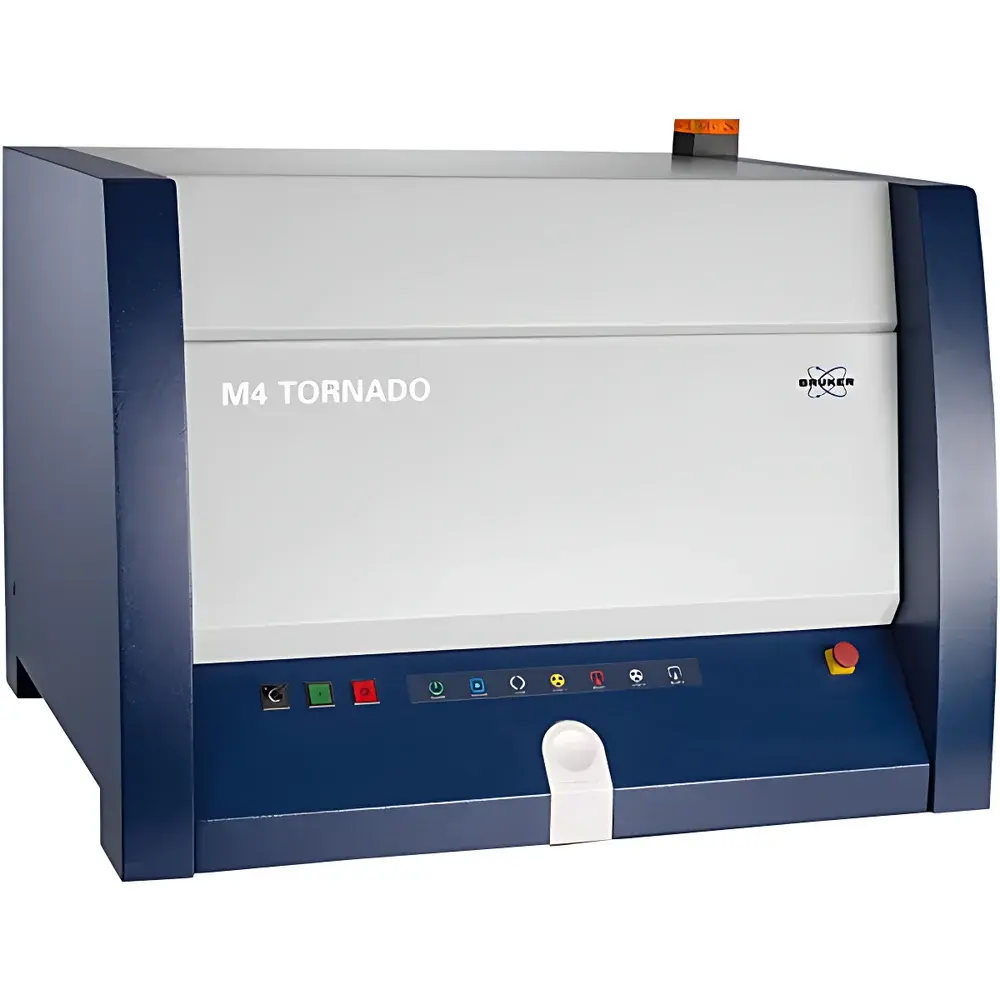
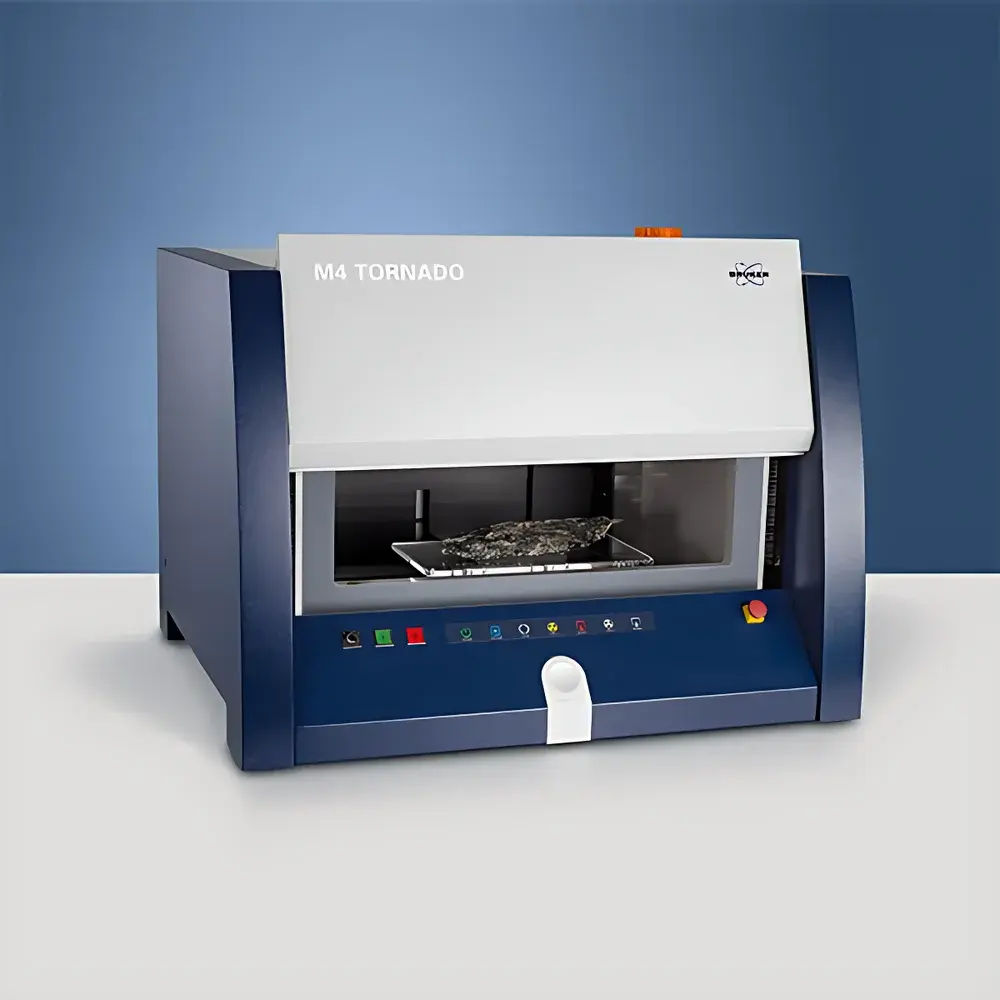
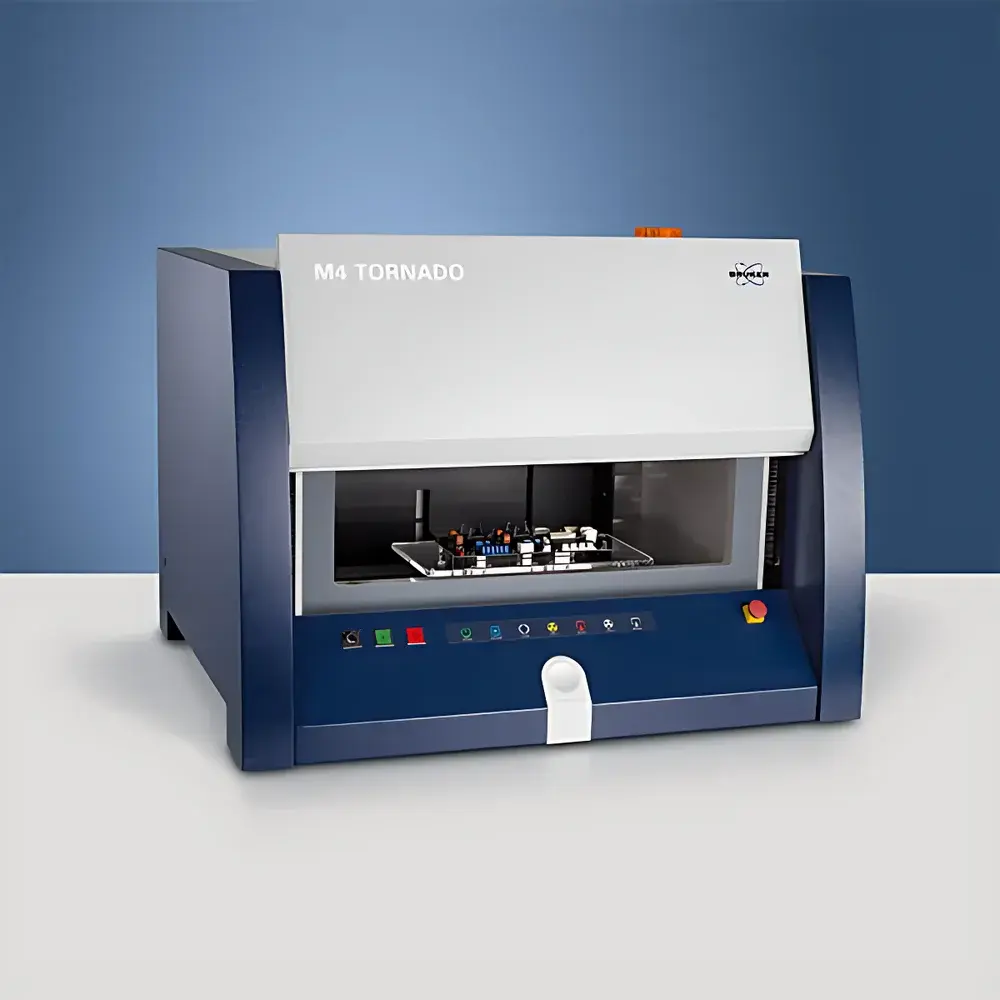
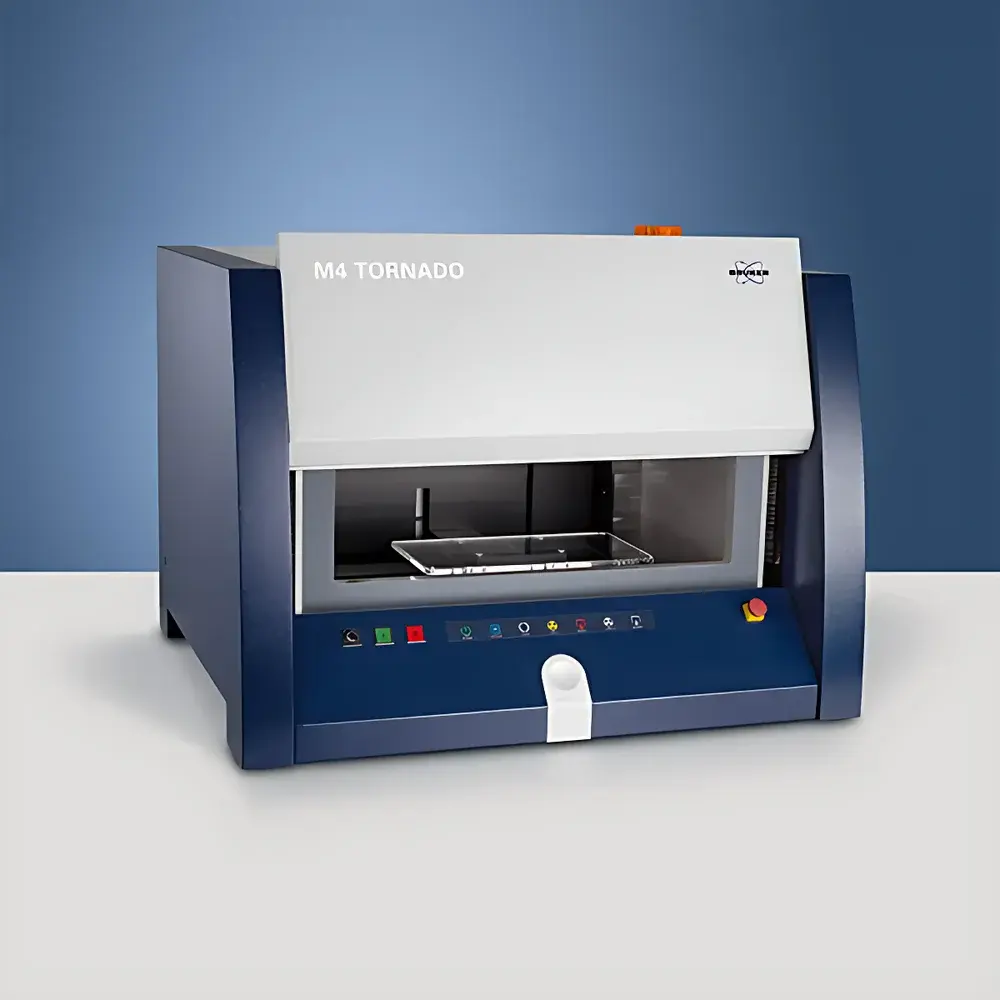
Bruker M4 TORNADO Micro-XRF Spectrometer
| Brand | Bruker |
|---|---|
| Origin | Germany |
| Configuration | Benchtop/Floor-standing |
| Application Type | General-purpose |
| Elemental Range | Mg to U |
| Quantification Range | 1 ppm – 99.99 wt% |
| Energy Resolution | <140 eV (Mn Kα) |
| Repeatability (RSD) | ≤0.1% |
| Detector | Silicon Drift Detector (SDD) |
| Spot Size | Adjustable down to ~25 µm |
| Excitation Source | Rh anode microfocus X-ray tube |
Overview
The Bruker M4 TORNADO is a high-performance benchtop/floor-standing micro-spot energy dispersive X-ray fluorescence (ED-XRF) spectrometer engineered for non-destructive, spatially resolved elemental analysis and mapping. Utilizing a high-brightness Rh-target microfocus X-ray tube coupled with a large-area silicon drift detector (SDD), the system delivers high-count-rate spectral acquisition with excellent energy resolution (<140 eV at Mn Kα) and sub-25 µm spatial resolution. Unlike wavelength-dispersive systems, the M4 TORNADO leverages ED-XRF physics—where characteristic X-ray photons emitted from a sample under primary X-ray excitation are dispersed by energy rather than wavelength—enabling rapid multi-element quantification without mechanical scanning of crystals. Its vacuum- or helium-purged measurement chamber minimizes absorption of light elements (down to Mg), supporting robust analysis of coatings, thin films, corrosion layers, and heterogeneous materials in research, quality control, and failure analysis environments.
Key Features
- Microfocus Rh X-ray source with variable spot size (25–500 µm), enabling high-resolution elemental mapping and line scans.
- Large-area SDD detector with Peltier cooling and digital pulse processing for high throughput and low-noise spectra.
- Motorized XYZ stage with optical microscope integration for precise sample positioning and region-of-interest selection.
- Automated atmosphere control (vacuum or He flush) to enhance sensitivity for elements from magnesium (Mg) through uranium (U).
- Quantitative analysis engine based on fundamental parameters (FP) method, validated against certified reference materials (CRMs) per ISO 17025-compliant workflows.
- Rugged mechanical design with vibration-damping base, suitable for shared lab environments and industrial QA/QC labs without dedicated shielding rooms.
Sample Compatibility & Compliance
The M4 TORNADO accommodates solid, powdered, and irregularly shaped samples up to 300 × 300 × 100 mm (W × D × H), including metallurgical cross-sections, semiconductor wafers, coated foils, concrete cores, and electronic assemblies. It supports non-contact analysis—critical for fragile, hydrated, or electrically sensitive specimens. The instrument complies with IEC 61000-6-3 (EMC) and IEC 61000-6-4, and meets radiation safety requirements per IEC 61010-1 and local regulatory frameworks (e.g., German RöV). Data integrity and audit readiness are supported through optional GLP/GMP-compliant software modules aligned with FDA 21 CFR Part 11 requirements—including electronic signatures, user access levels, and full audit trails for all acquisition and quantification parameters.
Software & Data Management
Powered by Bruker’s ESPRIT™ software suite, the M4 TORNADO provides intuitive workflow-driven operation—from automated calibration and matrix-matched standardization to hyperspectral imaging and statistical clustering (e.g., PCA-based phase identification). All spectra and maps are stored in vendor-neutral .spe and .tif formats; raw data export supports third-party chemometric tools (e.g., Python-based PyMCA, MATLAB). Batch processing, report generation (PDF/Excel), and metadata embedding (sample ID, operator, timestamp, instrument conditions) ensure traceability across multi-user laboratories. Optional cloud synchronization enables secure remote data review and collaborative interpretation across global R&D teams.
Applications
- Film & coating metrology: Thickness and composition profiling of multilayer stacks (e.g., TiN/Ti/Cu on Si wafers); quantification of dopants in nanoscale oxide films.
- Corrosion science: Spatial mapping of Cl, S, and Fe distributions in reinforced concrete to assess chloride ingress depth and rebar depassivation risk.
- Metallurgy: Gradient analysis across weld zones or heat-affected regions; segregation studies in high-entropy alloys.
- Electronics reliability: Failure analysis of solder joints, bond pads, and interconnects—identifying Kirkendall voiding, intermetallic growth, or contamination-induced electromigration.
- Geoscience & construction materials: Elemental heterogeneity mapping in cementitious matrices, fly ash distribution, and alkali-silica reaction (ASR) product identification.
- Forensics & conservation: Non-invasive pigment stratigraphy in paintings, provenance analysis of archaeological ceramics, and degradation assessment of historic metal artifacts.
FAQ
What is the minimum detectable limit (MDL) for light elements like Mg and Al?
MDLs depend on matrix, acquisition time, and atmosphere—but typical values range from 10–50 ppm for Mg and 5–20 ppm for Al under He purge and 300 s live time.
Can the M4 TORNADO perform depth profiling?
It does not perform true depth profiling via sputtering, but sequential analysis of polished cross-sections or angle-resolved measurements enable semi-quantitative depth information.
Is calibration transfer possible between different M4 TORNADO units?
Yes—via standardized FP calibration files and instrument-specific gain/offset corrections, enabling consistent results across multi-site deployments.
Does the system support automated particle analysis?
Yes—ESPRIT’s Particle Analysis module detects, classifies, and quantifies particles ≥1 µm (subject to contrast and count statistics) using integrated XRF spectra and optical image correlation.
What maintenance is required for long-term stability?
Annual SDD detector performance verification, X-ray tube output calibration, and optical alignment checks are recommended; no consumables other than standard laboratory-grade He or vacuum pump oil.
Related Products





