
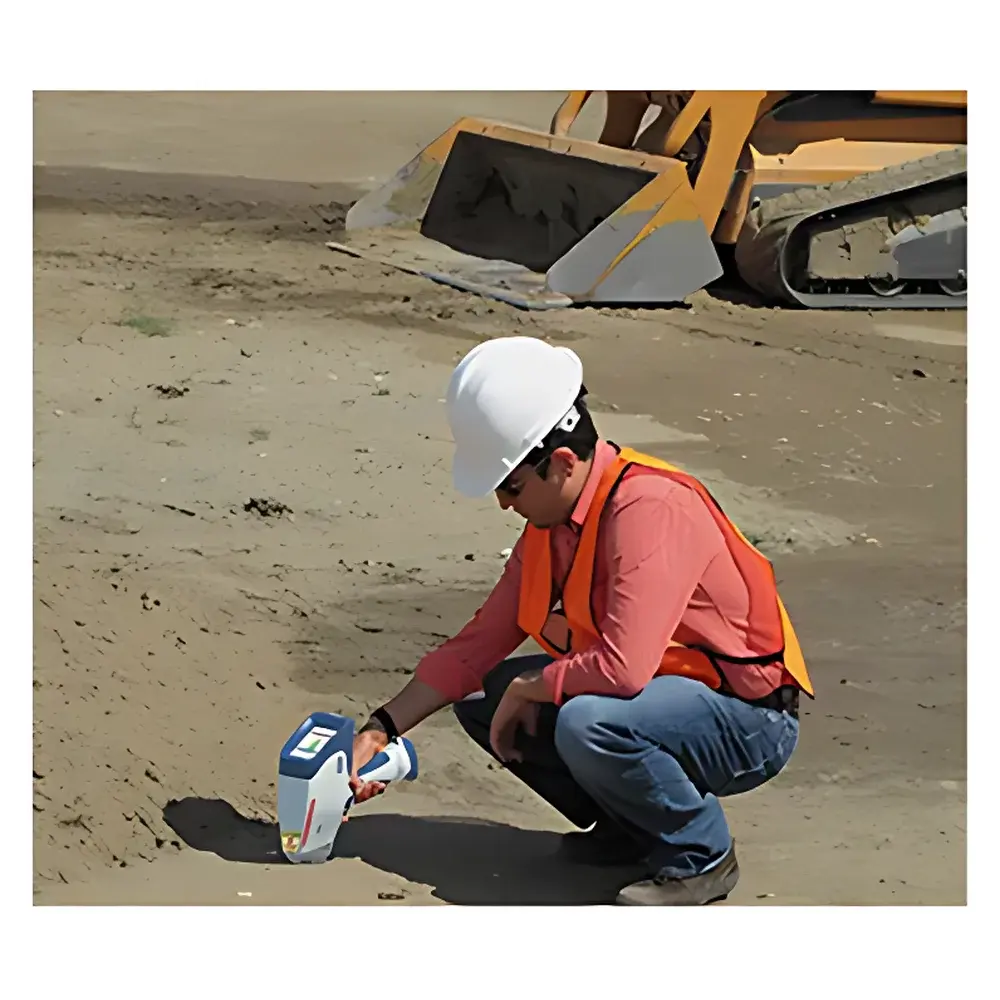
Bruker S1 TITAN Handheld XRF Soil Heavy Metal Analyzer
| Brand | Bruker |
|---|---|
| Origin | Germany |
| Model | S1 TITAN |
| Instrument Type | Handheld Energy-Dispersive X-ray Fluorescence (ED-XRF) Analyzer for Soil Heavy Metals |
| Elemental Range | ≥40 elements including Pb, As, Cd, Hg, Cu, Ni, Zn, Cr, Fe, Mn, Co, V, Ti, Se, Rb, Sr, Zr, Mo, Ag, Sn, Sb, Ba, W, U, Th, Y, Ce, Nb, Hf, Sc, Au, P, S, Cl, K, Ca |
| Detection Capability | Optimized for trace-level heavy metals in soil matrices |
| Compliance | Meets ISO 18562, ASTM D7953, EPA Method 6200 (field-deployable), and supports GLP/GMP data integrity requirements |
| Operating Environment | Field-portable |
| Sample Form | Solid soils, sediments, sludge, dust, filters, thin films, and heterogeneous particulates |
| Software | Bruker S1 PXRF software with embedded calibration libraries (Soil, Mining, Environmental), spectral deconvolution engine, and audit-trail-enabled reporting |
Overview
The Bruker S1 TITAN Handheld XRF Soil Heavy Metal Analyzer is an industrial-grade, field-deployable energy-dispersive X-ray fluorescence (ED-XRF) spectrometer engineered for rapid, non-destructive quantification of toxic and regulated heavy metals in soil and environmental solid matrices. Based on fundamental physics principles—where primary X-rays excite characteristic secondary (fluorescent) X-ray emissions unique to each element—the S1 TITAN delivers laboratory-grade elemental profiling directly at the sampling site. Its optimized X-ray tube (Rh or Au anode), high-resolution silicon drift detector (SDD), and real-time spectrum processing enable detection limits in the low parts-per-million (ppm) range for priority pollutants such as Pb, As, Cd, Hg, Cr, Ni, Cu, and Zn—critical for regulatory screening under national and international soil quality frameworks including EU Soil Thematic Strategy, China’s GB 15618–2018, and US EPA Region 10 Field Screening Guidance.
Key Features
- Robust, IP54-rated magnesium alloy housing with integrated shock-absorbing design for extended field durability and drop resistance up to 1 m onto concrete.
- Optimized excitation geometry and dynamic beam filtration enabling enhanced signal-to-noise ratio for light elements (e.g., S, P, Cl, K, Ca) alongside heavy metals—essential for comprehensive soil characterization beyond heavy metal screening.
- Real-time spectrum acquisition and quantification using fundamental parameter (FP) algorithms with matrix-matched calibrations preloaded for diverse soil types (clay, loam, sandy, organic-rich, acidic, alkaline).
- Integrated GPS, digital camera, and Bluetooth/Wi-Fi connectivity for geotagged, timestamped, and traceable measurement records aligned with ISO/IEC 17025 documentation standards.
- Battery life exceeding 8 hours per charge (hot-swappable Li-ion packs), supporting full-shift operation without interruption during large-scale site surveys or emergency response deployments.
Sample Compatibility & Compliance
The S1 TITAN is validated for direct analysis of minimally prepared samples: air-dried, sieved (<2 mm) soils; dried sludge cakes; homogenized sediment cores; filter media loaded with airborne particulates; and surface-contaminated dust layers. No acid digestion or lab-based sample preparation is required for screening-level compliance assessment. It adheres to ASTM D7953–22 (“Standard Test Method for Determination of Elements in Soil and Solid Waste by Portable X-Ray Fluorescence”) and serves as a Tier 1 field screening tool compliant with EPA Method 6200. Data output supports audit-ready reporting for GLP and GMP environments, including full electronic signatures, user access controls, and 21 CFR Part 11–compliant audit trails when used with Bruker’s enterprise software suite.
Software & Data Management
Bruker’s S1 PXRF software provides intuitive workflow-driven operation—from method selection and live spectral visualization to automated report generation in PDF, CSV, or XML formats. Embedded calibration models incorporate certified reference materials (CRMs) such as NIST SRM 2710a, 2711a, and IAEA-Soil-7. Spectral deconvolution uses iterative least-squares fitting to resolve overlapping peaks (e.g., As Kα / Pb Lα, Sb Kα / Sn Kα). All raw spectra, calibration logs, operator IDs, GPS coordinates, and instrument health diagnostics are stored locally and synchronized securely to cloud-based or on-premise LIMS platforms via HTTPS or SFTP protocols.
Applications
- Rapid baseline mapping of contaminated sites prior to remediation planning (e.g., former smelters, electroplating facilities, landfill perimeters).
- Real-time verification of excavation cut-off levels during brownfield redevelopment projects.
- Regulatory compliance monitoring for industrial effluent discharge zones and wastewater irrigation areas.
- Field validation of lab-analyzed results to assess spatial heterogeneity and guide composite sampling strategies.
- Emergency response triage following chemical spills or uncontrolled waste dumping incidents.
- Long-term trend analysis in agricultural land subjected to repeated biosolids application or phosphate fertilizer use.
FAQ
Does the S1 TITAN require sample digestion or chemical preparation before analysis?
No. It performs direct solid-phase analysis—only minimal drying and sieving are recommended for optimal precision.
Can it distinguish between different oxidation states (e.g., Cr(III) vs. Cr(VI))?
No. ED-XRF identifies total elemental concentration only; speciation requires complementary techniques such as HPLC-ICP-MS.
Is factory calibration transferable across global soil types?
Pre-installed calibrations cover broad geochemical variability, but site-specific validation using local CRMs is recommended for quantitative compliance reporting.
How is measurement uncertainty managed for regulatory submissions?
Uncertainty budgets are calculated per ISO/IEC Guide 98-3 (GUM) using repeatability, CRM traceability, and spectral fit residuals—fully documented in exported reports.
What cybersecurity protocols protect data integrity during wireless transmission?
All network communications employ TLS 1.2+ encryption; device firmware is signed and updated via secure OTA channels with SHA-256 verification.







