
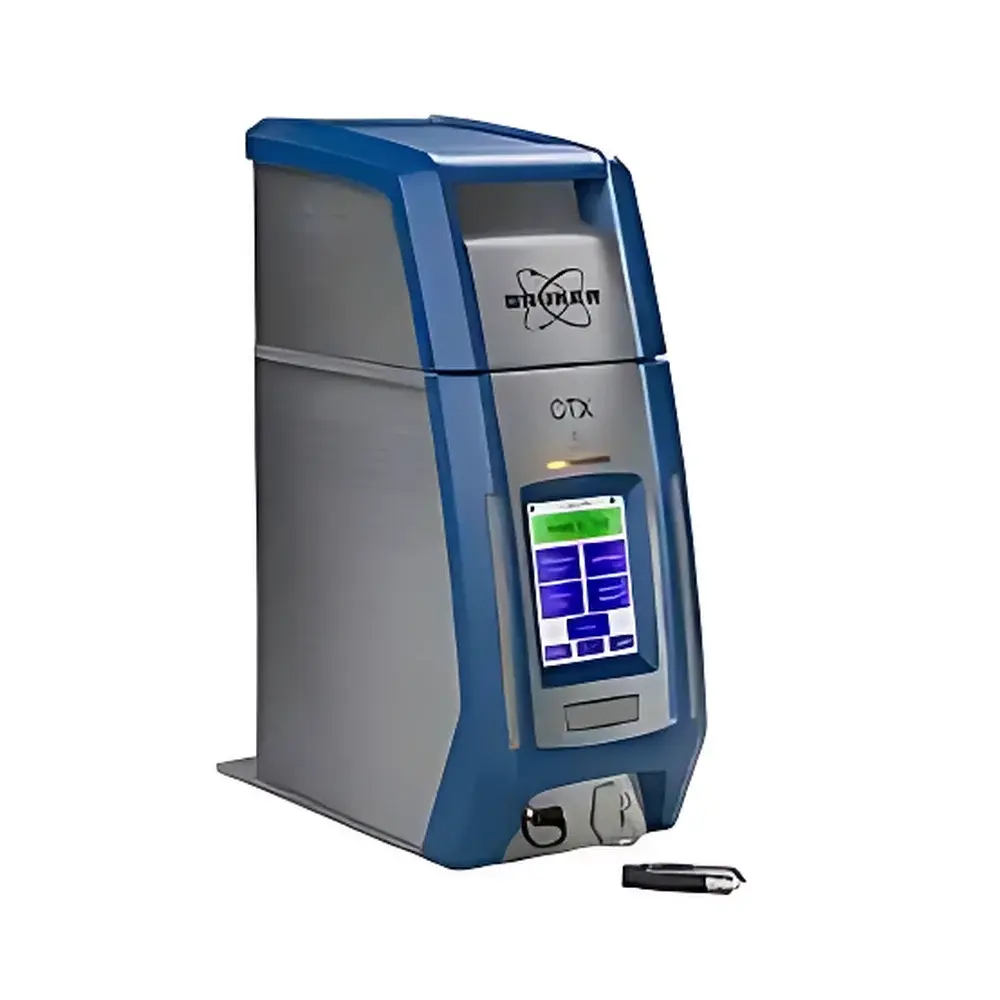
Bruker CTX Portable Energy Dispersive X-Ray Fluorescence (ED-XRF) Spectrometer
| Brand | Bruker |
|---|---|
| Origin | Germany |
| Model | CTX |
| Application | Handheld/Portable Elemental Analysis |
| Element Range | Mg–U (standard), Cl–U (optimized for cosmetics), Ti–U (heavy metals focus) |
| Energy Resolution | <140 eV (Mn Kα) |
| Detector | Silicon Drift Detector (SDD) |
| Operating Temperature | −10 °C to +40 °C |
| Sample Forms | Solids, powders, liquids, pastes, creams, gels, tablets |
| Regulatory Compliance | ASTM E2857, ISO 12885, USP <232>/<233>, FDA 21 CFR Part 11 (software-enabled), GLP/GMP-ready audit trail |
Overview
The Bruker CTX is a laboratory-grade, portable energy dispersive X-ray fluorescence (ED-XRF) spectrometer engineered for rapid, non-destructive elemental screening and semi-quantitative analysis in regulatory and quality control environments. Unlike benchtop ED-XRF systems, the CTX integrates high-performance SDD detection, optimized excitation geometry, and robust spectral deconvolution algorithms into a compact, ergonomic platform suitable for field-deployable operation. Its core measurement principle relies on primary X-ray excitation of sample atoms, followed by detection of characteristic secondary (fluorescent) X-rays emitted during electron shell relaxation. The resulting spectrum is processed using fundamental parameter (FP) algorithms and empirically validated calibration models to deliver accurate elemental intensities and concentration estimates. Designed specifically for cosmetics safety testing, the CTX targets toxicologically relevant heavy metals—including Pb, As, Hg, Cd, and Cr—while maintaining full coverage from magnesium (Mg, Z=12) to uranium (U, Z=92). Its portability enables real-time decision-making at raw material intake, in-process manufacturing checkpoints, finished goods inspection, customs clearance, and post-market surveillance.
Key Features
- High-resolution silicon drift detector (SDD) with <140 eV Mn Kα resolution ensures precise peak separation for overlapping transitions (e.g., As Kα/Pb Lα, Cr Kα/V Kα)
- Optimized X-ray tube configuration (Rh or Ag anode, 40 kV/100 µA max) delivers stable excitation across light-to-heavy elements without vacuum or helium purge requirements
- Integrated sample chamber accommodates heterogeneous cosmetic matrices—creams, lipsticks, powders, lotions, and liquid suspensions—in standardized containers or custom holders
- Pre-loaded, application-specific calibration curves for cosmetic matrices (e.g., foundation, lipstick, eyeshadow) traceable to NIST SRMs and CRM-certified standards
- Real-time spectral acquisition and processing with automated peak identification, background subtraction, and matrix correction
- Ruggedized industrial enclosure rated IP54 for dust and splash resistance; operational within −10 °C to +40 °C ambient range
- Compliance-ready software architecture supporting 21 CFR Part 11 electronic signatures, audit trails, user access levels, and data export in CSV, PDF, and XML formats
Sample Compatibility & Compliance
The CTX accepts unprepared or minimally prepared samples—no digestion, dilution, or pelletization required. Solid cosmetics (e.g., pressed powders, solid perfumes), semi-solids (creams, balms), and liquids (toners, serums) are analyzed directly in their native state. For viscous or particulate-laden samples, optional sample cups with Mylar or polyimide windows ensure consistent geometry and prevent detector contamination. Method validation follows ICH Q2(R2) guidelines, with documented linearity (R² > 0.995), precision (RSD < 5% at 10× LOD), limit of detection (LOD) down to 0.1–2 ppm depending on element and matrix, and recovery rates of 85–115% across spiked reference materials. The system supports compliance with global regulatory frameworks including EU Cosmetics Regulation (EC No. 1223/2009), US FDA Guidance for Industry on Heavy Metals in Cosmetics, China’s GB/T 35951–2018, and ASEAN Cosmetic Directive Annex II impurity limits.
Software & Data Management
CTX operation is managed via Bruker’s proprietary ARTAX™ software suite, deployed on embedded Windows OS with touchscreen interface. The software provides guided workflows for method setup, calibration management, spectral acquisition, and report generation. Quantitative analysis leverages FP-based modeling augmented by empirical calibrations derived from certified reference materials (CRMs) such as NIST SRM 2783 (Cosmetic Powder) and BAM CRM 056 (Toothpaste Matrix). All analytical sessions are time-stamped, user-logged, and archived with full spectral metadata. Data export options include compliant PDF reports with digital signatures, raw spectral files (.spe), and structured CSV outputs compatible with LIMS integration. Audit trail functionality records all user actions—including method edits, calibration updates, and result overrides—with immutable timestamps and operator IDs, satisfying GLP, GMP, and ISO/IEC 17025 documentation requirements.
Applications
- Routine screening of Pb, As, Hg, Cd, and Ni in cosmetic raw materials (talc, mica, pigments, clays) prior to formulation
- Finished product release testing per internal QC specifications or regulatory thresholds (e.g., ≤10 ppm Pb in lip products)
- Border inspection and customs verification at ports of entry to enforce national import restrictions
- Supplier qualification and incoming inspection in contract manufacturing organizations (CMOs)
- Post-market surveillance and recall investigations by regulatory agencies (e.g., FDA, CPSC, Health Canada)
- Research and development support for low-metal alternative ingredient sourcing and formulation optimization
FAQ
Does the CTX require sample digestion or acid dissolution before analysis?
No. The CTX performs direct, non-destructive analysis of intact cosmetic samples. Minimal preparation—such as homogenizing creams or packing powders into sample cups—is sufficient.
Can the CTX quantify elements below 1 ppm in complex organic matrices?
Yes, under optimized conditions: LODs range from 0.1 ppm (Pb, Hg in low-Z matrices) to ~2 ppm (As in high-Cl formulations), validated per ICH Q2(R2) protocols.
Is the CTX compliant with FDA 21 CFR Part 11 for electronic records?
Yes. ARTAX™ software includes role-based access control, electronic signatures, audit trail logging, and secure data archiving—fully configurable for Part 11 compliance.
How does the CTX handle spectral interferences common in cosmetic samples (e.g., Ca–Ti–Cr overlaps)?
Advanced deconvolution algorithms coupled with multi-element calibration models resolve overlapping peaks using reference spectra and matrix-matched standards.
What maintenance is required for long-term operational reliability?
Annual detector performance verification and X-ray tube output calibration are recommended; no routine consumables or gas refills are needed.





