
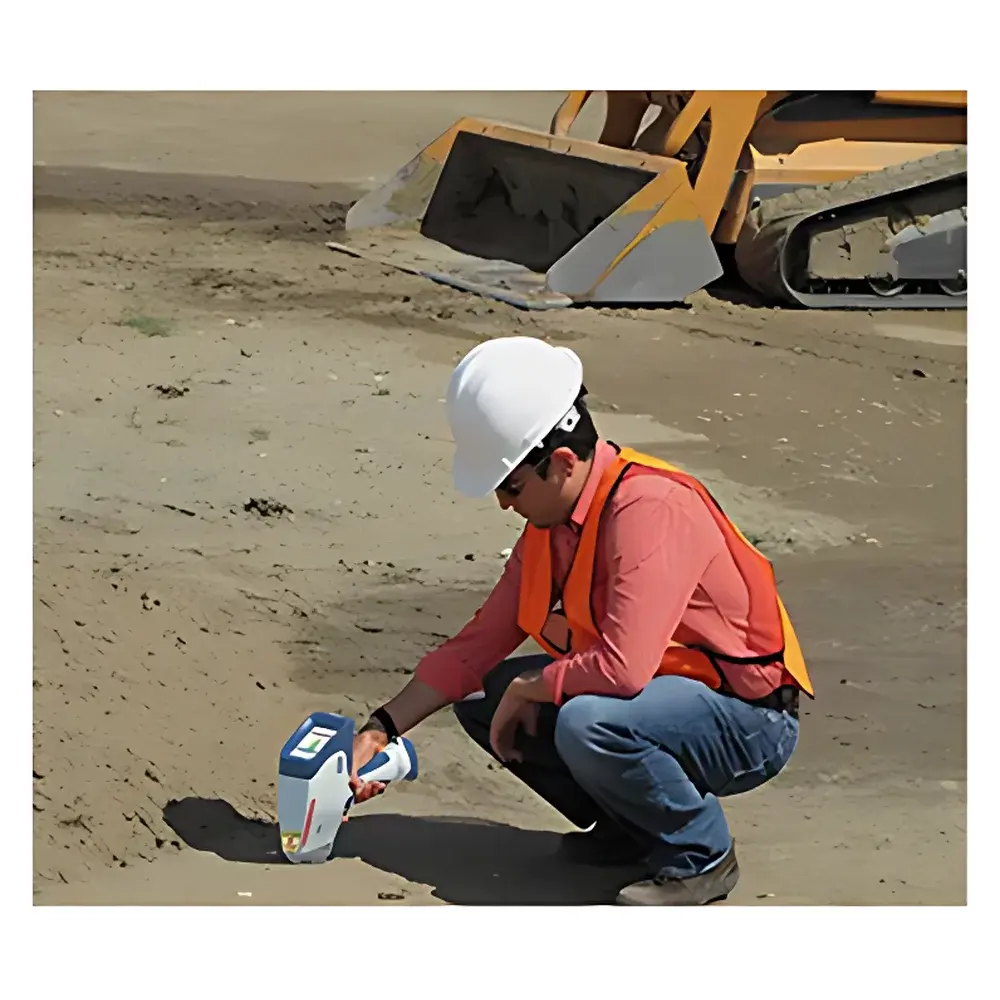
Bruker S1 TITAN Handheld X-ray Fluorescence (XRF) Soil Analyzer
| Brand | Bruker |
|---|---|
| Origin | Germany |
| Model | S1 TITAN |
| Instrument Type | Multi-element Field-Portable XRF Analyzer |
| Regulatory Compliance | CE, RoHS, IEC 62471 |
| Measurement Principle | Energy-Dispersive X-ray Fluorescence (ED-XRF) |
| Elemental Range | S (16) to U (92), ≥40 elements quantifiable in soil matrices |
| Detection Limits | Sub-ppm to low-ppm range for heavy metals (e.g., Pb, As, Cd, Hg, Cr, Ni, Cu, Zn) under optimized field conditions |
| Sample Forms | Solid soils, sediments, sludge, dust, filters, thin films, and heterogeneous particulates |
| Operating Environment | Field-deployable (–10 °C to 50 °C), IP54 rated |
| Safety | Integrated shutter, real-time dose monitoring, FDA-compliant radiation safety interlocks |
Overview
The Bruker S1 TITAN Handheld X-ray Fluorescence (XRF) Soil Analyzer is an industrial-grade, field-portable elemental analyzer engineered for rapid, non-destructive quantification of toxic and essential metals in environmental solid matrices. Based on energy-dispersive X-ray fluorescence (ED-XRF) spectroscopy, the instrument excites atoms in the sample using a micro-focus X-ray tube (Ag or Rh anode options), and measures characteristic secondary X-rays emitted during electron relaxation. This enables direct, matrix-corrected quantification without chemical digestion—critical for time-sensitive environmental screening, regulatory compliance verification, and site characterization workflows. Designed and manufactured in Germany, the S1 TITAN integrates high-resolution silicon drift detector (SDD) technology with adaptive fundamental parameters (FP) algorithms and empirical calibrations validated across diverse soil types (clay, loam, sandy, organic-rich, and contaminated matrices). Its robust architecture supports both routine monitoring and emergency response applications—including brownfield assessment, mining impact evaluation, agricultural land surveillance, and landfill leachate source tracking.
Key Features
- High-performance silicon drift detector (SDD) with <145 eV Mn Kα resolution ensures precise peak deconvolution for overlapping transitions (e.g., As Kα/Pb Lα, Cr Kα/V Kα).
- Optimized X-ray tube configurations (Ag or Rh anode) deliver enhanced sensitivity for light elements (S, P, Cl, K, Ca) and heavy metals (Pb, As, Cd, Hg, Cr, Ni) simultaneously.
- Integrated GPS, Bluetooth, and Wi-Fi enable georeferenced data logging and real-time synchronization with cloud-based LIMS or GIS platforms.
- Ruggedized magnesium alloy housing, IP54 ingress protection, and MIL-STD-810G shock/vibration resistance ensure operational reliability in harsh outdoor environments.
- Onboard calibration verification using certified reference materials (CRMs) such as NIST SRM 2710a, 2711a, and EPA 200.13-compliant soil standards.
- Automated spectral deconvolution and matrix correction via Bruker’s proprietary FP+ algorithm, minimizing operator dependency and enhancing reproducibility across varying moisture and organic content.
Sample Compatibility & Compliance
The S1 TITAN is validated for direct analysis of unprepared or minimally homogenized soil samples—including air-dried bulk soils, sieved fractions (<2 mm), sludge cakes, sediment cores, filter media, and surface dust wipes. It complies with ASTM D6728–22 (Standard Test Method for Determination of Metals in Soils by Portable XRF), EPA Method 6200 (Field Portable X-Ray Fluorescence Spectrometry), and ISO 18587:2016 (Soil quality — Determination of elemental composition by portable XRF). All firmware and measurement protocols support full audit trails required under GLP and ISO/IEC 17025 accreditation frameworks. Radiation safety conforms to IEC 62471 (Photobiological Safety) and local regulatory requirements for handheld X-ray devices; automatic beam shuttering and real-time dosimetry prevent unintended exposure.
Software & Data Management
Data acquisition, processing, and reporting are managed through Bruker’s proprietary S1 PXRF software suite, compatible with Windows OS and deployable on tablet or laptop interfaces. The software provides customizable reporting templates aligned with EPA, EU CLP, and national soil quality guidelines (e.g., China GB 15618–2018, US EPA Regional Screening Levels). Raw spectra, quantified results, GPS coordinates, operator ID, and calibration history are stored in encrypted SQLite databases compliant with FDA 21 CFR Part 11 for electronic records and signatures. Export formats include CSV, PDF, XML, and direct integration with ESRI ArcGIS, QGIS, and laboratory information management systems (LIMS) via ODBC or RESTful API.
Applications
- Rapid screening of priority pollutants (Pb, As, Cd, Hg, Cr, Ni, Cu, Zn) at industrial sites, former smelters, battery recycling facilities, and electroplating zones.
- Regulatory compliance monitoring per national soil contamination thresholds (e.g., Dutch Intervention Values, German BBodSchV, Chinese GB 15618).
- Pre-remediation baseline mapping and post-remediation verification of soil washing, stabilization, or excavation effectiveness.
- Urban agriculture risk assessment—detecting bioavailable metal accumulation in community garden soils and green infrastructure substrates.
- Research-grade semi-quantitative profiling of rare earth elements (Ce, Y, Nd), actinides (U, Th), and trace nutrients (Zn, Cu, Mn, Co) in pedogenic and anthropogenic soil horizons.
- Emergency response during spill incidents, illegal dumping events, or natural disasters involving hazardous material release.
FAQ
Does the S1 TITAN require sample digestion or acid extraction prior to analysis?
No. The instrument performs direct solid-phase analysis; however, for regulatory reporting requiring total metal content (e.g., EPA 3050B equivalence), lab-based digestion remains necessary. Field XRF data serve as rapid screening proxies correlated to digestible fractions via site-specific calibration.
How does moisture content affect measurement accuracy?
High moisture (>25 wt%) attenuates low-energy X-rays and suppresses light element signals. Bruker recommends air-drying samples to ≤15% moisture or applying moisture-correction models embedded in FP+ software.
Can the S1 TITAN distinguish between different oxidation states (e.g., Cr(III) vs. Cr(VI))?
No. ED-XRF is element-specific, not speciation-capable. For redox state determination, complementary techniques such as XANES or IC-ICP-MS are required.
Is factory recalibration required annually?
While not mandatory, Bruker recommends annual performance verification using CRMs and optional factory recalibration to maintain traceability to NIST standards and sustain measurement uncertainty budgets below ±15% RSD for key analytes.
What training and documentation are provided with the instrument?
Bruker delivers comprehensive operator certification training (online + onsite), ISO 17025-aligned method validation kits, SOP templates, and full technical documentation—including electrical safety certificates, radiation test reports, and CE declaration of conformity.







