
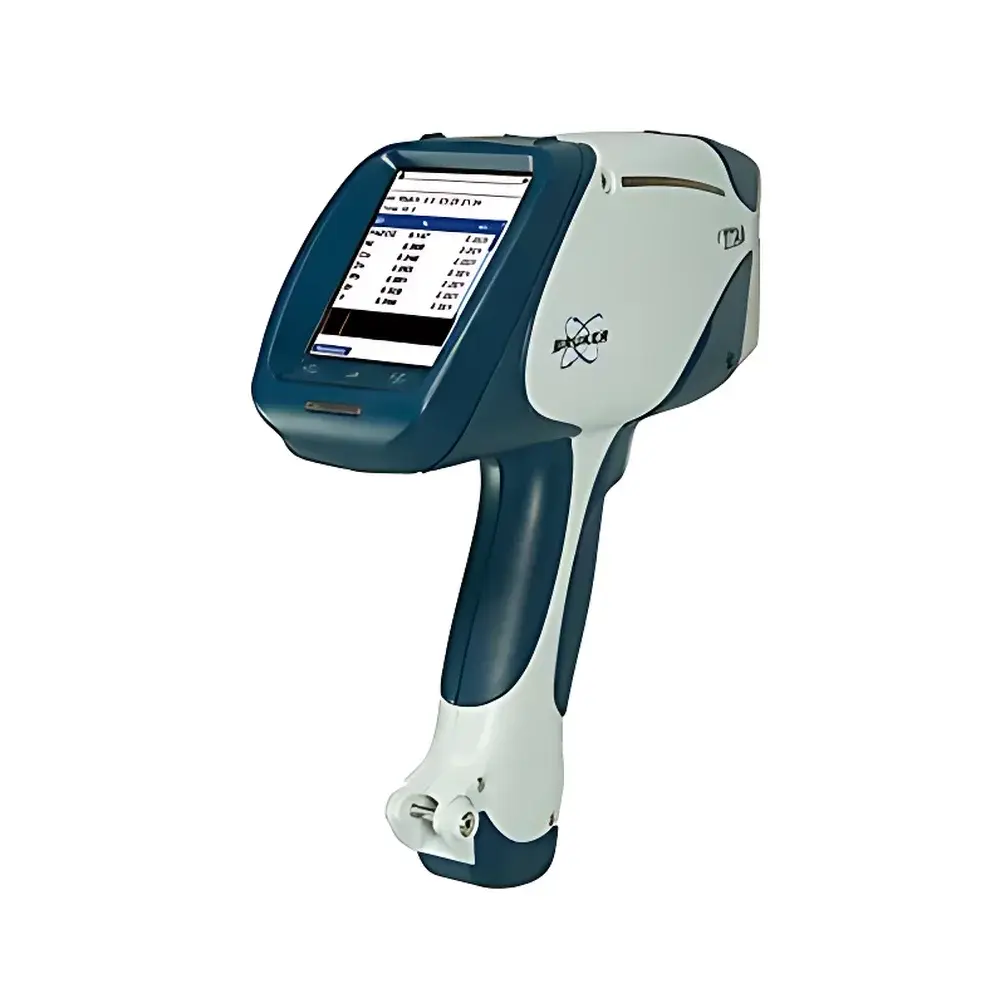
Bruker S1 TITAN Handheld Energy Dispersive X-Ray Fluorescence Spectrometer
| Brand | Bruker |
|---|---|
| Origin | Germany |
| Model | S1 TITAN |
| Application | Handheld/Portable |
| Elemental Range | Mg–U |
| Detection Limit | 1 ppm to 99.99% w/w |
| Energy Resolution | <140 eV (Mn Kα) |
| Repeatability | ±0.1% RSD |
| Detector | Silicon Drift Detector (SDD) |
| X-ray Tube | 50 kV microfocus |
| Weight | 1.23 kg |
| Compliance | ASTM F963, RoHS, EU Directive 2011/65/EU, California Proposition 65, TPCH, USP <232>/<233>, ISO 17025-aligned operation |
Overview
The Bruker S1 TITAN is a handheld energy dispersive X-ray fluorescence (EDXRF) spectrometer engineered for field-deployable elemental analysis across industrial, geological, environmental, and regulatory compliance applications. Operating on the fundamental principle of X-ray fluorescence—where primary X-rays from a microfocus tube excite atoms in a sample, inducing emission of characteristic secondary X-rays—the S1 TITAN delivers quantitative and qualitative elemental composition data in real time. Its core architecture integrates a high-efficiency 50 kV X-ray source with Bruker’s proprietary SharpBeam® X-ray optics, which precisely aligns the incident beam path and detector solid angle to maximize photon collection efficiency while minimizing scattered background. This optimized geometry enables reliable detection of light elements down to magnesium (Mg) and heavy elements up to uranium (U), supporting trace-level quantification (1 ppm LOD) and high-precision bulk analysis (up to 99.99% w/w) without vacuum or helium purge.
Key Features
- Lightweight ergonomic design (1.23 kg) with IP54-rated sealed housing for dust and moisture resistance in harsh field environments
- Bruker X-Flash® silicon drift detector (SDD) offering high count-rate capability and superior energy resolution (<140 eV at Mn Kα)
- SharpBeam® optical geometry that enhances signal-to-noise ratio, reduces power consumption, extends battery life, and improves measurement reproducibility (±0.1% RSD)
- Integrated 5-inch color touchscreen interface with intuitive SMART®Grade timing logic for adaptive acquisition control
- Pre-loaded and customizable calibrations for alloys (e.g., stainless steels, Ni-based superalloys, Ti grades), mining matrices (ore, soil, core), consumer goods (toys, packaging), and restricted substance screening (Pb, Cd, Hg, Cr⁶⁺, Br)
- Fully compliant firmware architecture supporting audit-ready data logging, user access levels, and electronic signature workflows aligned with GLP/GMP expectations
Sample Compatibility & Compliance
The S1 TITAN accommodates heterogeneous, irregular, and minimally prepared samples—including raw ore fragments, scrap metal pieces, coated components, soil composites, and polymer-encased electronics—without requiring lab-grade homogenization or pelletization. Its non-destructive, direct-beam analysis eliminates sample digestion and associated contamination risks. Method validation and performance verification follow internationally recognized protocols: ASTM E2857 for precision and bias assessment, ISO 12885 for portable XRF in environmental soil screening, and IEC 62321-5 for RoHS-compliant restricted substance testing. Data integrity complies with FDA 21 CFR Part 11 requirements via configurable audit trails, timestamped operator logs, and encrypted result storage.
Software & Data Management
Bruker’s proprietary MSA (Mobile Spectral Analysis) software provides real-time spectral deconvolution, matrix-matched calibration management, and automated grade identification (e.g., UNS, EN, ASTM alloy codes). All spectra, metadata, GPS coordinates, and operator inputs are stored in a secure SQLite database with optional cloud synchronization via Bruker Connect™. Export formats include CSV, PDF reports (with embedded spectra), and XML for LIMS integration. Firmware updates maintain alignment with evolving regulatory thresholds (e.g., updated RoHS Annex II limits, CPSC lead-in-paint standards) and support method revalidation per ISO/IEC 17025 clause 7.2.2.
Applications
- Positive Material Identification (PMI) for ASME B31.3 and API RP 578 compliance in petrochemical, power generation, and aerospace fabrication
- In-situ ore grade estimation and lithological mapping during exploration drilling and open-pit mining
- Scrap metal sorting and recycling stream optimization based on multi-element alloy signatures
- Regulatory screening of consumer products per ASTM F963 (toy safety), California Prop 65, and EU RoHS directives
- Environmental site assessment including contaminated soil Pb/Cd/As profiling and landfill leachate risk evaluation
- Quality assurance of precious metal content (Au, Pt, Pd) in jewelry and catalytic converters
FAQ
Does the S1 TITAN require external calibration standards for routine use?
No—factory-installed calibrations cover major alloy families and geochemical matrices; however, users may perform periodic verification using NIST-traceable reference materials.
Can it analyze light elements such as magnesium or aluminum in air?
Yes—optimized X-ray tube voltage, beam filtration, and SDD sensitivity enable robust Mg–Al detection without vacuum or He flush.
Is the instrument suitable for GMP-regulated pharmaceutical packaging testing?
Yes—when deployed with validated methods and configured for 21 CFR Part 11 compliance, it supports extractable metals testing per USP /.
What battery life can be expected during continuous operation?
Up to 8–10 hours on a single charge under typical analytical conditions (20–30 sec per reading, 50 kV/20 µA).
How does SharpBeam® technology improve detection limits compared to conventional handheld XRF?
By reducing geometric scatter and increasing peak-to-background ratio, SharpBeam® improves minimum detection limits by ~25–40% for mid-Z elements (e.g., Cr, Mn, Fe) relative to legacy collimated systems.





