
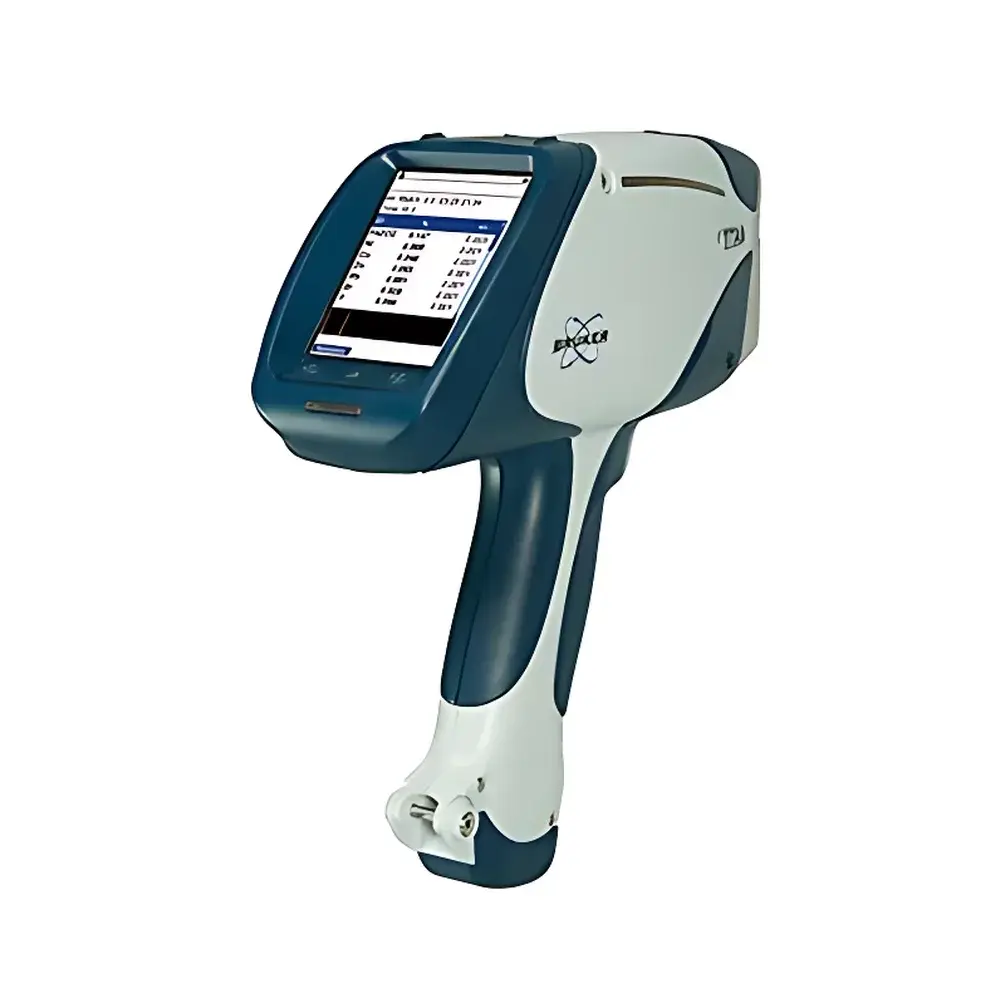
Bruker S1 TITAN Handheld Energy Dispersive X-Ray Fluorescence (ED-XRF) Spectrometer
| Brand | Bruker |
|---|---|
| Origin | Germany |
| Manufacturer Type | Authorized Distributor |
| Product Origin | Imported |
| Model | S1 TITAN |
| Application | Handheld / Portable |
| Industry Type | General-Purpose |
| Elemental Range | Mg–U |
| Quantification Range | 1 ppm – 99.99% |
| Energy Resolution | <140 eV (Mn Kα) |
| Detector | Silicon Drift Detector (SDD) |
| X-ray Tube | 50 kV |
| Weight | 1.23 kg |
| Display | Integrated Color Touchscreen |
| Key Technologies | SharpBeam® X-ray Geometry Optimization, SMART®Grade Timing Algorithm, X-Flash® SDD |
Overview
The Bruker S1 TITAN is a high-performance, handheld energy dispersive X-ray fluorescence (ED-XRF) spectrometer engineered for field-deployable elemental analysis with laboratory-grade reliability. Based on micro-focus X-ray tube excitation and silicon drift detector (SDD) technology, the instrument operates on fundamental principles of XRF—where primary X-rays induce characteristic secondary (fluorescent) X-ray emission from sample atoms, enabling qualitative and quantitative determination of elemental composition from magnesium (Mg) to uranium (U). Its lightweight architecture (1.23 kg), robust IP54-rated enclosure, and sealed optical path ensure operational integrity in demanding industrial, geological, and regulatory environments—including outdoor mining sites, scrap yards, manufacturing floors, and environmental monitoring zones. Designed for rapid, non-destructive analysis without sample preparation, the S1 TITAN delivers repeatable results under variable ambient conditions while maintaining compliance with international measurement standards.
Key Features
- Ultra-lightweight ergonomic design (1.23 kg) optimized for extended operator use and one-handed operation
- 50 kV micro-focus X-ray tube with programmable voltage and current control for enhanced excitation efficiency across light and heavy elements
- X-Flash® silicon drift detector (SDD) offering high count-rate capability and <140 eV energy resolution at Mn Kα—critical for resolving overlapping peaks in complex matrices
- SharpBeam® optimized X-ray geometry: precisely aligned tube-detector configuration that maximizes photon collection efficiency, minimizes scatter, reduces power consumption, and extends battery life per charge
- SMART®Grade real-time grade-matching algorithm enabling immediate alloy identification against embedded libraries (e.g., ASTM, ISO, UNS, and MIL standards)
- Integrated high-brightness color touchscreen with intuitive icon-driven interface, supporting glove-compatible operation and offline data review
- Ruggedized housing rated IP54 for dust and moisture resistance; shock-absorbing polymer casing tested to MIL-STD-810G for drop resilience
Sample Compatibility & Compliance
The S1 TITAN supports direct analysis of solid, heterogeneous, and irregularly shaped samples—including metals, ores, soils, polymers, ceramics, and coated surfaces—without requiring homogenization or pelletization. Its broad elemental coverage (Mg–U) and detection capability down to 1 ppm enable trace-level screening for regulated substances (e.g., Pb, Cd, Hg, Cr(VI), Br) in accordance with RoHS Directive 2011/65/EU, ASTM F963-23 (toy safety), California Proposition 65, and TPCH packaging requirements. For quality assurance and regulatory reporting, the system supports audit-ready documentation workflows compliant with ISO/IEC 17025, GLP, and FDA 21 CFR Part 11 when integrated with Bruker’s proprietary software suite and optional secure user authentication.
Software & Data Management
Data acquisition, processing, and reporting are managed via Bruker’s proprietary S1 PXRF software, which provides real-time spectral visualization, peak deconvolution, matrix correction algorithms (e.g., Fundamental Parameters and empirical calibration models), and customizable report generation (PDF, CSV, XML). The platform supports multi-language UI, remote firmware updates, and encrypted local storage with timestamped metadata. All analytical sessions include full spectral archives, measurement parameters, and operator ID logging—enabling traceability required for ISO 9001-certified QA/QC processes and third-party audits. Optional cloud synchronization allows centralized fleet management and cross-site method sharing across global operations.
Applications
- Positive Material Identification (PMI) in petrochemical, power generation, and aerospace facilities per ASME B31.3 and API RP 578
- Scrap metal sorting and recycling verification for alloy grade conformity and contaminant detection
- In-situ ore grade estimation, core logging, and geochemical mapping in exploration and open-pit mining
- Environmental site assessment: soil heavy metal screening (Pb, As, Cd, Cr) per EPA Method 6200 and ISO 18227
- Consumer product safety testing: lead in toys and apparel, brominated flame retardants in plastics, restricted substances in electronics
- Automotive catalyst analysis: Pt, Pd, Rh quantification in spent three-way catalytic converters
- Archaeological and metallurgical provenance studies using multi-element fingerprinting
FAQ
What elements can the S1 TITAN detect and quantify?
The instrument detects and quantifies elements from magnesium (Mg, Z=12) to uranium (U, Z=92), including all common alloying and regulated elements such as Al, Si, P, S, Ti, V, Cr, Mn, Fe, Co, Ni, Cu, Zn, As, Se, Br, Sr, Zr, Nb, Mo, Ag, Sn, Sb, Te, I, Ba, La, Ce, Pr, Nd, Sm, Eu, Gd, Tb, Dy, Ho, Er, Tm, Yb, Lu, Hf, Ta, W, Re, Os, Ir, Pt, Au, Hg, Tl, Pb, Bi, Th, and U.
Is the S1 TITAN suitable for regulatory compliance testing?
Yes—when operated with certified calibrations and documented procedures, it meets performance criteria outlined in ASTM E1621, ISO 12885, and EU RoHS Annex II for screening and semi-quantitative analysis. Full compliance reporting requires integration with validated methods and chain-of-custody protocols.
How does SharpBeam® technology improve analytical performance?
SharpBeam® optimizes the geometric relationship between the X-ray source and detector to increase signal-to-noise ratio, reduce background scatter, lower power demand, and enhance detection limits—particularly for light elements (e.g., Mg, Al, Si) in challenging matrices.
Can the S1 TITAN analyze coated or plated materials?
Yes—using layer-fitting algorithms and multi-layer calibration models, it supports thickness and composition analysis of thin films, galvanized coatings, and electroplated finishes, provided the coating is within measurable depth range (~micrometers) and not obscured by excessive surface contamination.
What maintenance is required for long-term reliability?
Routine maintenance includes periodic cleaning of the X-ray window and detector aperture, verification of calibration stability using reference standards, and annual performance validation per ISO 17025 guidelines. No consumables or vacuum pumps are required—unlike wavelength-dispersive systems.





