
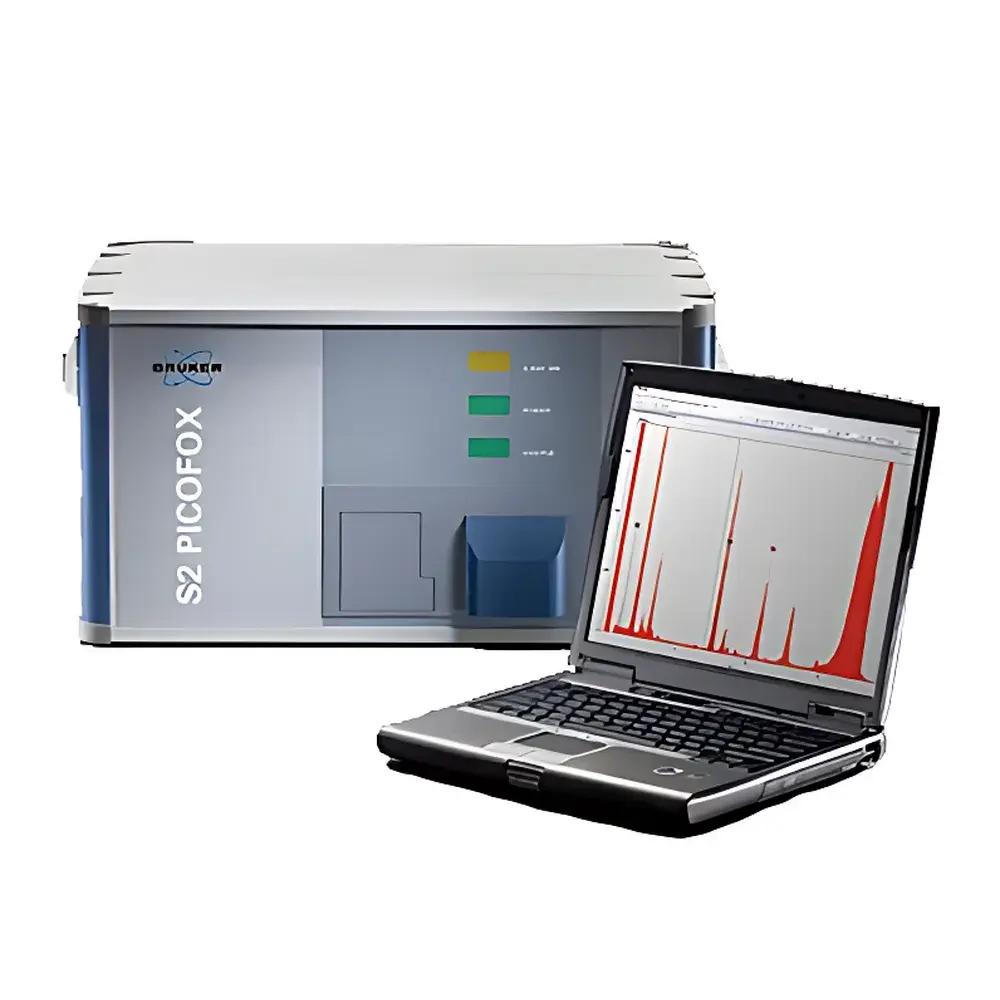
Bruker S2 PICOFOX Total Reflection X-Ray Fluorescence Spectrometer (TXRF)
| Brand | Bruker |
|---|---|
| Origin | Germany |
| Manufacturer Type | Authorized Distributor |
| Import Status | Imported |
| Model | S2 PICOFOX (TXRF) |
| Configuration | Benchtop |
| Application Scope | General-Purpose |
| Elemental Range | Al (13) to U (92) |
| Detection Limit | Down to 2 pg |
| Quantification Range | ppb to 100% |
| Energy Resolution | <125 eV at Mn Kα (FWHM, 100 kcps), <135 eV typical |
| Repeatability | ≤0.1% RSD |
| Detector | Fourth-Generation XFlash® Silicon Drift Detector (SDD) with Peltier Cooling |
Overview
The Bruker S2 PICOFOX is a benchtop total reflection X-ray fluorescence (TXRF) spectrometer engineered for ultra-trace multi-element analysis with minimal sample consumption and exceptional quantitative accuracy. Unlike conventional energy-dispersive X-ray fluorescence (ED-XRF) systems, TXRF operates on the principle of total external reflection—where an incident X-ray beam strikes a flat, polished quartz carrier at a grazing angle (10⁴-fold, resulting in signal-to-background ratios exceeding 10⁶ and enabling detection limits as low as 2 pg per element. The system delivers direct proportionality between measured fluorescence intensity and elemental mass deposited on the carrier—eliminating matrix effects common in bulk ED-XRF and enabling absolute quantification without matrix-matched standards.
Key Features
- Fourth-generation XFlash® silicon drift detector (SDD) with integrated Peltier cooling—no liquid nitrogen or cryogenic gases required; stable operation over extended duty cycles with <125 eV energy resolution at Mn Kα (100 kcps)
- Grazing-incidence optics with high-brilliance microfocus X-ray tube (Mo or W anode options), optimized for total reflection geometry and minimized dead time
- Automated sample positioning with motorized XYZ stage and precision laser alignment for reproducible carrier placement
- Two configurable autosampler options: 1-position manual carrier holder for rapid single-sample screening, and 25-position programmable carousel for unattended batch analysis
- Compact, self-contained benchtop architecture—no external chillers, gas supplies, or vacuum pumps; operational in standard laboratory environments (20–25°C, 40–60% RH)
- Factory-calibrated fundamental parameter (FP) quantification algorithms—enables accurate quantitation from raw intensity data without user-provided calibration standards
Sample Compatibility & Compliance
The S2 PICOFOX accepts diverse sample forms—including aqueous solutions (1–50 µL), suspensions, digested filters, dried residues, thin films, and sub-10 µg solid powders—without digestion or dilution. Sample preparation follows ISO 17294-2 (water analysis), ASTM D5673 (trace metals in petroleum), and EPA Method 200.8 (metals in drinking water). Instrument design complies with IEC 61000-6-3 (EMC), IEC 61000-6-4 (industrial emission), and EN 61010-1 (safety). Data integrity meets FDA 21 CFR Part 11 requirements through audit-trail-enabled software with role-based access control, electronic signatures, and immutable result archiving.
Software & Data Management
The instrument is controlled via Bruker’s proprietary SPECTRA.EVAL software, featuring intuitive workflow-driven interface, real-time spectral acquisition monitoring, and automated peak deconvolution using iterative least-squares fitting. Quantitative modules support FP-based calibration, internal standard correction (e.g., Ga or Y addition), and certified reference material (CRM) validation. All spectra, processing parameters, and metadata are stored in ACID-compliant SQLite databases with timestamped versioning. Export formats include CSV, PDF reports (with uncertainty propagation), and XML for LIMS integration (ASTM E1382-compliant).
Applications
The S2 PICOFOX serves laboratories requiring regulatory-grade trace metal quantification across multiple sectors: environmental testing (As, Cd, Pb, Hg in wastewater per ISO 17294); clinical toxicology (Cd, Pb, Se in serum/urine per CLIA guidelines); pharmaceutical quality control (catalyst residue analysis per ICH Q2(R2)); food safety (Al, Cr, Ni migration from packaging per EU 10/2011); and materials science (impurity profiling in high-purity Si wafers, thin-film stoichiometry verification). Its portability and low infrastructure demand also support field-deployable applications such as on-site soil screening or forensic evidence analysis.
FAQ
What sample volume is required for liquid analysis?
Typical liquid volumes range from 1 µL to 50 µL, deposited onto a quartz carrier and dried under inert atmosphere or IR lamp.
Can the system quantify light elements below aluminum?
No—the minimum detectable atomic number is Al (Z=13) due to absorption in the beryllium window and air path; vacuum or He-flushed configurations are not supported in this benchtop variant.
Is matrix matching necessary for quantification?
Not for routine analysis—fundamental parameter modeling compensates for inter-element effects; however, for complex organic matrices (e.g., blood plasma), internal standardization is recommended.
How is detector stability maintained without liquid nitrogen?
The XFlash® SDD uses multi-stage Peltier cooling to maintain –20°C operating temperature, with active thermal feedback and drift compensation algorithms ensuring long-term spectral stability.
Does the system support GLP/GMP compliance?
Yes—software includes full audit trail, user authentication, electronic signature capability, and 21 CFR Part 11–compliant data handling protocols.
Related Products



