
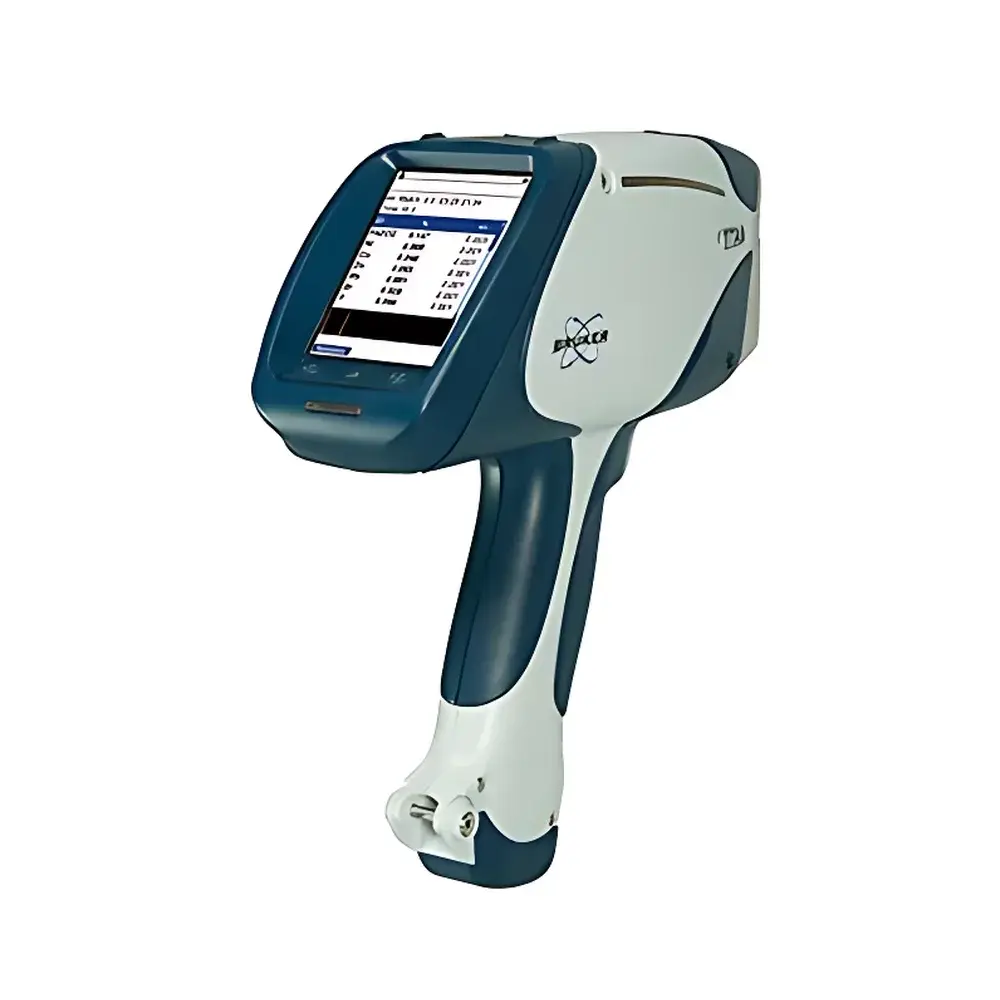
Bruker S1 TITAN Handheld Energy Dispersive X-Ray Fluorescence Spectrometer
| Brand | Bruker |
|---|---|
| Origin | Germany |
| Model | S1 TITAN |
| Element Range | Mg–U |
| Detection Limit | 1 ppm–99.99% |
| Energy Resolution | <140 eV (Mn Kα) |
| Repeatability | ±0.1% RSD |
| Detector | Silicon Drift Detector (SDD) |
| X-ray Tube | 50 kV microfocus tube |
| Form Factor | Handheld (1.23 kg) |
| Compliance | ASTM F963, RoHS, USP <232>/<233>, EPA Method 6200, ISO 12885, IEC 62321 |
Overview
The Bruker S1 TITAN is a handheld energy dispersive X-ray fluorescence (EDXRF) spectrometer engineered for field-deployable elemental analysis with laboratory-grade performance. Based on microfocus X-ray tube excitation and silicon drift detector (SDD) technology, the instrument operates on the fundamental principle of X-ray fluorescence: primary X-rays induce inner-shell electron ejection in sample atoms; subsequent electron relaxation emits characteristic secondary X-rays whose energies are element-specific and intensities quantitatively correlate with elemental concentration. The S1 TITAN delivers rapid, non-destructive, in-situ analysis across the Mg–U range (atomic number 12–92), supporting trace-level detection down to 1 ppm while maintaining robust repeatability (±0.1% RSD under controlled conditions). Its lightweight design (1.23 kg), sealed IP54-rated enclosure, and integrated 5-inch color touchscreen enable operation in demanding industrial, geological, and regulatory environments—without requiring sample preparation or vacuum pumping.
Key Features
- SharpBeam® Optics Engine: Bruker’s proprietary X-ray beam geometry optimization aligns the microfocus X-ray tube, collimation system, and SDD active area to maximize photon collection efficiency—reducing required tube power, extending battery life, and improving peak-to-background ratio and limit of detection.
- X-Flash® SDD Detector: High-resolution silicon drift detector with Peltier cooling ensures stable spectral response at ambient temperatures, delivering <140 eV energy resolution at Mn Kα (5.89 keV), critical for resolving overlapping peaks in complex matrices (e.g., Cr/V, Pb/As, Sb/Sn).
- SMART®Grade Acquisition Logic: Adaptive counting time control dynamically adjusts measurement duration based on real-time signal statistics, ensuring statistically valid results without user-defined time presets—ideal for heterogeneous samples and mixed-alloy identification.
- Ruggedized Industrial Design: Die-cast magnesium housing with rubber overmolding, IP54 ingress protection (dust- and splash-resistant), and MIL-STD-810G shock/vibration compliance ensure operational reliability in foundries, mines, scrap yards, and outdoor survey sites.
- 50 kV Microfocus X-ray Source: High-energy excitation enables efficient excitation of heavier elements (e.g., Ba, Pb, U) while minimizing bremsstrahlung background—enhancing sensitivity for regulated toxic metals (Cd, Hg, Pb, Cr⁶⁺ surrogate) in consumer goods and environmental media.
Sample Compatibility & Compliance
The S1 TITAN supports direct analysis of solids (alloys, ores, soils, polymers, ceramics), powders (pressed pellets), and thin films—requiring no consumables or external gas purge. Factory-calibrated methods cover >30 pre-optimized applications, including alloy grade identification (ASTM E1086, ISO 17226), mining geochemistry (ASTM D5630, ISO 12885), RoHS screening (IEC 62321-5), toy safety (ASTM F963-17 Section 4.3.5), and packaging compliance (CPSC-CH-E1001, TPCH). All calibrations are traceable to NIST SRM reference materials and validated per ISO/IEC 17025 requirements. Data integrity meets FDA 21 CFR Part 11 criteria when used with Bruker’s optional TitanLink™ software suite, supporting electronic signatures, audit trails, and role-based access control for GLP/GMP-regulated workflows.
Software & Data Management
TitanLink™ PC software provides full instrument control, method development, multivariate calibration (PLS, MLR), spectral deconvolution, and report generation compliant with ISO 14284 and ASTM E2857. Raw spectra and processed results are stored in vendor-neutral .csv and .trc formats. Cloud synchronization via Bruker’s TitanCloud™ platform enables centralized fleet management, remote firmware updates, and cross-site data harmonization. All analytical sessions automatically log operator ID, GPS coordinates, timestamp, exposure parameters, and spectral metadata—supporting chain-of-custody documentation for environmental monitoring and regulatory submissions.
Applications
- Positive Material Identification (PMI) in petrochemical, power generation, and aerospace infrastructure
- In-field ore grade estimation and lithogeochemical mapping during exploration drilling
- Scrap metal sorting and recycling stream verification (e.g., stainless steel 304 vs. 316, Cu–Ni alloys)
- Consumer product compliance testing: lead in toys/clothing (California Prop 65), cadmium in plastics, brominated flame retardants
- Soil and sediment screening for As, Cd, Pb, Hg in brownfield remediation and agricultural land assessment
- Quality assurance of catalysts, pigments, and battery cathode materials (e.g., Ni–Co–Mn–Al oxides)
FAQ
Does the S1 TITAN require annual recalibration?
No—factory calibrations are stable for ≥12 months under normal use; however, daily verification using Bruker-supplied check standards (e.g., SS316, brass CRM) is recommended per ISO 17025 clause 7.7.
Can it analyze light elements below magnesium?
No—the instrument’s beryllium window and air-path geometry limit reliable detection to Mg (Z=12) and heavier elements; for Na–F analysis, vacuum-purged or He-flushed benchtop EDXRF systems are required.
Is radioactive source licensing required?
No—the S1 TITAN uses a fully shielded, electronically gated 50 kV X-ray tube; it is exempt from nuclear regulatory licensing in the EU (EURATOM Directive 2013/59), USA (NRC 10 CFR 30.18), and most OECD jurisdictions.
How is measurement uncertainty reported?
TitanLink™ calculates expanded uncertainty (k=2) per ISO/IEC Guide 98-3 (GUM), incorporating type-A (statistical repeatability) and type-B (calibration uncertainty, matrix effects, detector drift) components—exportable in PDF reports with full uncertainty budget breakdown.
What battery life can be expected during continuous operation?
Two hot-swappable Li-ion batteries provide ≥8 hours of typical usage (30-sec measurements, 50% screen brightness, ambient 25°C); battery health and cycle count are monitored and logged in real time.




