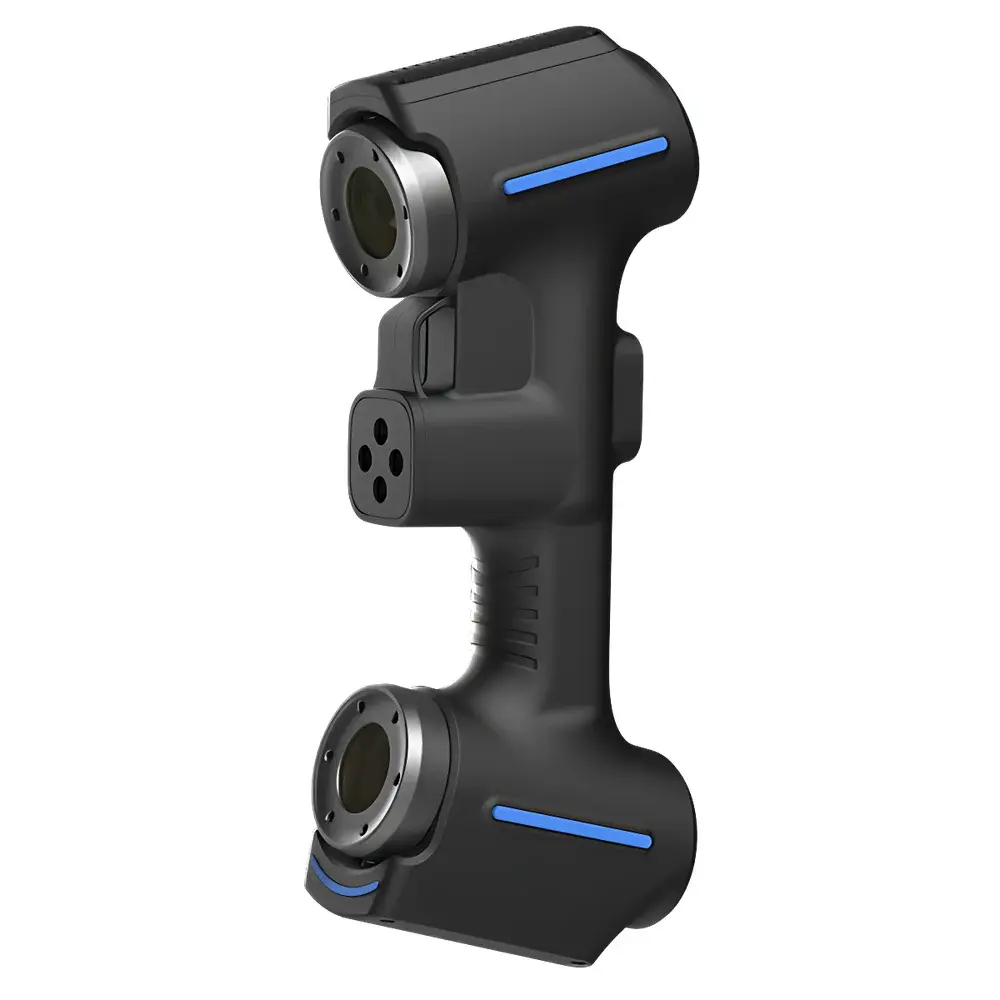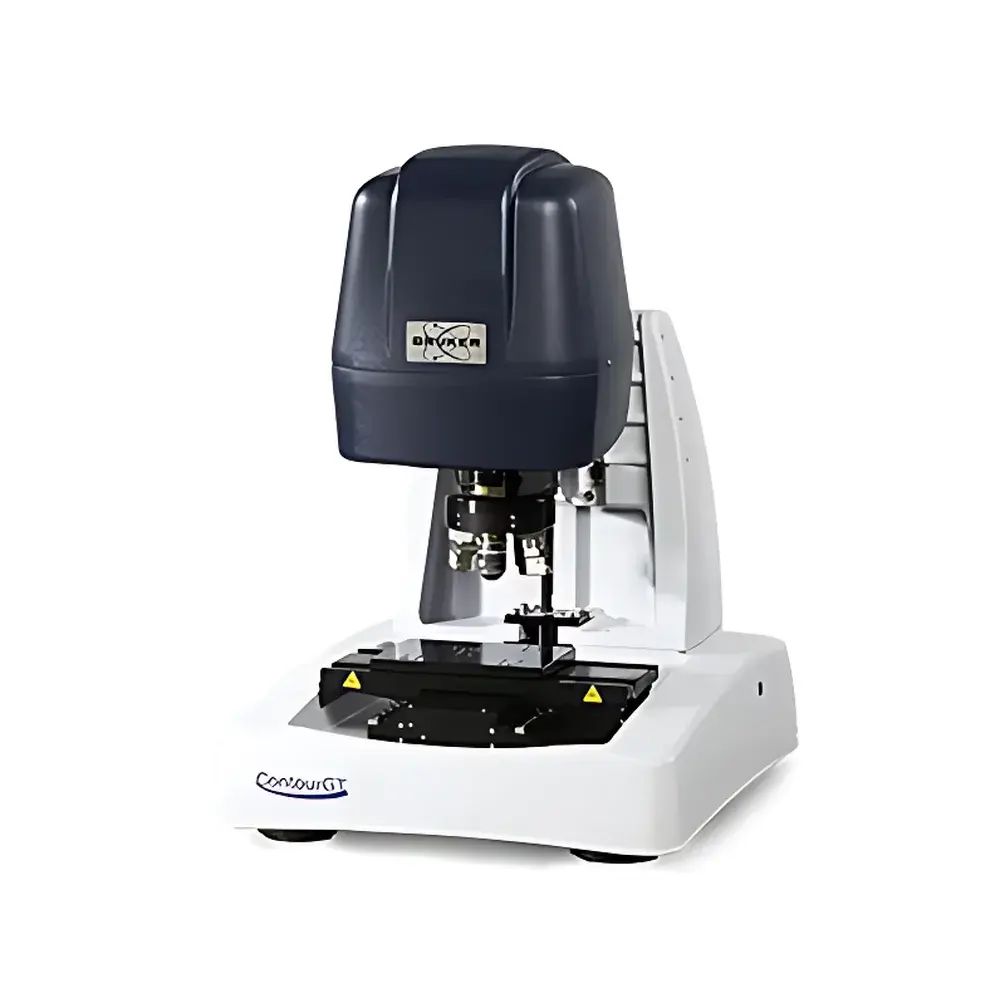
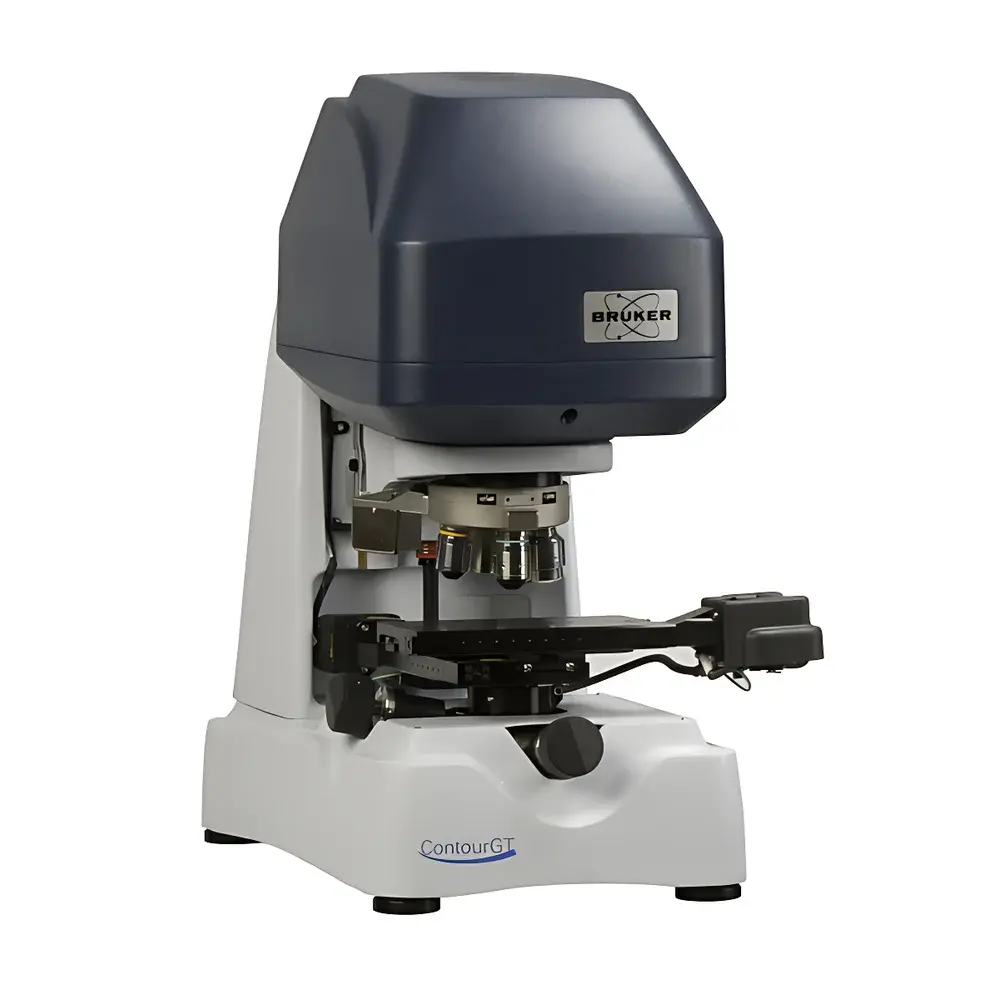
Bruker ContourGT-I Optical Profilometer System
| Brand | Bruker |
|---|---|
| Origin | USA |
| Manufacturer Type | Authorized Distributor |
| Product Category | Imported Instrument |
| Model | ContourGT-I |
| Pricing | Available Upon Request |
| Type | Non-Contact 3D Optical Profilometer / Surface Roughness Analyzer |
Overview
The Bruker ContourGT-I Optical Profilometer System is a high-precision, non-contact 3D surface metrology platform engineered for quantitative topographic characterization across research laboratories and industrial quality control environments. Built upon Bruker’s decades-long heritage in optical interferometry and white-light scanning technology, the ContourGT-I employs phase-shifting interferometry (PSI) and vertical scanning interferometry (VSI) to deliver sub-nanometer vertical resolution and nanometer-level repeatability in surface height measurements. Its core architecture integrates a robust optical head with a motorized, programmable tilt stage and fully automated XYZ sample positioning—enabling precise alignment and multi-angle surface interrogation without mechanical repositioning or operator intervention. Designed for ISO 25178-compliant areal surface texture analysis, the system supports traceable measurement of parameters including Sa, Sq, Sz, Sdr, and Sk, making it suitable for applications demanding strict adherence to international surface metrology standards.
Key Features
- Programmable, motorized tilt stage with ±15° angular range and <0.001° positional repeatability for optimized illumination and viewing geometry across complex surfaces.
- High-stability, integrated vibration isolation base with active damping characteristics—eliminating external environmental perturbations without requiring external air tables.
- Automated XYZ translation stage (100 mm × 100 mm travel, 0.1 µm encoder resolution) synchronized with objective turret for seamless field-of-view switching and stitching.
- Modular optical head supporting multiple objectives (2.5× to 100×), enabling lateral resolutions from 0.45 µm to 6.9 µm and vertical measurement ranges from 100 nm to 10 mm.
- Vision64 software platform with intuitive workflow-driven interface, real-time measurement preview, and customizable report templates compliant with GLP/GMP documentation requirements.
- On-the-fly measurement automation via scriptable macros and batch processing routines—reducing operator dependency and enhancing inter-laboratory reproducibility.
Sample Compatibility & Compliance
The ContourGT-I accommodates samples ranging from 10 mm × 10 mm wafers to full 300 mm semiconductor substrates, as well as irregularly shaped biomedical implants, precision-machined engine components, and curved optical lenses. Its non-destructive, non-contact methodology eliminates risk of surface damage or probe wear—critical for soft polymers, thin-film coatings, and fragile MEMS structures. The system conforms to ASTM E2382–22 (Standard Guide for Measurement of Surface Topography Using Optical Profilometers), ISO 25178-2:2012 (Geometrical Product Specifications – Surface Texture), and supports audit-ready data logging per FDA 21 CFR Part 11 when configured with electronic signature and user access controls.
Software & Data Management
Vision64 provides a unified environment for acquisition, analysis, visualization, and reporting. It includes built-in algorithms for noise filtering, edge detection, form removal (polynomial, Gaussian, spline), and advanced segmentation for defect identification and feature extraction. All raw interferometric data—including phase maps, intensity stacks, and Z-height matrices—are stored in vendor-neutral HDF5 format. Audit trails record user actions, parameter changes, and calibration events with timestamps and operator IDs. Export options include CSV, TIFF, STL, and PDF reports with embedded metadata—facilitating integration into LIMS and enterprise QA databases.
Applications
- Semiconductor: Wafer-level roughness mapping, CMP uniformity assessment, trench depth profiling, and photomask inspection.
- Medical Devices: Surface finish verification of orthopedic implants, stent strut morphology, and micro-textured tissue scaffolds.
- Optics & Photonics: Metrology of anti-reflective coatings, diffractive optical elements, and laser mirror flatness.
- Automotive: Cylinder bore cross-hatch analysis, bearing raceway waviness, and tribological surface characterization.
- Academic Research: In-situ deformation studies, thin-film growth monitoring, and biomaterial interface topography quantification.
FAQ
Does the ContourGT-I require external vibration isolation?
No—the system features an integrated passive/active hybrid isolation base engineered to meet ISO 25178 stability requirements without auxiliary air tables or floor mounts.
Can Vision64 software be validated for regulated environments?
Yes—when deployed with role-based access control, electronic signatures, and audit trail configuration, Vision64 supports 21 CFR Part 11 compliance for pharmaceutical and medical device QA/QC workflows.
What surface materials can be measured reliably?
The system measures reflective, semi-transparent, and diffusely scattering surfaces—including silicon, stainless steel, fused silica, PDMS, and anodized aluminum—with no coating or conductive treatment required.
Is stitching capability included in standard configuration?
Yes—automated multi-field stitching is native to Vision64 and supports both grid-based and feature-guided alignment for large-area topography reconstruction.
How is calibration traceability maintained?
Bruker provides NIST-traceable step-height and roughness reference standards; system calibration routines validate lateral scale, vertical linearity, and noise floor performance prior to each measurement session.