
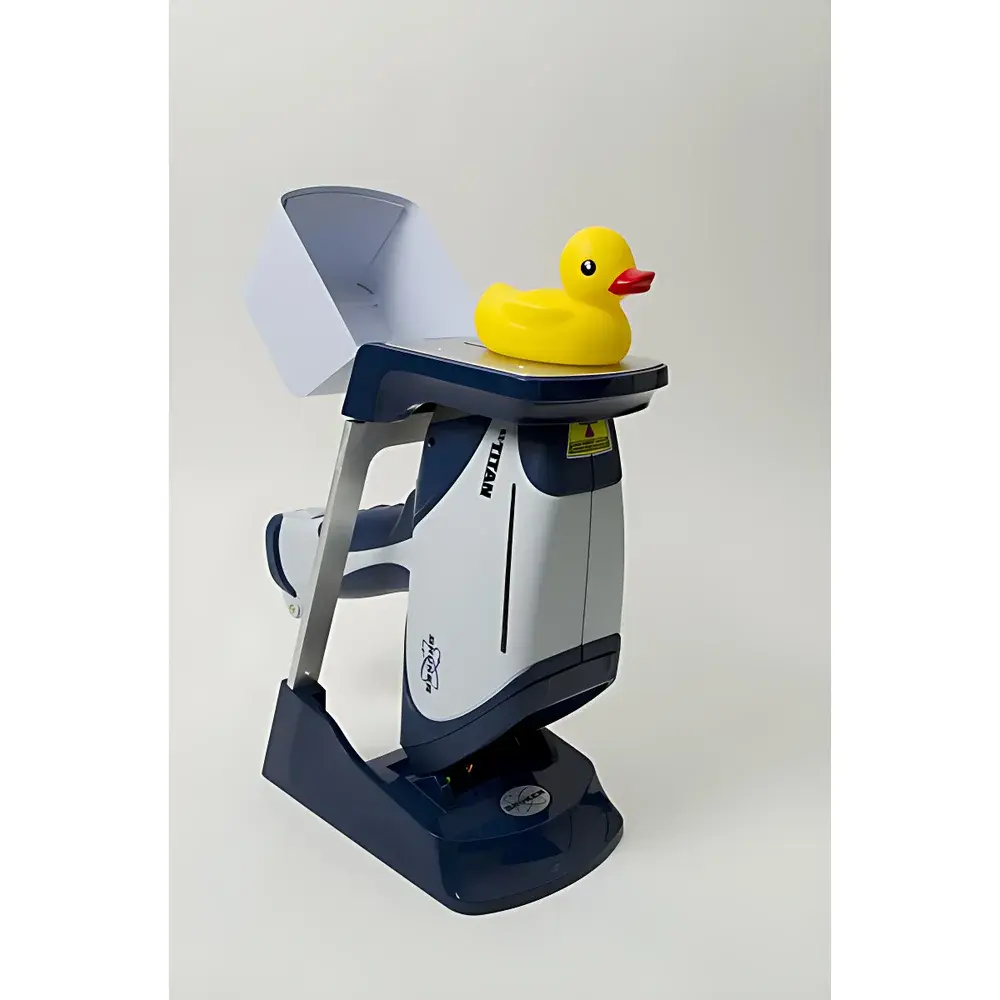
Bruker S1 TITAN600 Handheld Energy Dispersive X-Ray Fluorescence Spectrometer
| Brand | Bruker |
|---|---|
| Origin | Germany |
| Model | S1 TITAN600 |
| Application | Handheld/Portable |
| Element Range | Na–U |
| Detection Limit | 1 ppm |
| Energy Resolution | <140 eV |
| Repeatability | 0.1% |
| Detector | Silicon Drift Detector (SDD) |
| Regulatory Compliance | RoHS II (2011/65/EU), CPSIA 2008, EPA Method 6200, California Proposition 65, US Safe Drinking Water Act |
Overview
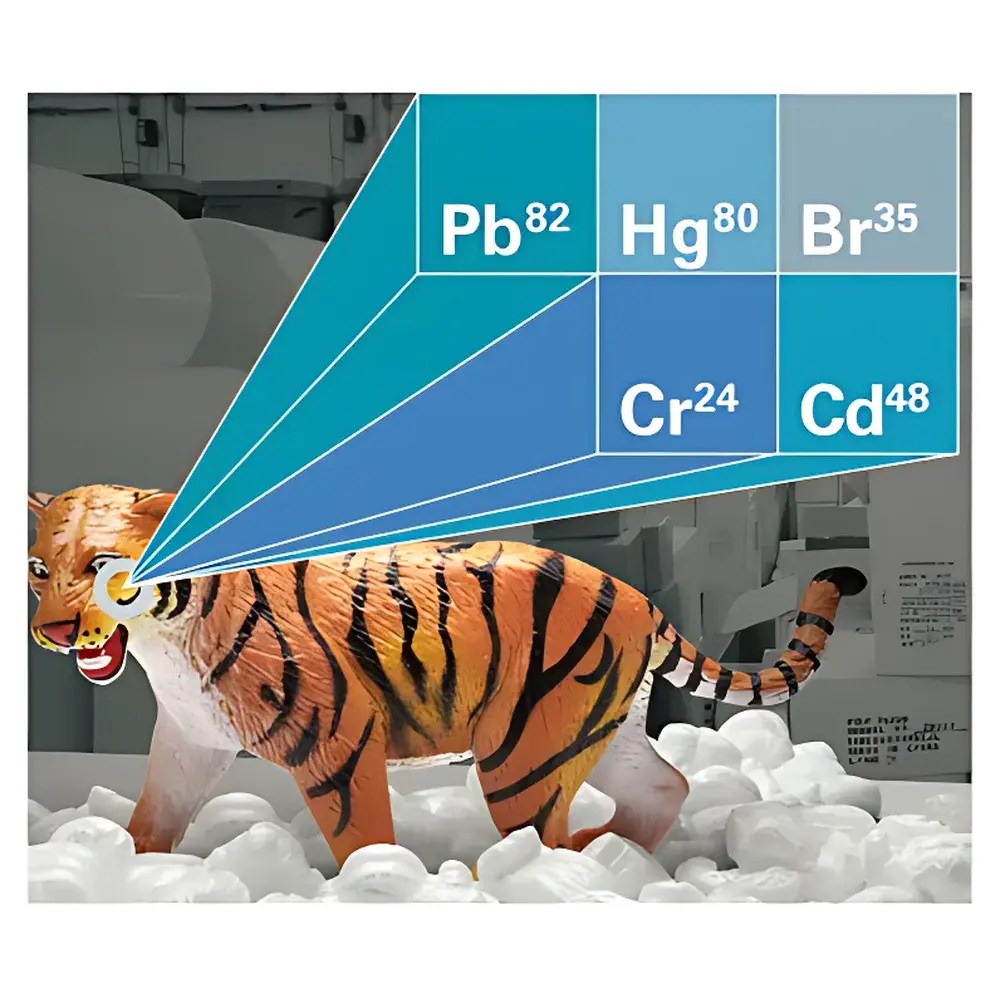
The Bruker S1 TITAN600 is a field-deployable, handheld energy dispersive X-ray fluorescence (EDXRF) spectrometer engineered for rapid, non-destructive elemental analysis of solid and powdered samples in real time. Operating on the fundamental principle of X-ray fluorescence—where primary X-rays excite atoms in the sample, inducing emission of characteristic secondary X-rays—the instrument delivers quantitative and semi-quantitative data across the elemental range from sodium (Na, Z=11) to uranium (U, Z=92). Its optimized excitation geometry, high-power microfocus X-ray tube, and large-area silicon drift detector (SDD) enable sub-140 eV energy resolution at Mn Kα, ensuring robust spectral separation of adjacent peaks—critical for accurate quantification of regulated elements such as Pb, Cd, Hg, Cr, Br (as proxy for PBB/PBDE), and Cl (for PVC screening). Designed for regulatory screening workflows, the S1 TITAN600 meets the analytical demands of RoHS II compliance verification, CPSIA-mandated lead testing in children’s products, and EPA 6200-compliant soil screening—without sample preparation or laboratory infrastructure.
Key Features
- Integrated high-performance SDD detector with <140 eV resolution at Mn Kα, enabling precise discrimination of overlapping emission lines (e.g., As Kα/Cr Kβ, Pb Lα/As Kα)
- Ruggedized IP54-rated enclosure with reinforced magnesium alloy housing, drop-tested to 1.5 m, and sealed against dust and moisture for field durability
- Real-time spectrum acquisition and on-device processing using Bruker’s proprietary FP (Fundamental Parameters) and empirical calibration algorithms
- Automated beam filtration and voltage/current optimization (up to 50 kV / 100 µA) to maximize sensitivity for light elements (Na–Cl) and heavy metals (Pb, Hg, Cd) in heterogeneous matrices
- Battery-powered operation (rechargeable Li-ion, >10 h typical runtime) with hot-swappable battery support for uninterrupted field deployment
- Onboard GPS tagging, digital camera integration, and Bluetooth/Wi-Fi connectivity for georeferenced data logging and remote firmware updates
Sample Compatibility & Compliance
The S1 TITAN600 supports direct analysis of flat, curved, irregular, and granular surfaces—including plastics, polymers, metal alloys, soils, ceramics, and electronic components—without homogenization or digestion. Its collimated beam (3 mm or 8 mm spot size selectable) minimizes matrix effects in heterogeneous samples. The instrument is pre-configured with certified factory calibrations traceable to NIST SRMs for RoHS (plastics, metals, solder), CPSIA (Pb in toys), soil (EPA 6200), cement/lime (ASTM C114), and drinking water-related copper alloys (US EPA 100.1, CA Prop 65). All measurement modes comply with ISO 12885:2008 (XRF safety), IEC 62321-5:2013 (RoHS testing), and ASTM E1621 (EDXRF for consumer products). Audit-ready data files include full spectral metadata, instrument settings, operator ID, timestamp, and GPS coordinates—supporting GLP/GMP documentation requirements.
Software & Data Management
Bruker’s S1 PX software provides a validated, CFR Part 11–compliant environment for method development, data acquisition, and reporting. It features role-based user access control, electronic signatures, and immutable audit trails for all calibration changes, measurement events, and report exports. Quantitative analysis employs matrix-matched standards and iterative FP modeling, with uncertainty estimation per ISO/IEC 17025 guidelines. Data export supports CSV, PDF, and XML formats compatible with LIMS integration. Firmware and calibration libraries are updated via Bruker’s secure cloud portal, ensuring alignment with evolving regulatory thresholds (e.g., EU Commission Delegated Directive (EU) 2015/863 amendments).
Applications
- Routine screening of electronic components, PCBs, cables, and enclosures for RoHS II restricted substances (Pb, Cd, Hg, Cr⁶⁺, Br, Cl)
- In-field verification of toy and juvenile product compliance with CPSIA 2008 (total Pb ≤100 ppm in accessible substrates)
- Soil and sediment analysis per EPA Method 6200 for As, Pb, Cd, Cr, and Hg at contaminated sites
- On-site assessment of construction materials (cement, gypsum, lime) for heavy metal leachability risk
- Scrap metal sorting and alloy grade identification—including low-Pb copper verification per NSF/ANSI 61 and CA AB 1953
- Recycling stream characterization of WEEE and e-waste fractions for hazardous element recovery planning
FAQ
Does the S1 TITAN600 require annual recalibration by a certified lab?
No—its factory-calibrated FP engine and automated internal reference checks eliminate mandatory annual recalibration; however, performance verification using certified check standards (e.g., NIST 2711a) is recommended before each analytical campaign.
Can it quantify chromium(VI) directly?
No—EDXRF measures total Cr; Cr⁶⁺ speciation requires wet-chemical extraction per EN ISO 3613 or EPA 3060A followed by colorimetric or IC analysis.
Is operator radiation safety training required?
Yes—users must complete ANSI N43.3-compliant training; the device incorporates interlocked shutter, real-time dose monitoring, and automatic beam cutoff upon tilt or obstruction.
What sample preparation is needed for plastic RoHS screening?
None—flat, clean surfaces are analyzed directly; curved or textured parts benefit from repeat measurements and averaging to mitigate geometric effects.
How does it handle light-element interference in halogen screening?
Via dual-beam excitation (vacuum-assisted mode optional) and deconvolution algorithms that resolve Cl Kα (2.62 keV) from S Kα (2.31 keV) and Ca Kα (3.69 keV), supported by matrix-matched polymer calibrations.





