
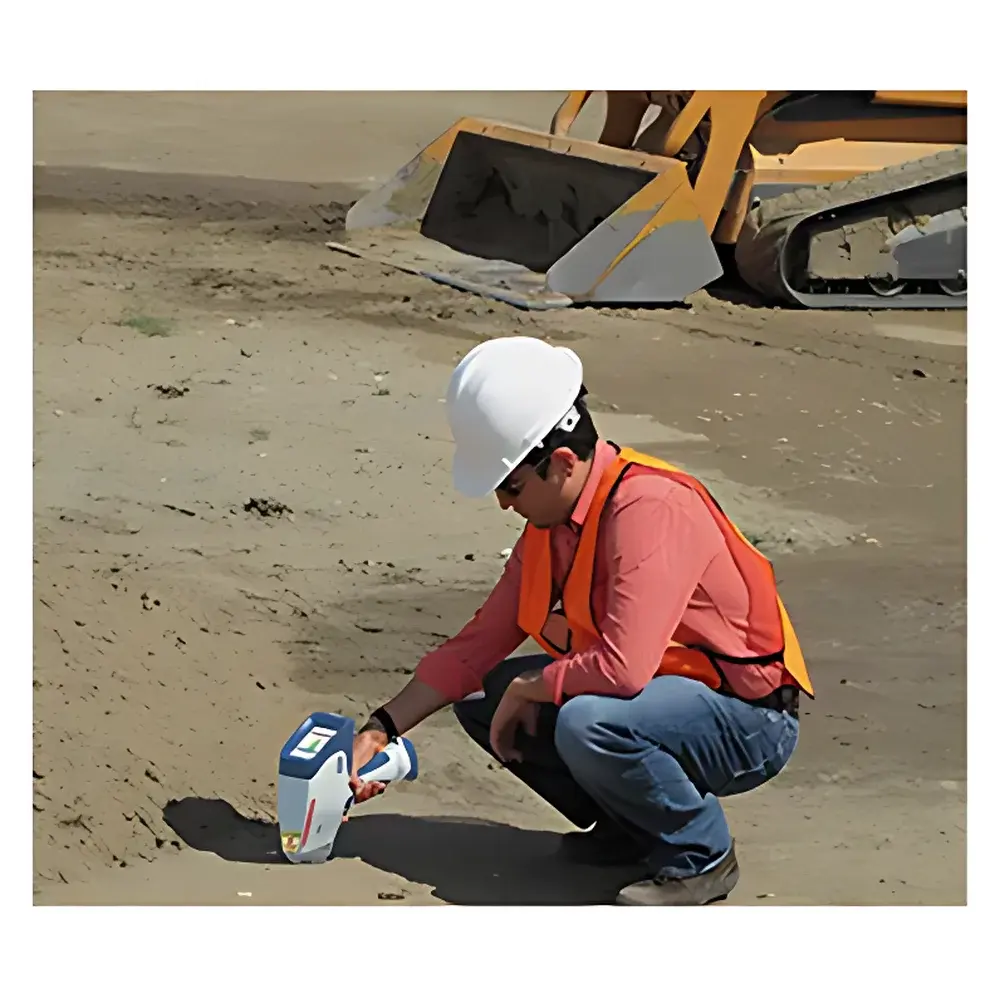
Bruker S1 TITAN Handheld X-ray Fluorescence (XRF) Soil Analyzer
| Brand | Bruker |
|---|---|
| Origin | Germany |
| Model | S1 TITAN |
| Instrument Type | Multi-element Portable XRF Analyzer for Soil and Environmental Matrices |
| Regulatory Compliance | CE, RoHS, FDA 21 CFR Part 11 (software-enabled), ISO 12847, ASTM D6358–22, USP <233> (for regulatory-grade workflows) |
| Detection Range | S (16) to U (92) — 40+ elements quantifiable in soil matrices |
| Measurement Principle | Energy-Dispersive X-ray Fluorescence (ED-XRF) with Rh anode microfocus X-ray tube and large-area silicon drift detector (SDD) |
Overview
The Bruker S1 TITAN Handheld X-ray Fluorescence (XRF) Soil Analyzer is an industrial-grade, field-deployable elemental analyzer engineered for rapid, non-destructive quantification of metals and metalloids in heterogeneous environmental solid matrices. Based on energy-dispersive X-ray fluorescence (ED-XRF) spectroscopy, the instrument employs a high-stability rhodium-target microfocus X-ray tube and a high-resolution silicon drift detector (SDD) to deliver precise, matrix-corrected elemental concentrations in real time. Designed specifically for regulatory and investigative environmental monitoring, the S1 TITAN meets the analytical demands of soil screening, contaminated land assessment, EPA Region 10 protocols, and EU Soil Thematic Strategy compliance workflows. Its robust mechanical architecture, IP54-rated enclosure, and integrated GPS/IMU enable reliable operation under variable ambient conditions—including high humidity, dust-laden sites, and temperature fluctuations common at mining perimeters, industrial brownfields, and agricultural runoff zones.
Key Features
- Optimized excitation geometry and proprietary FP (fundamental parameters) calibration algorithms for accurate quantification of low-Z elements (S, P, Cl, K, Ca) through high-Z analytes (Pb, U, Th) in complex soil matrices
- Real-time spectral deconvolution with automatic peak identification and interference correction for overlapping lines (e.g., As Kα/Pb Lα, Cr Kβ/V Kα)
- Integrated sample positioning sensor and beam collimation system to ensure consistent measurement geometry across irregular surfaces (clods, aggregates, filter media)
- Battery-powered operation (>12 hours continuous use) with hot-swappable Li-ion packs certified to UN 38.3 transport standards
- On-device data validation tools including internal reference checks, duplicate measurement tracking, and statistical outlier detection per ISO/IEC 17025:2017 Annex A.4 guidelines
- Ruggedized magnesium alloy chassis with MIL-STD-810G shock/vibration resistance and optional protective boot for extended field deployment
Sample Compatibility & Compliance
The S1 TITAN is validated for direct analysis of unprepared or minimally prepared environmental solids, including air-dried soils, sediments, sludges, mine tailings, construction debris, airborne particulate filters (e.g., PVC, polycarbonate), and dried biofilms. It complies with ASTM D6358–22 (Standard Test Method for Determination of Metals in Soils by Portable XRF), ISO 12847 (Soil quality — Determination of selected elements by portable XRF), and supports GLP/GMP-aligned data integrity requirements via optional audit trail logging and electronic signature modules compliant with FDA 21 CFR Part 11. All factory calibrations are traceable to NIST SRM 2710a, 2711a, and IAEA-375 reference materials.
Software & Data Management
The instrument operates with Bruker’s proprietary S1 PXRF software suite, supporting method-based analysis workflows, customizable reporting templates (PDF/CSV/XLSX), and georeferenced data export compatible with ArcGIS, QGIS, and ESRI Survey123. Data encryption (AES-256), role-based user access control, and full audit trail functionality—including operator ID, timestamp, GPS coordinates, instrument status logs, and raw spectrum metadata—are enabled by default in regulatory configurations. Cloud synchronization via secure HTTPS endpoints allows centralized data aggregation across multi-site monitoring programs without compromising chain-of-custody integrity.
Applications
- Rapid screening of priority pollutants (Pb, As, Cd, Hg, Cr, Ni, Zn, Cu) at Superfund sites and legacy industrial facilities
- Pre-excavation risk assessment for brownfield redevelopment projects in accordance with ASTM E1527–21
- Long-term temporal monitoring of metal migration in vadose zone profiles and groundwater plume delineation support
- Verification of remediation efficacy post-treatment (e.g., soil washing, stabilization, phytoremediation)
- Regulatory submission-ready data generation for state environmental agencies (e.g., California DTSC, Texas TCEQ) and EU Member State authorities under Directive 2004/35/EC
- Field validation of laboratory ICP-MS/OES results during QA/QC audits
FAQ
Does the S1 TITAN require sample digestion or homogenization prior to analysis?
No—direct solid analysis is supported for air-dried, sieved (<2 mm) soils. For highly heterogeneous or organic-rich samples, light grinding and pelletizing may improve precision; however, no acid digestion is required for screening-level quantification.
How does the instrument handle interferences from soil matrix effects (e.g., Fe, Si, Al absorption)?
Matrix corrections are applied automatically using fundamental parameter (FP) modeling combined with empirical calibration curves derived from >200 certified reference soils spanning diverse geological origins and organic matter content (0.5–15% LOI).
Is the S1 TITAN suitable for detecting mercury (Hg) in soils at regulatory action levels?
Yes—the instrument achieves sub-5 ppm detection limits for Hg in typical mineral soils (at 60 s counting time), meeting USEPA Region 10 screening thresholds and EU CLP classification criteria for hazardous waste characterization.
Can measurement data be exported in formats compatible with national environmental databases?
Yes—structured exports include ISO 19115-compliant metadata, WKT-formatted spatial coordinates, and element concentration fields aligned with INSPIRE and EPA STORET schema conventions.
What maintenance is required to sustain long-term accuracy?
Annual performance verification using NIST-traceable check sources (e.g., Mn/Cu/Zn/Pb multielement foil) is recommended; detector resolution and tube output are monitored continuously via onboard diagnostics and logged in the audit trail.







