
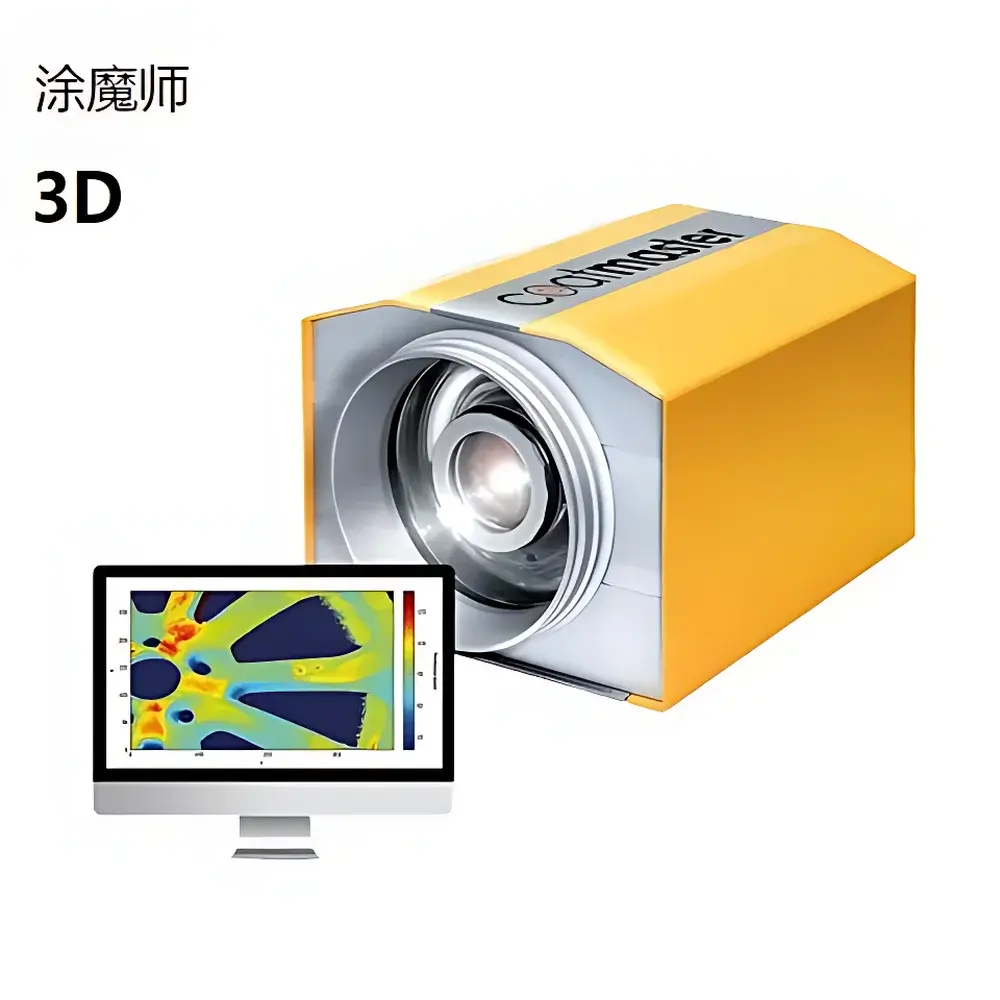
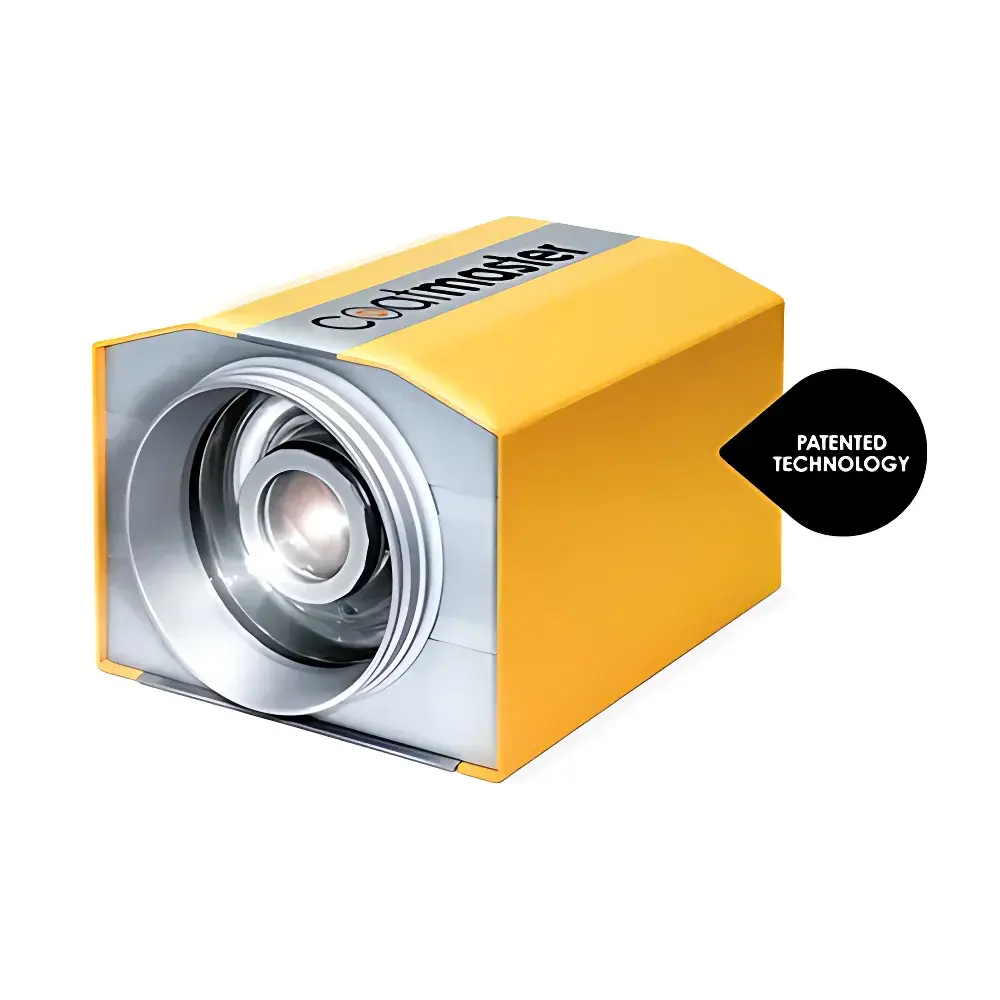
Coatmaster Atline Online Rubber Coating Thickness Analyzer
| Brand | Coatmaster |
|---|---|
| Origin | Switzerland |
| Model | Coatmaster Atline |
| Measurement Principle | ATO Photothermal Method |
| Substrate Compatibility | Rubber, Metal, CFRP, Plastic, Glass |
| Coating Compatibility | Lubricants, Polyurethane, Silicone, Liquid/Powder Coatings, Dacromet |
| Measurement Speed | ≤1 second per reading |
| Repeatability | <0.3 µm (on rubber substrates) |
| Accuracy vs. Reference | <±0.5 µm |
| Operating Distance & Angle | Tolerant (no strict alignment required) |
| Data Output | Real-time digital display, timestamped CSV export |
| Compliance | Designed for GLP/GMP environments |
Overview
The Coatmaster Atline Online Rubber Coating Thickness Analyzer is an industrial-grade, non-contact thickness measurement system engineered specifically for real-time, in-line monitoring of thin functional coatings applied to elastomeric substrates—most notably natural and synthetic rubber components used in automotive, aerospace, and rail transportation systems. Unlike conventional eddy current or beta-backscatter gauges—which fail on non-conductive, highly absorptive, or curved rubber surfaces—the Coatmaster Atline employs the patented ATO (Advanced Thermal Optics) photothermal measurement principle. This method delivers quantitative, physics-based thickness determination by applying a controlled, low-energy optical pulse to the coating surface, inducing a transient thermal response. An integrated high-speed infrared detector captures the time-resolved surface temperature decay profile, while proprietary digital signal processing (DSP) algorithms correlate thermal dynamics with coating thickness—fully independent of substrate conductivity, color, gloss, or geometry. The system is calibrated traceably against certified reference standards and operates without physical contact, eliminating wear, contamination risk, or mechanical interference with moving production lines.
Key Features
- True non-contact, non-destructive measurement—no probe contact, no surface damage, no consumables
- Universal substrate compatibility: validated on rubber (EPDM, NBR, silicone), metal, carbon fiber reinforced polymer (CFRP), thermoplastics, and glass
- Multi-coating capability: measures lubricant films (e.g., silicone oils), polyurethane topcoats, aqueous dispersions, powder coatings, and Dacromet-type conversion layers
- Robust industrial design: IP65-rated enclosure, vibration-resistant mounting, and ambient temperature operation (10–40 °C)
- Sub-micron repeatability: <0.3 µm standard deviation on repeated measurements at fixed locations on rubber substrates
- Real-time feedback loop integration: analog (4–20 mA) and digital (Ethernet/Modbus TCP) outputs enable direct linkage to PLCs and MES systems for closed-loop process control
- No probe exchange or recalibration required when switching between substrates or coating types—single-instrument versatility across product families
Sample Compatibility & Compliance
The Coatmaster Atline is routinely deployed for quality-critical applications where coating integrity directly impacts friction performance, sealing efficacy, acoustic damping, and service life—such as automotive weatherstrips, wiper blades, sunroof guides, and suspension bushings. Its measurement validity has been verified per ISO 2808 (paints and varnishes—determination of film thickness), ASTM D7091 (standard practice for nondestructive measurement of dry film thickness of nonmagnetic coatings applied to ferrous metals and nonconductive coatings on non-ferrous metals), and internal OEM specifications requiring ≤±0.5 µm agreement against cross-sectional SEM or stylus profilometry. The system’s software architecture supports full audit trails—including user login, parameter changes, calibration events, and raw thermal waveform archives—meeting GLP and GMP documentation requirements. When configured with encrypted local storage and role-based access, it satisfies foundational elements of FDA 21 CFR Part 11 for electronic records and signatures in regulated manufacturing environments.
Software & Data Management
The Coatmaster Control Suite provides intuitive, browser-based configuration and visualization. Each measurement is timestamped, geotagged (via optional encoder input), and stored with full metadata—including substrate ID, coating batch number, operator code, and environmental conditions (optional external sensor integration). Historical datasets export natively to CSV or SQL-compatible formats for SPC analysis in Minitab, JMP, or custom Python/Pandas workflows. Trend dashboards highlight drift, outliers, and shift patterns using Shewhart-style control charts. For inline deployment, the system supports automated pass/fail logic with configurable tolerance bands and immediate visual/audible alerts upon deviation—enabling rapid root-cause investigation into spray nozzle clogging, viscosity drift, or robotic path inaccuracies. All firmware updates and calibration certificates are digitally signed and version-controlled within the platform.
Applications
- Automotive: In-process verification of silicone lubricant thickness (0.5–10 µm) on EPDM door seals to ensure consistent coefficient of friction and compression set resistance
- Railway: Monitoring polyurethane wear-layer thickness on rubber suspension mounts to prevent premature fatigue failure under cyclic loading
- Aerospace: Quantifying anti-static coating uniformity on silicone rubber gaskets used in avionics enclosures
- Medical device manufacturing: Validating biocompatible hydrogel coating thickness on silicone catheter tubing
- Industrial automation: Closed-loop feedback to robotic spray systems adjusting atomization pressure and dwell time based on real-time thickness deviation
FAQ
How does the ATO photothermal method differ from laser triangulation or confocal microscopy?
ATO relies on thermal diffusion physics—not optical geometry—making it insensitive to surface reflectivity, transparency, or curvature. It measures bulk thermal response, enabling reliable quantification even on black, matte, or highly contoured rubber parts where optical methods fail.
Can the system measure multilayer coatings on rubber?
Current Atline firmware supports single-layer thickness determination. For bilayer systems (e.g., primer + topcoat), layer-specific resolution requires laboratory-grade Coatmaster Lab instruments with multi-wavelength excitation and advanced deconvolution modeling.
Is air purge or environmental shielding required during operation?
No. The ATO method uses near-infrared excitation (1064 nm) and mid-wave IR detection (3–5 µm), both minimally affected by ambient humidity or particulates. No nitrogen purging or laminar flow hoods are needed for factory-floor deployment.
What validation documentation is provided for regulatory submissions?
Each unit ships with a Factory Calibration Certificate traceable to PTB (Physikalisch-Technische Bundesanstalt) standards, IQ/OQ protocols, and a Design Qualification (DQ) summary aligned with ISO 13485 and ICH Q9 principles.
Does the system support integration with Industry 4.0 platforms like OPC UA or MQTT?
Yes. Native OPC UA server implementation is available as an optional firmware module, enabling seamless interoperability with Siemens MindSphere, PTC ThingWorx, and Rockwell FactoryTalk InnovationSuite.
Related Products



