
Q-Lab Xe-3-HDS Xenon Arc Weathering Test Chamber
| Brand | Q-Lab |
|---|---|
| Origin | USA |
| Model | Xe-3-HDS |
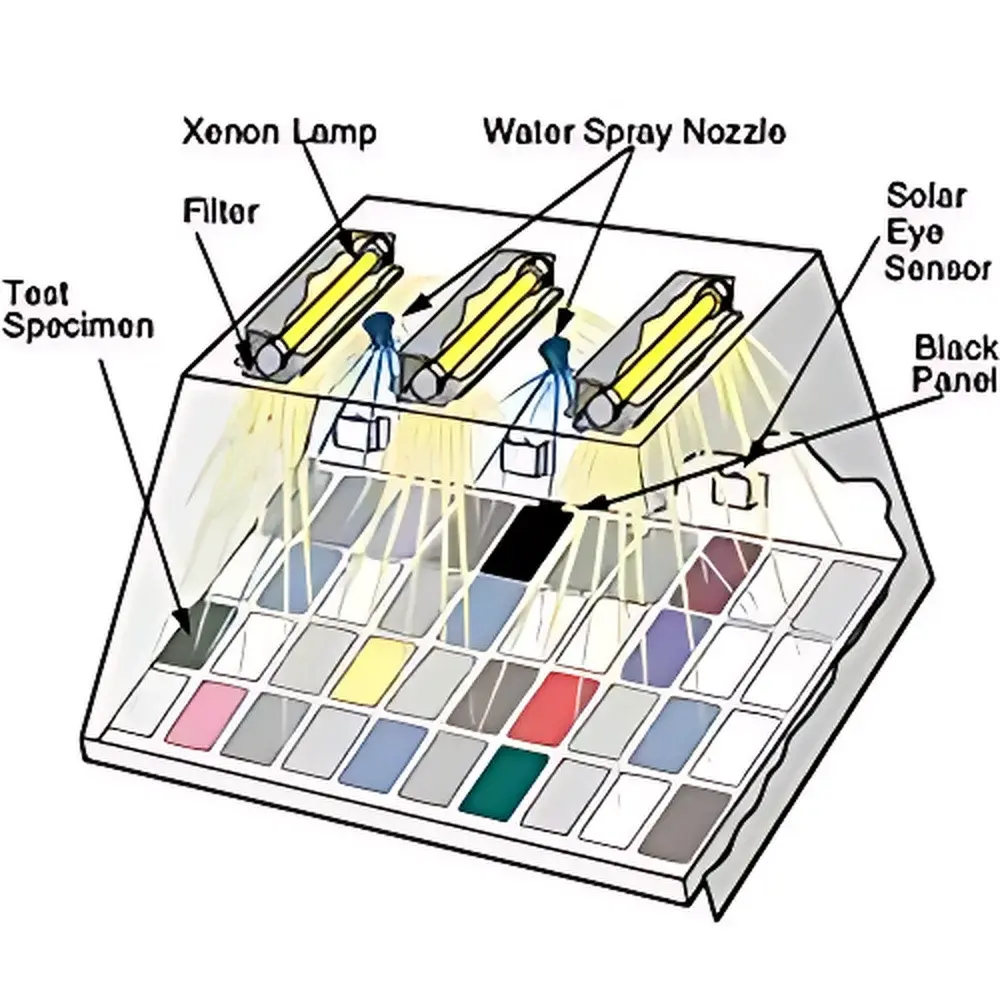
| Lamp Type | Air-Cooled Xenon Arc Lamp (3-lamp configuration) |
| Spectral Range | Full-spectrum solar simulation (290–800 nm) |
| Irradiance Control | SOLAR EYE® broadband or narrowband (340 nm, 420 nm, or TUV 300–400 nm) |
| Black Panel Temperature Range | 42–120 °C |
| Chamber Air Temperature Range | Ambient to 90 °C (with optional refrigerated cooling unit) |
| Relative Humidity Control | 10–95% RH (standard) |
| Sample Tray Dimensions | 451 mm × 718 mm |
| Sample Capacity | Up to 51 specimens (51 mm × 102 mm) |
| Dual Spray System | Standard (deionized water + secondary solution, e.g., acid rain or detergent) |
| Calibration | AUTOCAL® automated calibration system |
| Compliance | ASTM G155, ISO 4892-2, SAE J2527, AATCC TM16, ISO 11341, IEC 60068-2-9 |
| Interface | Touchscreen controller with built-in Ethernet, self-diagnostic alerts, GLP/GMP-ready audit trail logging |
Overview
The Q-Lab Xe-3-HDS Xenon Arc Weathering Test Chamber is an engineered solution for accelerated outdoor weathering simulation under controlled laboratory conditions. Utilizing three air-cooled xenon arc lamps, it delivers a full-spectrum solar irradiance (290–800 nm) that closely replicates natural sunlight—including critical UV, visible, and near-infrared wavelengths—enabling precise evaluation of photodegradation, color fading, gloss loss, chalking, cracking, and embrittlement in polymeric, coated, textile, and automotive materials. Unlike fluorescent UV or carbon arc systems, the xenon arc source provides spectrally accurate exposure, essential for correlation with real-world field performance. The Xe-3-HDS integrates simultaneous control of black panel temperature (BPT), chamber air temperature, and relative humidity—parameters known to significantly influence degradation kinetics per ASTM G155 and ISO 4892-2. Its horizontal sample orientation and patented dual-spray capability further enhance realism by enabling sequential or concurrent wetting with deionized water and a secondary chemical solution (e.g., synthetic acid rain or surfactant formulations), thereby simulating complex environmental stressors encountered in urban, industrial, or coastal service environments.
Key Features
- Air-cooled xenon lamp architecture—eliminates external chillers, reduces footprint, and lowers total cost of ownership versus water-cooled alternatives.
- SOLAR EYE® irradiance feedback control ensures stable, repeatable spectral output at user-selectable wavelengths (340 nm, 420 nm, or TUV 300–400 nm), maintaining ±5% irradiance tolerance over time.
- Dual-spray system standard: primary deionized water spray + secondary chemical spray (e.g., pH 3.0 acid rain, ASTM D5894-compliant solutions), each independently programmable for duration, frequency, and sequence.
- Horizontal sample tray (451 mm × 718 mm) accommodates up to 51 standard 51 mm × 102 mm specimens—or irregular 3D parts via optional fixtures—without reorientation during testing.
- AUTOCAL® automated calibration system enables rapid, operator-independent verification of BPT and irradiance sensors using traceable CT202 and CR20 reference instruments.
- Touchscreen controller with embedded Ethernet supports remote monitoring, data export (CSV/Excel), firmware updates, and GLP/GMP-compliant audit trails including user logins, parameter changes, alarm history, and calibration records.
- Optional refrigerated cooling unit extends low-temperature operation down to −10 °C chamber air temperature, enabling cold-humid cycling per ISO 11341 and SAE J2527.
Sample Compatibility & Compliance
The Xe-3-HDS accepts flat panels, molded components, coated substrates, textiles, and elastomers without modification. Its open-tray design eliminates chamber wall proximity effects common in vertical chambers, ensuring uniform irradiance distribution across all samples (per ISO 4892-2 Annex B). The system meets or exceeds requirements for international standards including ASTM G155 (Cycle A, B, C), ISO 4892-2 (Method A), SAE J2527 (Class A/B), AATCC TM16-2021 (Option 3), and IEC 60068-2-9 (heat-cold-humidity cycling). All optical components—including quartz envelope filters and borosilicate outer filters—are certified for long-term spectral stability; only Window-IR filters require scheduled replacement per Q-Lab’s maintenance schedule. Humidity control uses purified water (≥1 MΩ·cm resistivity) to prevent mineral deposition on optics and sensors, supporting uninterrupted operation in regulated environments.
Software & Data Management
The embedded controller runs Q-Lab’s proprietary firmware v4.2+, offering intuitive cycle programming (up to 99 steps per test), real-time graphing of BPT, RH, irradiance, and chamber temperature, and automatic event logging. Data export complies with 21 CFR Part 11 requirements when paired with Q-Lab’s optional Q-Suite™ software (v6.0+), which adds electronic signatures, role-based access control, and electronic lab notebook (ELN) integration. Calibration records—including CT202 thermocouple verification and CR20 sensor recalibration certificates issued annually by Q-Lab’s NIST-traceable metrology lab—are stored directly on device memory and exportable as PDF. Firmware updates are delivered via secure HTTPS and validated cryptographically prior to installation.
Applications
This chamber is routinely deployed in R&D labs and QC departments across automotive OEMs (paint durability, interior trim aging), aerospace (composite UV resistance), coatings manufacturers (gloss retention, chalking index), textile producers (colorfastness to light and moisture), and photovoltaic module suppliers (encapsulant yellowing, backsheet delamination). Its dual-spray functionality supports corrosion-accelerated testing per ASTM D5894 and ISO 11341 for coated metals, while extended UV-B output enables polymer stabilization studies requiring high-energy photon flux. The system’s reproducibility—demonstrated in interlaboratory round-robin studies published in Polymer Degradation and Stability—makes it suitable for specification compliance testing, supplier qualification, and regulatory submission dossiers.
FAQ
What lamp lifetime can be expected, and how is lamp aging compensated?
Xenon lamps are rated for 1500 hours of operation under nominal irradiance settings. The SOLAR EYE® system continuously compensates for lamp spectral drift and intensity decay by adjusting power supply output, maintaining target irradiance throughout lamp life.
Is external ventilation required for safe operation?
Yes. The Xe-3-HDS requires dedicated exhaust ducting (minimum 150 CFM) to remove heat and ozone generated during lamp operation. Q-Lab provides detailed HVAC specifications in the Installation Manual.
Can the chamber operate unattended for extended durations?
Yes. Designed for continuous 24/7 operation, it features redundant thermal cutouts, door interlock safety circuits, and self-diagnostic alerts transmitted via email or SNMP trap when anomalies occur.
How often must humidity and temperature sensors be replaced or recalibrated?
Black panel sensors (CT202 series) require annual recalibration at Q-Lab’s accredited lab. Chamber air RH and temperature sensors are field-replaceable consumables with a recommended 12-month service interval.
Does the system support IQ/OQ/PQ documentation packages?
Yes. Q-Lab supplies vendor-validated Installation Qualification (IQ), Operational Qualification (OQ), and Performance Qualification (PQ) protocols compliant with ISO/IEC 17025 and FDA guidance for equipment used in regulated quality systems.



