
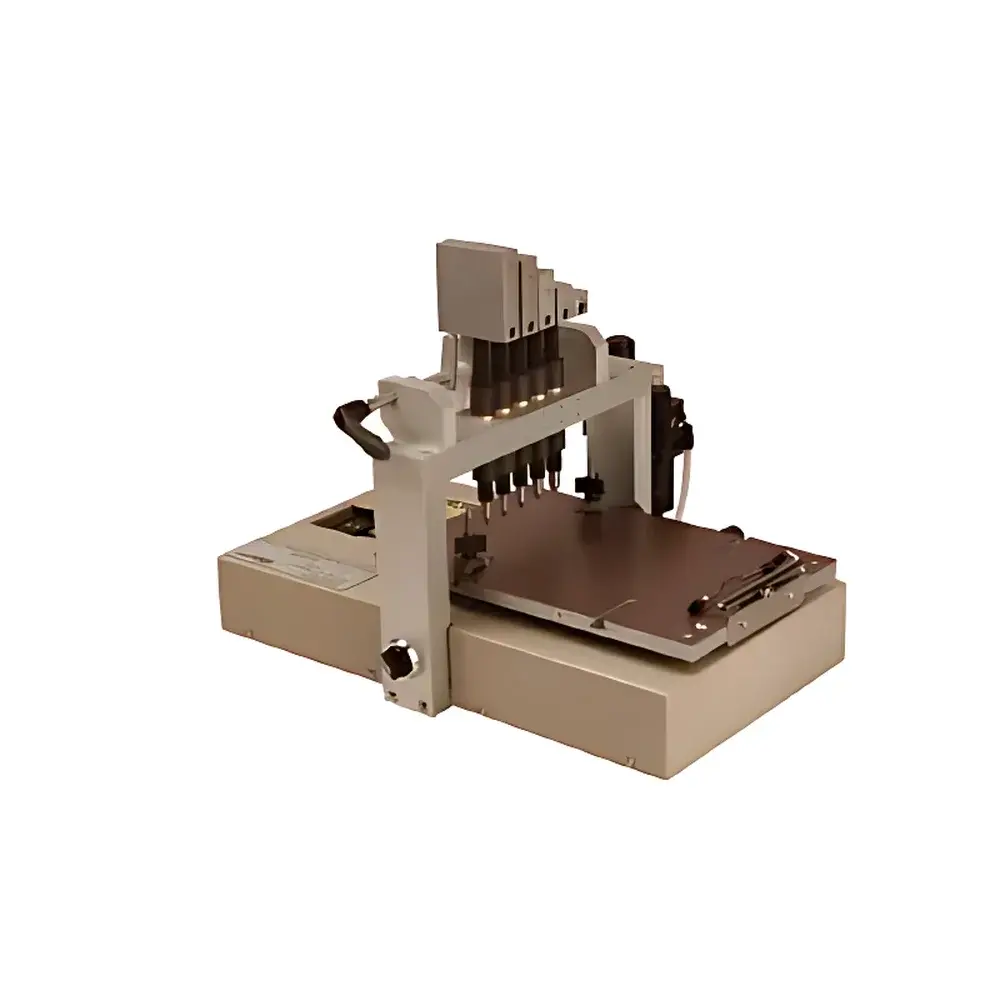
Taber 710 Five-Arm Scratch Resistance Tester
| Brand | Taber |
|---|---|
| Origin | USA |
| Model | 710 |
| Actuation | Pneumatic |
| Number of Test Arms | 5 |
| Normal Force Range | 2 N to 25 N (standard weights: 2, 3, 4, 5, 6, 7, 10, 15, 20 N |
| optional | 8, 13, 18, 25 N) |
| Indenter Options | Spherical tungsten carbide tips, Ø1.0 mm and Ø7.0 mm |
| Sample Thickness Limit | ≤22 mm |
| Sample Dimensions (recommended) | 125 mm × 300 mm |
| Traverse Speed Control | Adjustable via regulated air pressure |
| Timing Resolution | 0.01 s |
| Compliance | ASTM D7027, ISO 20566, SAE J2527, GMW 14698, Ford BN 108-13, Chrysler LP-463DD-18-01, Nissan NES M0159 |
Overview
The Taber 710 Five-Arm Scratch Resistance Tester is an engineered solution for quantitative evaluation of surface resistance to mechanical damage induced by controlled linear scratching under standardized normal loads. Designed in accordance with the principles of tribological contact mechanics, the instrument employs five independent, pneumatically actuated arms—each terminating in a precisely ground tungsten carbide indenter—to apply reproducible, vertically oriented forces across a moving test specimen. Unlike single-point abrasion testers, the 710’s multi-arm architecture enables simultaneous assessment of multiple load conditions or repeated testing under identical parameters without manual reconfiguration. The test platform traverses linearly at a constant velocity governed by regulated compressed air, while electronic timing ensures precise cycle duration control down to 0.01-second resolution. This configuration supports both qualitative mar detection and semi-quantitative scratch depth/visibility analysis when coupled with standardized visual or instrumental evaluation protocols.
Key Features
- Pneumatically driven linear traverse system with fine-tuned speed regulation via precision air pressure controller featuring internal lubrication for long-term stability
- Five independently mounted, rigid spline shafts enabling concurrent application of discrete normal forces (2–25 N) using calibrated stainless-steel weights
- Interchangeable spherical tungsten carbide indenters: standard Ø1.0 mm (for fine mar assessment) and Ø7.0 mm (for broader scratch simulation), each hardened to ≥1500 HV
- Ergonomic cantilever handle for rapid vertical positioning and arm retraction—facilitating unobstructed sample loading and post-test inspection
- Spring-loaded clamping fixture included as standard, compatible with edge-mounting on specimens up to 22 mm thick; optional sliding clamp kits available for thicker or irregularly shaped substrates
- Digital timer with 0.01 s resolution and automatic cycle termination logic, integrated into the main control panel
- Removable protective wear plate on the test bed to preserve dimensional integrity during extended use
- Modular weight set (2, 3, 4, 5, 6, 7, 10, 15, 20 N) with traceable calibration documentation; optional weights (8, 13, 18, 25 N) available for specialized applications
Sample Compatibility & Compliance
The Taber 710 accommodates flat or moderately curved specimens with maximum thickness of 22 mm and recommended dimensions of 125 mm × 300 mm. Specimens must be rigidly secured to prevent lateral movement or flexure during traversal; soft or highly deformable materials require auxiliary backing support. The instrument complies with globally recognized automotive and industrial standards including GMW 14698 (scratch resistance of organic coatings), Ford BN 108-13 (resistance to scratching), Chrysler LP-463DD-18-01 (scratch and mar resistance of automotive plastics), Nissan NES M0159 (interior scratch testing), and ISO 20566 (determination of scratch resistance of coated substrates). It also serves as a functional equivalent for ASTM D7027 Annex A1 (multi-arm scratch method) and supports GLP-aligned test documentation when used with validated SOPs.
Software & Data Management
While the Taber 710 operates as a stand-alone electromechanical tester without embedded software, its design facilitates integration into laboratory data management systems. All operational parameters—including applied load, traverse speed (derived from regulated air pressure), cycle count, and elapsed time—are manually recorded or logged via external digital timers or LIMS interfaces. For audit readiness, users may implement electronic lab notebooks (ELNs) that capture metadata such as operator ID, environmental conditions (temperature/humidity per ISO 291), calibration status of weights and indenters, and photographic documentation of pre- and post-test surfaces. The system supports 21 CFR Part 11 compliance when paired with validated electronic signature workflows and secure audit trails.
Applications
The Taber 710 is routinely deployed in R&D, quality assurance, and supplier qualification laboratories across automotive OEMs and Tier-1 suppliers for evaluating interior trim, instrument panels, center consoles, and exterior painted components. It is equally applicable to coated metals, laminated polymers, decorative films, UV-cured inks, and soft-touch overmolded surfaces. In non-automotive sectors, it supports durability validation of medical device housings (per ISO 10993-1 biocompatibility interface considerations), consumer electronics casings, architectural laminates, and packaging substrates subject to handling-induced surface degradation. Its five-arm configuration allows comparative screening of formulation variants, curing profiles, or coating thickness gradients within a single test run.
FAQ
What types of indenters are supplied with the Taber 710?
The standard configuration includes five Ø1.0 mm spherical tungsten carbide tips and five Ø7.0 mm spherical tungsten carbide tips, all fully interchangeable and mounted on hardened steel shanks.
Can the Taber 710 test curved or three-dimensional parts?
Flat specimens are required for repeatable results. Slightly curved samples may be tested using custom fixtures that ensure consistent normal force vector alignment; however, true 3D geometry necessitates alternative instrumentation such as robotic scratch testers.
Is calibration certification included with the weight set?
Each standard weight set is supplied with a manufacturer’s calibration certificate traceable to NIST standards; periodic recalibration is recommended annually or per internal QA policy.
Does the Taber 710 meet FDA requirements for medical device testing?
While not FDA-certified per se, the instrument satisfies mechanical test method requirements outlined in ISO 10993-1 for surface integrity evaluation of device housings, provided test protocols are validated and documented per GMP/GLP principles.
What maintenance is required for long-term pneumatic performance?
Regular inspection of the air regulator’s internal lubrication reservoir, replacement of inline filters every 6 months, and verification of seal integrity on the traverse cylinder are sufficient to maintain specification-grade repeatability over 10+ years of operation.



