
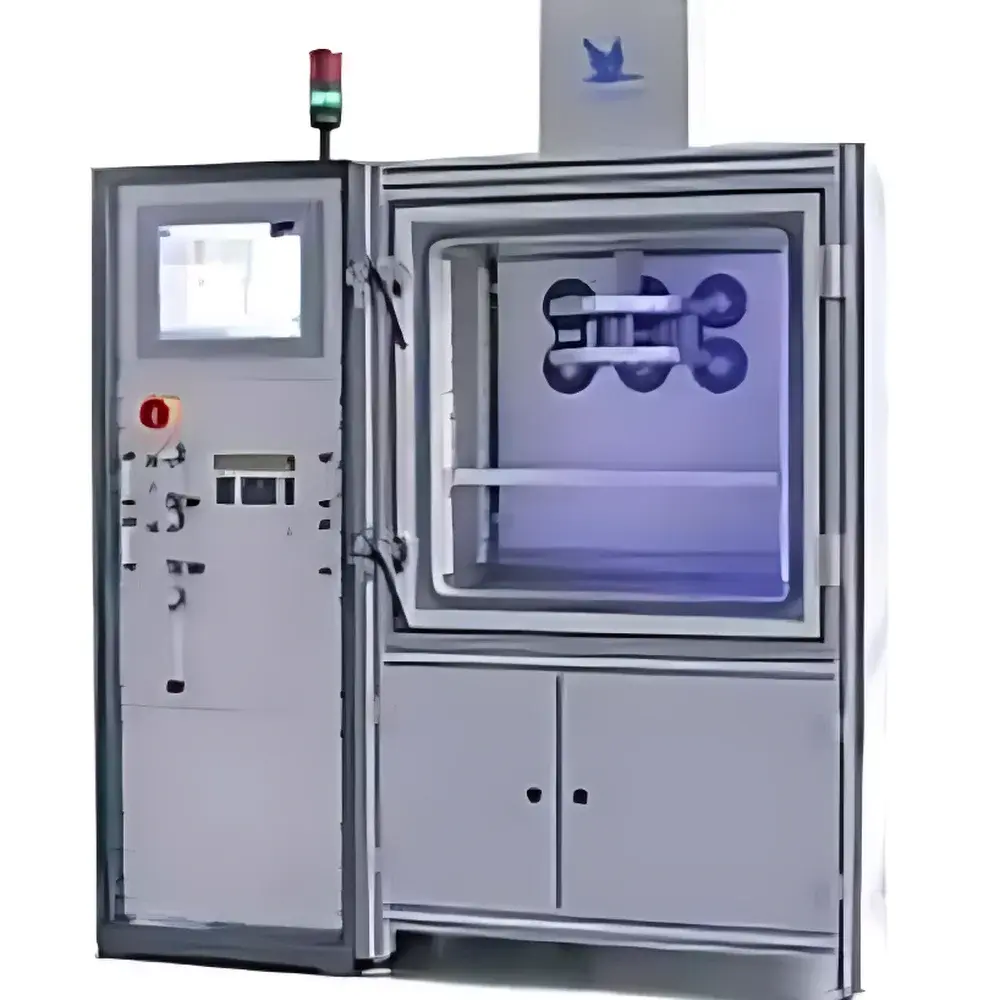
ANSEROS SIM6300-T-CL Ozone Aging Test Chamber
| Brand | ANSEROS |
|---|---|
| Origin | Germany |
| Model | SIM6300-T-CL |
| Compliance | ASTM D1149, ISO 1431-1, DIN ISO 1431-1 |
| Ozone Generation | Maintenance-free corona discharge generator |
| Ozone Monitoring | Certified ozone analyzer (MP series) with closed-loop feedback control |
| Control System | Programmable logic controller (PLC) with interrupt-resume functionality for long-term durability testing |
| Air Circulation | Recirculating turbojet system integrated with catalytic ozone destruct unit and activated carbon filter |
| Sample Mounting | Dual-mode fixture—static test racks and dynamic rotating sample disc (4-position V-groove clamping) |
| Data Interface | RS232 serial port for real-time logging to ANSEROS on-board monitoring software |
| Chamber Configuration | Climate-controlled enclosure with temperature stabilization (ambient to +70 °C, ±0.5 °C uniformity) |
Overview
The ANSEROS SIM6300-T-CL Ozone Aging Test Chamber is an engineered environmental test system designed for accelerated evaluation of elastomeric material degradation under controlled ozone exposure. Based on the fundamental principle of oxidative chain scission in unsaturated polymer networks—particularly natural rubber (NR), styrene-butadiene rubber (SBR), and nitrile butadiene rubber (NBR)—this chamber replicates atmospheric ozone stress at elevated concentrations (typically 25–200 pphm) while maintaining precise thermal and airflow conditions. Unlike ambient exposure tests requiring months or years, the SIM6300-T-CL enables laboratory simulation of up to 10 years of outdoor service life within standardized test durations defined by ASTM D1149 and ISO 1431-1. Its fully enclosed recirculating air path, coupled with active ozone destruction and continuous concentration monitoring, ensures metrological traceability and repeatability across sequential test cycles—critical for QC laboratories operating under GLP or ISO/IEC 17025 frameworks.
Key Features
- Maintenance-free corona discharge ozone generator with stable output over extended operational periods (≥5,000 h mean time between failures)
- Calibrated MP-series ozone analyzer providing real-time, NIST-traceable measurement with ±2% full-scale accuracy and 0.1 pphm resolution
- Closed-loop concentration control algorithm maintaining setpoint deviation ≤±5 pphm during dynamic load changes
- Programmable PLC-based controller supporting multi-step test profiles, pause/resume sequences, and automatic interruption recovery—essential for multi-week durability validation
- Integrated turbojet-driven air circulation system ensuring uniform ozone distribution (≤±3% spatial variation) and rapid chamber equilibration (<15 min from cold start)
- Dual-mode sample presentation: static mounting racks for flat specimens and motorized rotating disc (0–60 rpm, adjustable) to simulate mechanical strain during aging
- On-board data acquisition via RS232 interface, compatible with ANSEROS proprietary monitoring software for time-stamped logging of ozone concentration, chamber temperature, runtime, and alarm events
Sample Compatibility & Compliance
The SIM6300-T-CL accommodates standard test specimens per ASTM D1149 (dumbbell-shaped, 25 mm × 6 mm × 2 mm) and ISO 1431-1 (ring or strip formats), with optional custom fixtures available for non-standard geometries. The 4-position V-groove dynamic clamp secures specimens under constant tensile strain (20% elongation typical), enabling crack initiation and propagation analysis under combined oxidative and mechanical stress. All operational parameters—including ozone concentration, temperature (ambient to +70 °C, ±0.5 °C stability), and exposure duration—are fully configurable to satisfy test requirements across automotive OEM specifications (e.g., VW PV 3305, GMW 15822), aerospace standards (SAE AMS 3655), and regulatory submissions under FDA 21 CFR Part 11 when paired with validated software configurations.
Software & Data Management
The ANSEROS on-board monitoring system provides local visualization of live ozone concentration, chamber temperature, and elapsed test time via a high-contrast LCD interface. Raw sensor data is streamed continuously via RS232 to external PCs running ANSEROS LogView software—a Windows-based application supporting CSV export, trend charting, and automated report generation compliant with ISO/IEC 17025 documentation requirements. Audit trails record all user actions (e.g., parameter changes, manual overrides), timestamps, and system alarms. When deployed in regulated environments, optional 21 CFR Part 11-compliant configuration includes electronic signatures, role-based access control, and immutable data archiving—fully traceable for internal audits or regulatory inspections.
Applications
This chamber serves critical roles in R&D and quality assurance for tire manufacturers, automotive sealing systems suppliers, medical device component producers, and industrial hose fabricators. Typical use cases include comparative screening of antioxidant formulations, validation of vulcanization protocols, assessment of surface coating efficacy against ozone cracking, and failure analysis of field-returned elastomer components. Its reproducible aging kinetics support correlation studies between laboratory test results and real-world service performance—enabling predictive lifetime modeling and accelerated qualification of new polymer blends prior to pilot production.
FAQ
What ozone concentration range does the SIM6300-T-CL support?
The chamber delivers and maintains ozone concentrations from 25 pphm to 200 pphm, adjustable in 1 pphm increments, with certified stability over 96-hour continuous operation.
Is temperature control integrated into the ozone exposure cycle?
Yes—precise PID-controlled heating maintains chamber temperature between ambient and +70 °C, with uniformity ≤±0.5 °C across the test volume, independent of ozone generation load.
Can the rotating sample disc be disabled for static-only testing?
Absolutely—the PLC allows full deactivation of rotational motion while retaining all other environmental controls, supporting both ISO 1431-1 Method A (static) and Method B (dynamic) protocols.
How is ozone safely removed after test completion?
A catalytic ozone destruct unit—combined with a redundant activated carbon filter—reduces residual ozone to <0.05 pphm before chamber venting, meeting OSHA PEL and EU Directive 2004/10/EC occupational exposure limits.
Does ANSEROS provide calibration certificates for the ozone analyzer?
Each MP-series analyzer ships with a factory calibration certificate traceable to PTB (Physikalisch-Technische Bundesanstalt), valid for 12 months; annual recalibration is recommended for ISO/IEC 17025 compliance.
Related Products



