
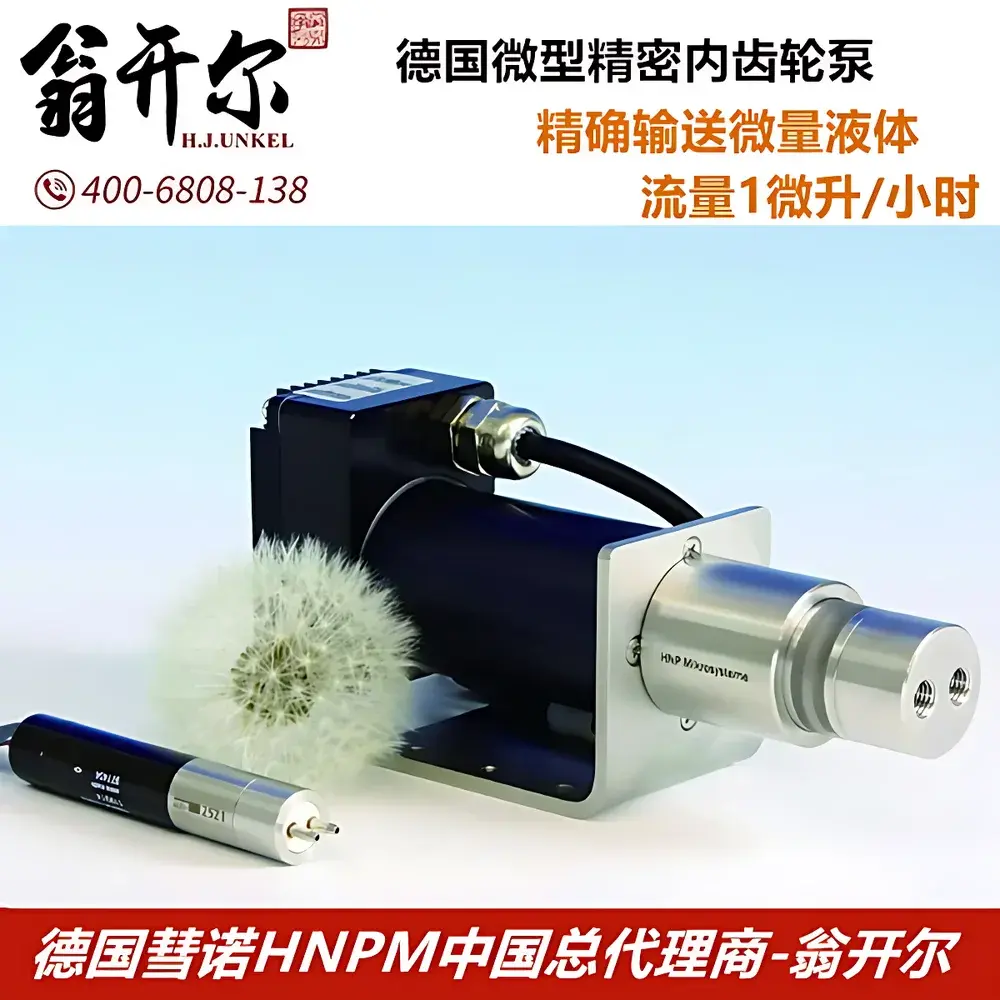
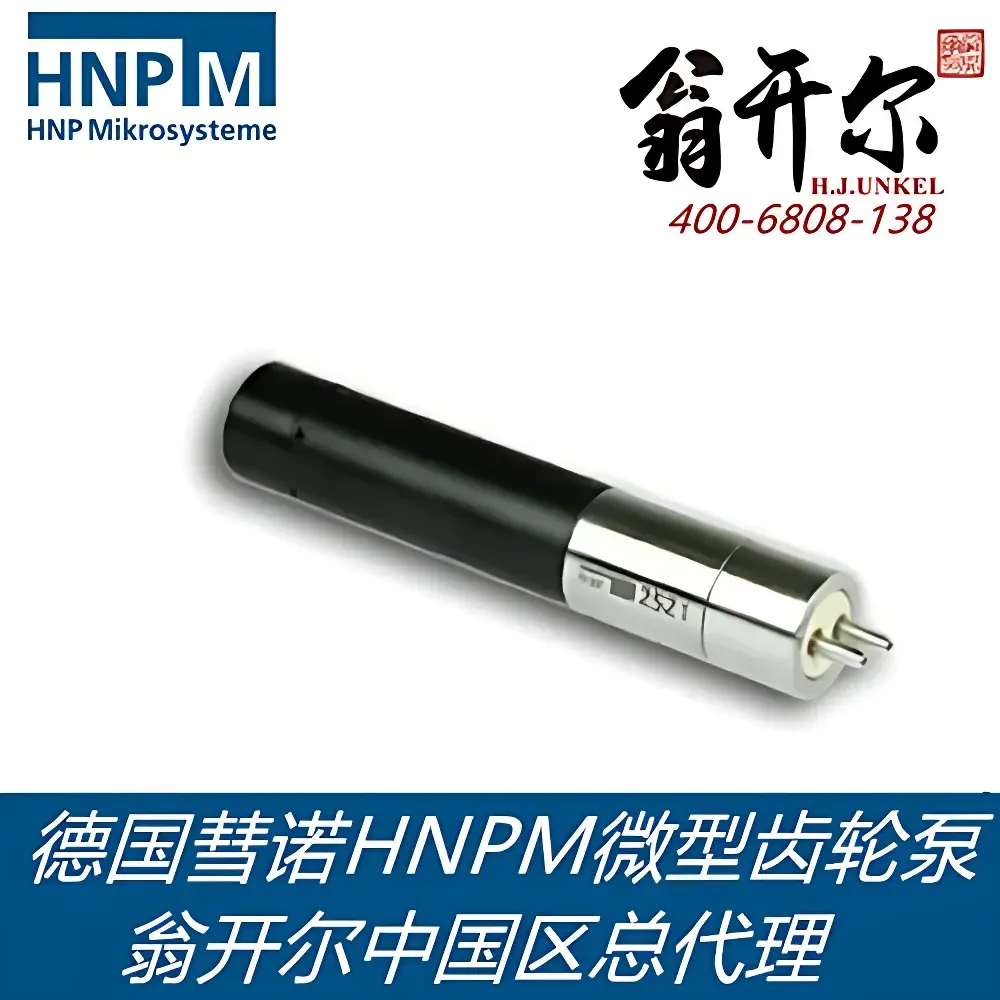
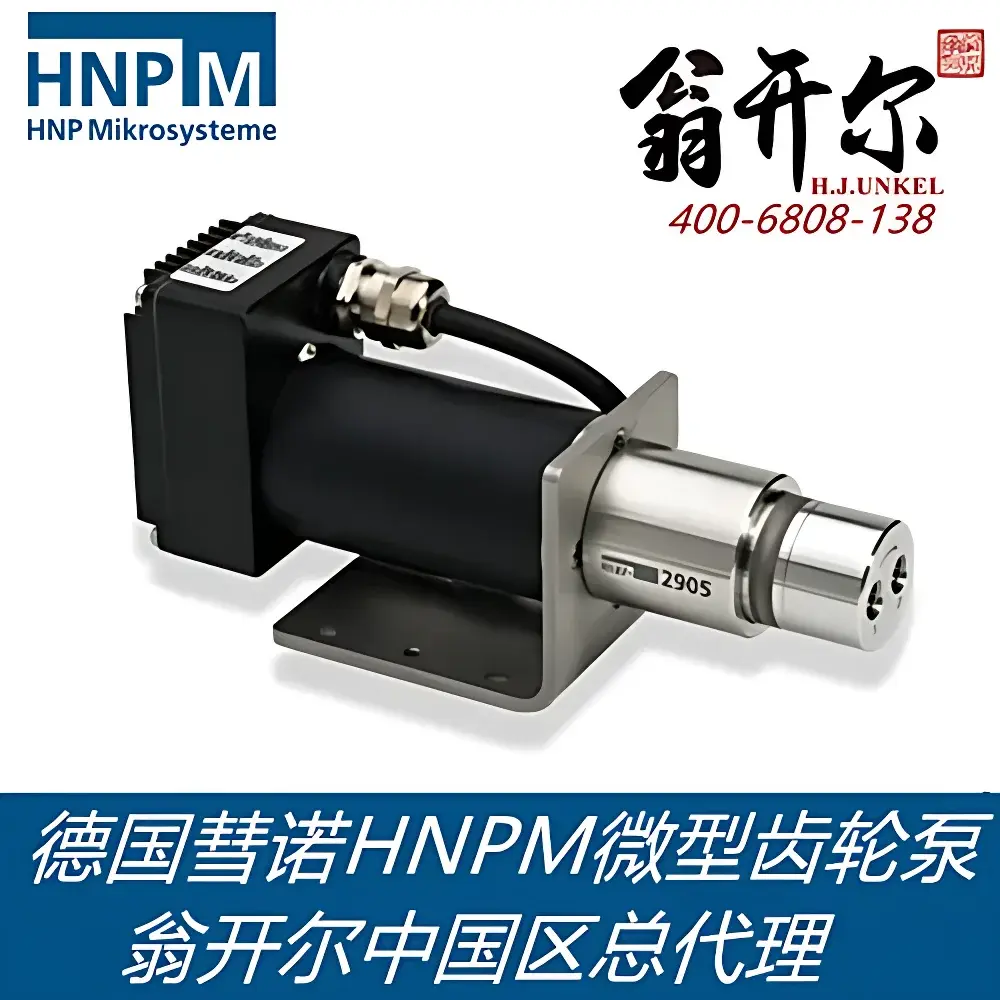
HNPM mzr-2905 Micro Annular Gear Pump
| Brand | HNPM |
|---|---|
| Origin | Germany |
| Model | mzr-2905 |
| Drive Type | Electric DC Servo Motor |
| Speed Range | 0–300 rpm |
| Flow Rate | 1 µL/h – 1.1 L/h |
| Pressure Capability | Up to 150 bar |
| Viscosity Range | 0.3 – 1,000,000 mPa·s |
| Material Construction | Tungsten Carbide & Ceramic Components |
| Inlet/Outlet Ports | Standardized 1/4″–28 UNF, 1/8″ NPT, or 3/8″ NPT |
| Optional Modules | Fluid Sealing, Heating (up to 150 °C), Thermal Insulation (−20 °C to +200 °C), Gear Reduction, ATEX-certified Explosion-Proof Version |
| Compliance | Designed for GLP/GMP-aligned workflows |
Overview
The HNPM mzr-2905 micro annular gear pump is a precision-engineered, German-manufactured positive displacement pump designed for ultra-accurate metering and continuous dosing of liquids across an exceptionally broad rheological spectrum. Based on the proven annular gear principle—where a rotor rotates eccentrically within a fixed stator ring—the mzr-2905 achieves near-pulseless flow by minimizing volumetric displacement variation per revolution. This architecture inherently delivers low shear stress, minimal dead volume ( 10,000 hours MTBF under nominal load). Unlike peristaltic or syringe-based systems, the mzr-2905 maintains consistent volumetric accuracy independent of backpressure up to 150 bar, making it suitable for pressurized chromatographic elution, high-viscosity adhesive dispensing, and closed-loop reactor feed control. Its compact footprint (≤ 120 mm × 60 mm × 50 mm) and lightweight titanium/aluminum housing enable seamless integration into analytical platforms, OEM instrumentation, and modular lab-on-chip systems.
Key Features
- Annular gear displacement mechanism ensuring <0.5% flow pulsation amplitude (RMS) across full speed range
- Tungsten carbide gears and ceramic bushings providing wear resistance against abrasive solvents, slurries, and aggressive media (pH 1–14, halogenated organics, strong acids/bases)
- Integrated brushless DC servo motor with closed-loop speed control and bidirectional rotation capability
- Modular expansion support: fluid-sealed variants for vacuum-compatible or moisture-sensitive dosing; heating modules (max. 150 °C) with PID-controlled thermal stability ±0.5 °C; thermal insulation sleeves enabling operation from −20 °C to +200 °C
- Standardized mechanical interfaces (1/4″–28 UNF, 1/8″ NPT, 3/8″ NPT) facilitating rapid integration into existing fluidic manifolds and ISO-standardized lab automation frameworks
- ATEX-compliant explosion-proof configuration available (II 2G Ex db IIB T4 Gb) for Zone 1 hazardous environments
Sample Compatibility & Compliance
The mzr-2905 handles Newtonian and non-Newtonian fluids—including shear-thinning polymers, thixotropic gels, and particle-laden suspensions—without degradation of structural integrity or metrological fidelity. Its material compatibility extends to hydrocarbons, polar aprotic solvents (e.g., DMF, DMSO), aqueous electrolytes, and biofluids (plasma, cell culture media). The pump meets CE marking requirements per Machinery Directive 2006/42/EC and Electromagnetic Compatibility Directive 2014/30/EU. While not intrinsically certified to ISO 8573 for compressed air purity, its dry-running capability eliminates lubricant contamination risks in ultra-clean applications. When deployed in regulated environments (e.g., pharmaceutical QC labs), the mzr-2905 supports IQ/OQ validation protocols and integrates with audit-trail-capable SCADA systems compliant with FDA 21 CFR Part 11 and EU Annex 11 requirements.
Software & Data Management
The mzr-2905 operates via analog (0–10 V / 4–20 mA) or digital (RS-485 Modbus RTU, optional CANopen) interface, enabling synchronization with LabVIEW, MATLAB, or custom PLC-based control logic. HNPM provides open-protocol communication libraries and configuration utilities for deterministic flow ramping, multi-step dosing sequences, and real-time error logging (e.g., stall detection, temperature over-limit, pressure saturation). For traceability-critical workflows, the pump’s firmware records timestamped operational metadata—including cumulative revolutions, thermal history, and motor current draw—which can be exported as CSV or embedded into LIMS-linked electronic batch records. No proprietary cloud platform is required; all data remains locally controllable and exportable without vendor lock-in.
Applications
- HPLC/UHPLC solvent delivery in low-flow nano- and capillary-scale separations
- Precision deposition of conductive inks, photoresists, and encapsulants in printed electronics manufacturing
- Controlled reagent addition in microreactors and continuous-flow synthesis systems
- Dosing of high-viscosity adhesives (e.g., epoxies, silicones) in automated assembly lines with ≤ ±0.25% volumetric repeatability
- Vacuum-compatible liquid introduction in surface science chambers (e.g., ALD, CVD precursors)
- Calibration fluid delivery in gravimetric and primary standard traceability chains per ISO/IEC 17025
FAQ
What is the minimum measurable flow rate with metrological confidence?
At 1 µL/h (0.278 nL/s), the mzr-2905 achieves ±1.5% full-scale accuracy when operated at ≤ 5 rpm with temperature-stabilized fluid paths and calibrated upstream pressure compensation.
Can the pump handle particulates?
Yes—solid particles ≤ 10 µm in diameter are tolerated when using tungsten carbide wetted components; filtration to ≤ 5 µm is recommended for long-term reliability with abrasive slurries.
Is flow linearity affected by viscosity changes during operation?
No—volumetric displacement remains constant regardless of viscosity; however, torque demand increases proportionally, requiring appropriate motor sizing for >100,000 mPa·s fluids.
How is calibration maintained over time?
HNPM recommends annual recalibration against gravimetric or turbine-based primary standards; built-in motor encoder feedback enables drift monitoring via cumulative pulse counting.
Does the pump require priming or exhibit self-priming capability?
Yes—the mzr-2905 is self-priming up to 5 m suction lift under ambient conditions and does not require external evacuation or fill-assist mechanisms.



