
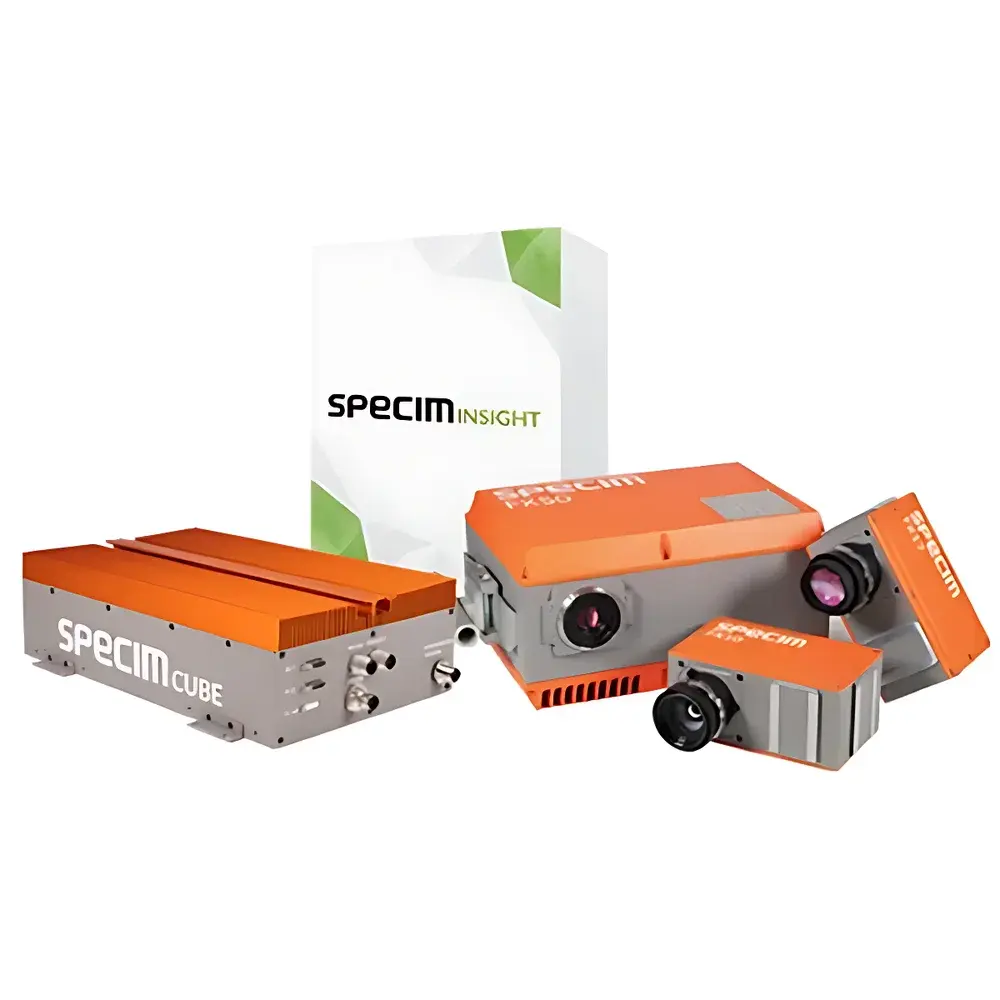
SpecimONE Hyperspectral Imaging Sorting Platform
| Brand | Konica Minolta |
|---|---|
| Origin | Japan |
| Manufacturer Type | Authorized Distributor |
| Origin Category | Imported |
| Model | SpecimONE |
| Pricing | Upon Request |
| Operating Principle | Push-broom Scanning |
Overview
The SpecimONE Hyperspectral Imaging Sorting Platform is an integrated, turnkey solution engineered for industrial material classification and real-time sorting applications. Built upon the push-broom scanning principle—where spatial information is acquired line-by-line while spectral dispersion occurs across a fixed slit—the system captures contiguous, high-fidelity spectral data cubes (x, y, λ) with pixel-level spectral resolution. Unlike conventional RGB or multispectral systems, SpecimONE delivers hundreds of narrowband spectral channels (typically spanning 400–1000 nm or configurable SWIR ranges), enabling discrimination of materials based on intrinsic molecular absorption features rather than superficial color or texture alone. Designed specifically for OEMs, machine builders, and vision system integrators, SpecimONE decouples domain expertise in spectroscopy from deployment complexity: users develop classification models offline using representative sample spectra, then deploy them directly onto production-line hardware without custom coding or third-party middleware dependencies.
Key Features
- Industrial-grade Specim FX-series hyperspectral camera—field-proven for stability, radiometric accuracy, and resistance to vibration, temperature drift, and ambient lighting variation
- SpecimINSIGHT software suite: intuitive graphical interface for spectral library creation, supervised/unsupervised model training (e.g., PLS-DA, SVM, Random Forest), cross-validation, and model export to embedded runtime environments
- SpecimCUBE real-time processing unit: FPGA-accelerated architecture with deterministic latency (< 50 ms per frame), onboard GPU support for deep learning inference, and dual GigE Vision interfaces compliant with GenICam standard
- Native integration with leading machine vision SDKs—including MVTec HALCON, Teledyne DALSA Sherlock, and Cognex VisionPro—via standardized image acquisition protocols and metadata injection (e.g., confidence maps, class IDs as auxiliary pixel data)
- Self-contained platform architecture: no reliance on external PC servers, proprietary OS lock-in, or subscription-based software licensing; all firmware, drivers, and application logic are maintained under Specim’s unified version control
Sample Compatibility & Compliance
SpecimONE supports heterogeneous sample streams including granular solids (e.g., plastics, minerals, food kernels), continuous webs (paper, textiles, foil), and conveyed particulates (recyclables, pharmaceutical tablets). Sample presentation requires consistent illumination (typically LED-based line lights with stable spectral output and uniform intensity profile) and mechanical synchronization between conveyor speed and camera line rate. The platform conforms to CE marking requirements for industrial machinery (2006/42/EC), meets EMC Directive 2014/30/EU, and operates within IEC 60529 IP54-rated enclosures when deployed in typical factory environments. While not certified for Class I Div 1 hazardous locations, optional NEMA 4X housings and filtered optical windows enable operation in dusty or washdown-prone zones. Data handling adheres to ISO/IEC 17025 traceability guidelines for calibration records and model validation reports.
Software & Data Management
SpecimINSIGHT provides full audit trail functionality—including user login logs, parameter change timestamps, and versioned model archives—supporting GLP and GMP-aligned workflows. Exported classification models retain full spectral preprocessing steps (dark current subtraction, flat-field correction, wavelength calibration interpolation) and embed statistical confidence metrics per pixel. Raw data is stored in vendor-neutral formats (ENVI .hdr/.bin, HDF5) with embedded EXIF-like metadata (integration time, lens F-number, stage position, ambient temperature). For regulated industries, optional 21 CFR Part 11 compliance packages include electronic signatures, role-based access control, and immutable audit logs synchronized across distributed CUBE units via secure TLS-encrypted network protocols.
Applications
- Plastics recycling: identification and separation of PET, HDPE, PP, and PVC by polymer-specific C–H and C=O vibrational overtones in the NIR range
- Agricultural sorting: detection of mold-infected grains, foreign organic matter, or varietal misclassification in cereal, coffee, or nut streams
- Pharmaceutical manufacturing: verification of tablet coating uniformity, excipient distribution, and counterfeit detection via spectral fingerprint matching
- Mineral processing: lithological differentiation of ore types (e.g., hematite vs. goethite) and gangue rejection in dry beneficiation lines
- Food safety: non-contact detection of fecal contamination on poultry carcasses or surface spoilage indicators in fresh produce
FAQ
Does SpecimONE require custom programming to integrate into existing PLC-controlled production lines?
No. SpecimCUBE exposes classification results via standard industrial communication protocols—including Modbus TCP, EtherNet/IP, and PROFINET—allowing direct mapping of class IDs and confidence scores to PLC tags without intermediate software layers.
Can models trained on one SpecimONE system be deployed on another unit without revalidation?
Yes, provided both units use identical camera models, lenses, illumination geometry, and calibration certificates. SpecimINSIGHT enforces model portability through embedded sensor characterization data and spectral response normalization routines.
Is remote monitoring and diagnostics supported?
Yes. SpecimCUBE includes a web-based diagnostic dashboard accessible via HTTPS, displaying real-time health metrics (FPGA temperature, memory utilization, frame drop rate), live preview streams, and automated calibration status alerts.
What spectral range options are available beyond the standard VNIR configuration?
SWIR variants (900–1700 nm and 1000–2500 nm) are available with InGaAs or MCT detector arrays, subject to export licensing requirements under Japan’s Foreign Exchange and Foreign Trade Act.
How frequently must the system be recalibrated?
Radiometric and spectral calibration is recommended annually or after any mechanical impact, lens replacement, or significant ambient temperature excursion (>15 °C deviation from initial calibration conditions).






